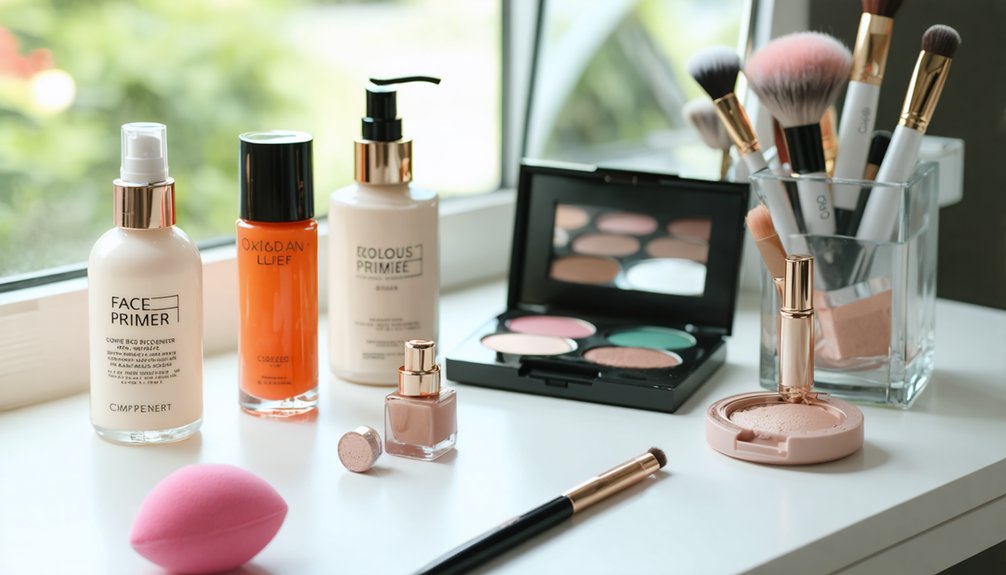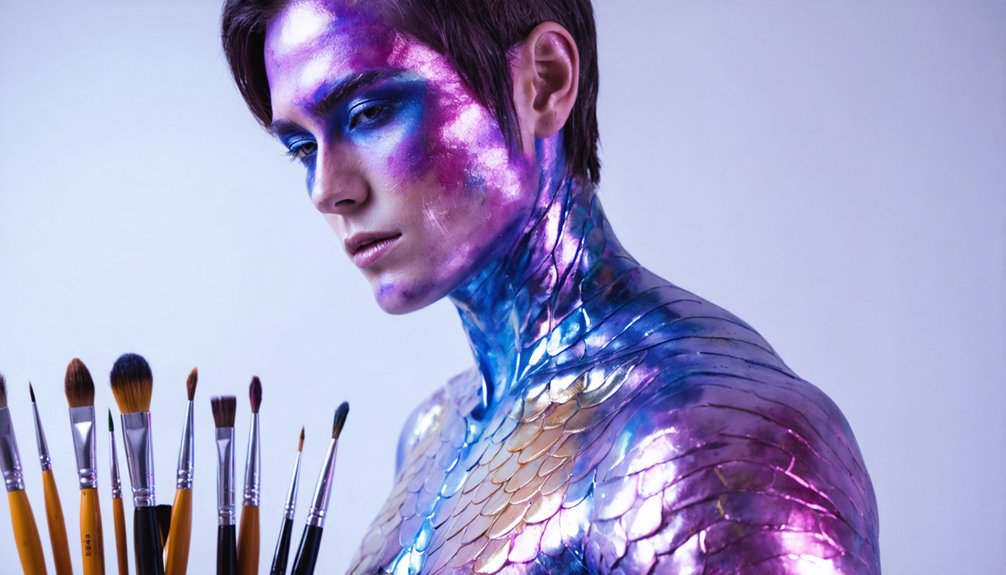
Transforming into a sci-fi character starts with choosing your character type—alien, cyborg, or robot—since that decision drives every material and technique you’ll use. You’ll build foam latex or silicone prosthetics over a life cast, bond them with medical-grade adhesives, and layer metallic, neon, or phosphorescent pigments for depth and realism. Expect application times ranging from five to seven-plus hours. Keep exploring to master every stage of the transformation process.
Key Takeaways
- Sci-fi SFX makeup uses prosthetics, metallic pigments, and layered painting techniques to physically transform actors into aliens, cyborgs, or robots.
- Choose your character type first—alien, cyborg, or robot—as this dictates material selection, color palette, and construction techniques.
- Foam latex suits expressive alien builds, while silicone mimics realistic skin; thermoplastics create rigid mechanical cyborg elements.
- Secure prosthetics using Pros-Aide adhesive on degreased skin, curing each edge carefully, then sealing with barrier spray for durability.
- Plan application schedules carefully; complex prosthetic looks can take 5–7+ hours, requiring staged workflows covering adhesion, airbrushing, and painting.
What Is Sci-Fi Special Effects Makeup?
Sci-fi special effects (SFX) makeup uses prosthetics, specialized materials, and layered paint techniques to physically transform performers into aliens, robots, cyborgs, mutants, and futuristic soldiers.
Unlike purely digital approaches, practical SFX makeup creates three-dimensional textures that interact naturally with lighting effects on set, giving characters a tangible, cinematic presence.
Practical SFX makeup builds real texture that catches light naturally — giving characters depth no digital effect can replicate.
When you’re building a sci-fi character, SFX makeup works alongside costume design to unify the overall visual concept. Foam prosthetics, adhesive appliances, airbrushed finishes, and surface painting each serve specific structural and aesthetic functions.
The result isn’t just a costume — it’s a fully realized physical transformation that cameras capture with depth and authenticity.
Whether you’re working in film, television, or theater, mastering SFX makeup gives you the tools to construct believable futuristic beings from the skin outward.
Famous Sci-Fi Makeup Looks You Should Study First
Before you start building your own sci-fi looks, you should study the makeup designs that set the industry standard. Examine the alien prosthetics from *Star Wars* and *Guardians of the Galaxy* to understand how sculptors reshape facial anatomy while keeping expressions readable.
Then analyze the Borg Queen’s cyborg construction from *Star Trek: First Contact* to see how artists fuse chromed mechanical elements with organic skin textures.
For robot and android reference, study *The Terminator*’s rigid prosthetics and reflective finishes to understand how surface treatment communicates non-human physicality on camera.
Iconic Alien Prosthetics Studied
Analyze these landmark designs to sharpen your craft:
- Chewbacca — Study how an articulated mask supports natural creature movement without sacrificing character readability.
- Gamora — Examine full-body application techniques that unify alien anatomy across every visible surface.
- Borg Queen (*Star Trek: First Contact*) — Observe how rigid prosthetics and mechanical elements merge convincingly with organic skin.
Each example reveals deliberate material choices that transform performers into fully realized, physically grounded beings.
Cyborg Makeup Worth Analyzing
Alien prosthetics teach you how to build nonhuman anatomy from the skin out, but cyborg makeup pushes you into different creative territory — one where chrome, circuitry, and organic tissue have to coexist convincingly on the same surface.
Study the Borg Queen from *Star Trek: First Contact* closely. Her design integrates cybernetic enhancements directly into flesh-toned prosthetics, using chromed mechanical elements that appear fused rather than attached. That distinction matters. You’re not decorating skin — you’re reengineering it.
Pay attention to how robotic articulation is suggested through rigid panel shapes and reflective airbrushing layered against softer organic textures. The contrast between cold metallic finishes and warm skin tones is what sells the illusion.
Dissect how edge blending and surface painting unify both materials into one coherent, believable form.
Memorable Robot Design Examples
Study these three design principles:
- Cosmetic camouflage conceals skin shifts between prosthetic edges and natural flesh, maintaining mechanical believability.
- Color blending unifies chrome, shadow, and base tones across rigid surfaces, preventing visual inconsistency.
- Expressive rigidity — the Borg Queen’s segmented construction proves mechanical characters still demand emotionally readable facial geometry.
Analyze these examples methodically. Each decision communicates character before a single line of dialogue lands.
Choose Your Character Type: Alien, Cyborg, or Robot
Before picking up a brush or prosthetic, you’ll need to decide which character type you’re building—alien, cyborg, or robot—since each demands a distinct set of materials, techniques, and visual priorities.
Aliens require expressive facial appliances, neon or phosphorescent pigments, and nonhuman anatomical shaping. Your cosmetic application must preserve emotional readability beneath heavy prosthetics.
Cyborgs demand seamless costume integration, blending chromed mechanical elements directly against organic skin textures. You’re merging two visual languages—human and machine—so gradual between surfaces must feel intentional and precise.
Robots prioritize reflective finishes, rigid prosthetics, and metallic airbrushing. Little organic texture appears here; instead, you’re constructing a surface that reads as manufactured.
Identify your character’s core visual identity first. That single decision dictates every material choice and technique that follows.
Stock Your Kit With the Right SFX Makeup Materials
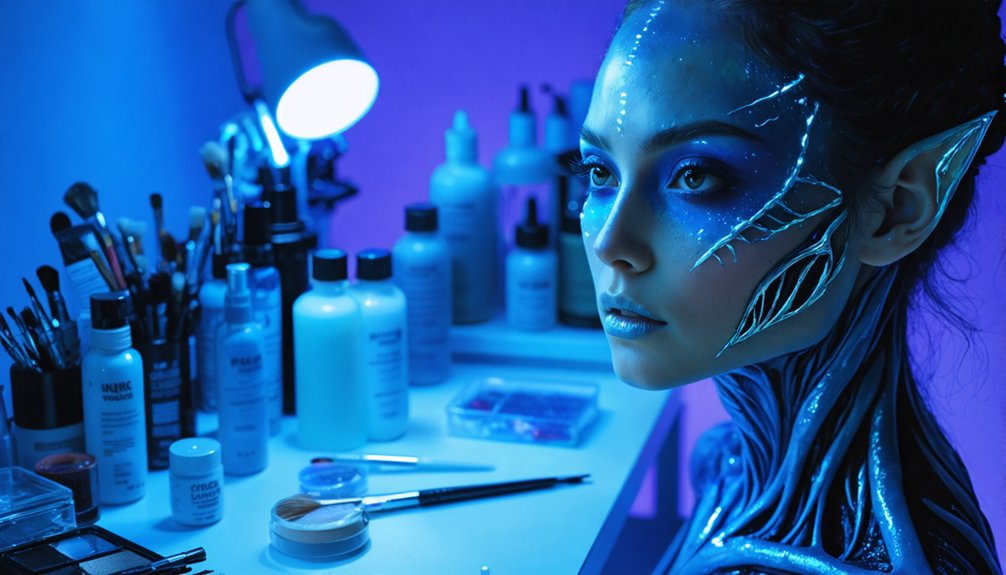
Once you’ve locked in your character type, your next step is assembling the materials that make that transformation physically possible. Your kit should reflect both your character’s anatomy and your production’s lighting considerations—harsh stage lighting exposes weak blending, while cinematic setups reward layered texture.
Build your foundational kit around these essentials:
- Foam latex or silicone prosthetics — sculpted appliances that reshape facial structure for aliens, cyborgs, and creatures with nonhuman anatomy.
- Metallic and phosphorescent pigments — airbrush-ready formulas that create robotic finishes or bio-engineered skin tones that react dynamically under varied lighting.
- Spirit gum, medical adhesive, and sealants — bonding agents that anchor prosthetics through movement and support seamless costume integration at necklines, hairlines, and wrist edges.
Precision material selection separates convincing characters from costume failures.
Build Prosthetics That Transform Your Face
To build prosthetics that convincingly reshape your face, you’ll need to choose between foam latex, silicone, and gelatin materials, each offering different levels of flexibility and skin-like texture.
Once you’ve selected your material, sculpt your facial appliances over a life cast of your own face to guarantee accurate anatomical fit across brow ridges, cheekbones, and jaw contours.
Apply the finished pieces in deliberate layers, blending edges with spirit gum or medical adhesive.
Then build up surface texture through stippling, airbrushing, and paint glazing to achieve depth and realism.
Choosing Your Prosthetic Materials
Choosing the right prosthetic materials determines how convincingly your transformation reads on camera or stage. Historical influences from theatrical creature design and cultural symbolism embedded in alien aesthetics both shape which materials serve your character best.
Each material carries distinct physical properties that affect realism, durability, and emotional impact.
- Foam latex compresses and moves with your facial muscles, keeping character emotion readable beneath heavy appliances.
- Silicone mimics skin translucency with striking accuracy, creating unsettling realism that pulls audiences deeper into your world.
- Thermoplastics offer rigid structural support for mechanical or cybernetic elements, making your character feel genuinely nonhuman.
Layer these materials strategically. Combine flexible foam bases with rigid accent pieces to build surfaces that hold up under studio lighting and extended wear.
Sculpting Facial Appliances Effectively
Start by taking a life cast. This gives you an accurate three-dimensional map to sculpt over.
Build your appliance in layers, addressing facial symmetry early. Asymmetry reads instantly on camera and breaks believability.
Use firm clay to establish primary forms, then refine surface texture with loop tools and silicone shapers.
Keep mechanical movement in mind. Appliances covering the brow, cheek, or jaw must flex naturally so emotion stays readable through heavy prosthetic coverage.
Layering For Realistic Texture
Once your appliance is sculpted, layering materials in the right sequence transforms a flat foam shape into something that reads as living skin on camera.
Texture layering builds depth that cameras can’t ignore—each coat adds dimension, pore structure, and tactile realism.
Follow this sequence to create surfaces that hit emotionally:
- Seal and stipple the foam base with prosthetic sealer, pressing texture into the surface before it fully cures.
- Apply color blending using thin, translucent layers of alcohol-activated pigment, building subsurface warmth before adding surface tone.
- Highlight veins and pores with fine brushwork, anchoring the character’s biology in something viscerally believable.
Each layer you add makes the transformation feel earned—not costumed, but inhabited.
Paint Metallic, Neon, and Alien Skin Tones Like a Pro
Whether you’re painting a gleaming android, a bioluminescent mutant, or a textured alien species, your choice of pigment and application technique determines how convincing the final result looks on camera. Start with a base coat suited to your character type—metallic acrylics or alcohol-activated paints work best for robotic skin, while neon and phosphorescent pigments punch through on-camera for mutant designs.
Use color blending to fade between tones smoothly, avoiding harsh edges that read as artificial under studio lighting. For texture detailing, apply darker shades into recessed areas and highlight raised surfaces with reflective finishes to reinforce dimension. Airbrushing delivers the most controlled layering for large surface areas.
Seal every layer progressively to lock in color and protect the finish throughout long shooting days.
Keep Prosthetics Secure Through a Full Day of Wear
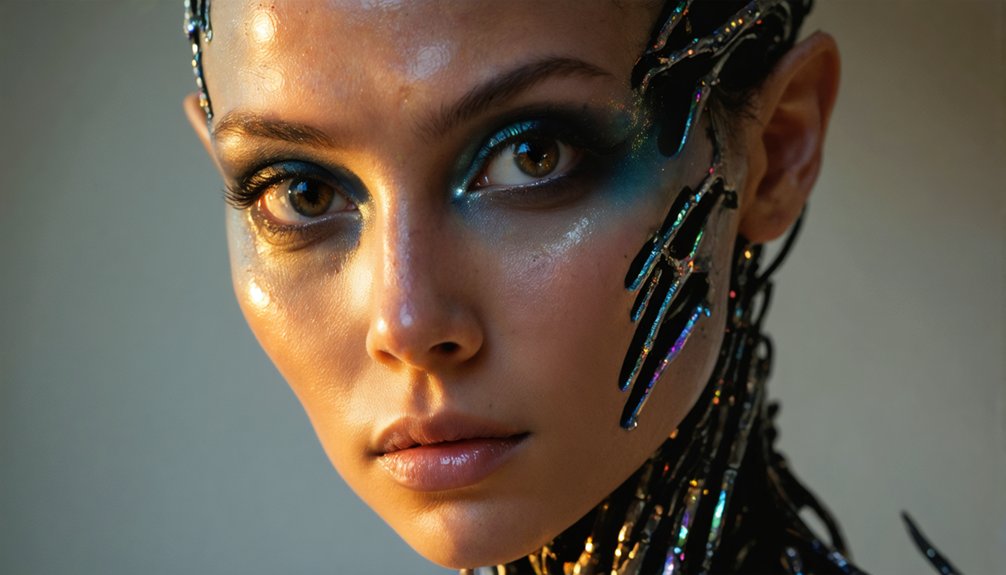
Keeping prosthetics bonded through hours of physical performance requires the right adhesive matched to the right surface. Makeup durability depends on preparation, product selection, and sealing technique. Prosthetic adhesives like Pros-Aide and medical-grade silicone bond create flexible, skin-safe holds that move with your face without lifting.
Follow these three steps to protect your transformation:
- Degrease thoroughly — oil undermines every adhesive; use 99% isopropyl alcohol before application.
- Layer and cure each edge — press seams flat, apply adhesive in thin passes, and allow full cure time between layers.
- Seal with barrier spray — lock painted surfaces under a sweat-resistant topcoat to prevent breakdown mid-performance.
Precision application turns a fragile appliance into a character that performs confidently through every demanding scene.
How Long Does Sci-Fi SFX Makeup Actually Take?
Securing your prosthetics correctly is only half the equation — the other half is understanding exactly how much time a full sci-fi transformation demands. Application timelines vary greatly by costume design complexity. Jamie Campbell Bower’s Vecna required 7.5 hours daily. Doug Jones’ prosthetic-heavy roles averaged five to six hours. Even Tim Curry’s Darkness makeup exceeded five hours.
You should budget conservatively. Map out each layer — foam appliances, adhesive setting, airbrushing, and surface painting — and estimate application windows per stage.
Rushed application creates visible seams and compromised finishes that break audience engagement entirely.
Build scheduling buffers into your production timeline. Coordinate with your team so everyone arrives ready, materials are pre-staged, and lighting conditions are confirmed before the first prosthetic piece goes on.
Frequently Asked Questions
Can Sci-Fi SFX Makeup Techniques Be Used for Theater Productions?
You can absolutely use sci-fi SFX makeup in theater! Apply futuristic prosthetics to reshape facial structures and build alien anatomy using layered foam and paint, creating visually striking characters that read powerfully under stage lighting.
How Do Makeup Artists Collaborate With Visual Effects Teams on Set?
Like medieval scribes passing manuscripts, you’ll hand off your prosthetic application and color blending work to VFX teams, who digitally enhance your practical foundation, ensuring seamless integration between physical textures and computer-generated elements on set.
What Awards Have Recognized Outstanding Sci-Fi Makeup Work in Film?
You’ll find that the Academy Awards’ Best Makeup and Hairstyling category actively recognizes cosmetic innovation, honoring teams who’ve mastered futuristic aesthetics. BAFTA similarly celebrates groundbreaking creature and sci-fi character work that pushes practical transformation techniques to cinematic extremes.
How Do Performers Maintain Emotional Expressiveness Under Heavy Prosthetic Makeup?
You’ll maintain emotional communication by working with makeup artists who design prosthetics that preserve facial mobility. Expressive appliances flex with your natural muscle movements, keeping reactions visible and ensuring your character’s emotions remain readable through heavy layers.
Can Beginners Realistically Attempt Full-Body Sci-Fi Makeup Transformations at Home?
You can attempt full-body transformations at home, but you’ll face significant cosmetic challenges. Start with smaller prosthetic applications, prioritize safety considerations like skin-patch testing, and gradually build your technical skills before tackling complete sci-fi character conversions.
References
- https://www.cinemamakeup.com/sci-fi-makeup/
- https://camerareadycosmetics.com/collections/sfx-makeup
- https://www.cinemamakeup.com/blogs/sfx-makeup-school-sci-fi-horror-fantasy-creature-design/
- https://www.studiobinder.com/blog/what-is-sfx-makeup-definition/
- https://www.slashfilm.com/858903/what-these-sci-fi-villains-look-like-in-real-life/
- https://www.slashfilm.com/888620/the-most-impressive-sci-fi-makeup-transformations-of-all-time/
- https://nerdist.com/article/best-makeup-effects-oscars-the-fly-mad-max-american-werewolf/
- https://www.buzzfeed.com/kristenharris1/most-impressive-sfx-makeup-transformations-onscreen
- https://www.slashfilm.com/997371/what-these-iconic-movie-aliens-look-like-under-the-makeup/