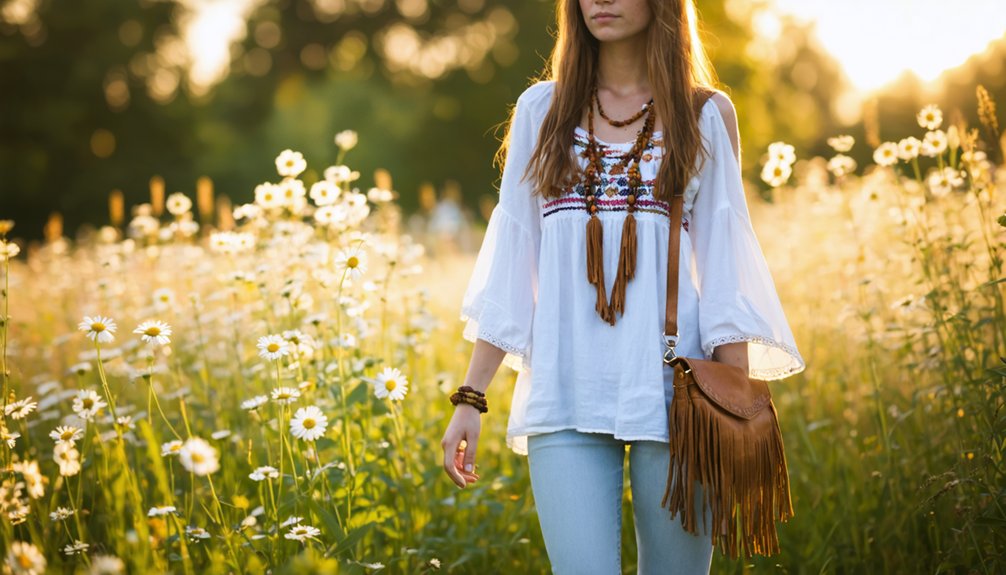
You’d recognize a 1960s hippie flower child ensemble by its deliberate rejection of mainstream conformity through flowy silhouettes, earthy tones, and handcrafted accessories. Bell-bottoms, flowing dresses, and natural fabrics communicated anti-establishment values, while peace signs, beaded necklaces, and flower crowns externalized spiritual and political convictions. Grooming choices, like unstructured hair and bare feet, reinforced authenticity over corporate expectation. Each element carried ideological weight that extended far beyond mere aesthetics, and there’s considerably more to unpack about this movement’s lasting cultural fingerprint.
Key Takeaways
- Flowy silhouettes like bell-bottoms, maxi dresses, and oversized tunics prioritized bodily freedom over tailored, conformist clothing structures.
- Natural fabrics like cotton and linen, featuring floral prints and earthy tones, reflected environmental consciousness and anti-establishment values.
- Accessories like flower crowns, beaded necklaces, and peace bracelets served as deliberate countercultural and spiritual declarations.
- Barefoot styles or minimalist sandals rejected capitalist conformity, symbolizing resistance against dominant corporate dress expectations.
- Long, natural hair, carefree grooming, and braless choices extended the movement’s rejection of mainstream societal norms.
The Defining Features That Made 1960s Hippie Style Unmistakable
The 1960s hippie aesthetic didn’t emerge from thin air—it was a deliberate visual rejection of postwar conformity, translating countercultural values directly into dress.
You’ll recognize its cultural significance through flowy silhouettes, bell-bottoms, and Indian fabric dresses that embodied communal living and spiritual connections.
Music influences from folk and rock festivals shaped festival fashion, embedding artistic expression into every garment choice.
Earthy tones and floral prints reflected environmental consciousness, while the braless approach and gender-neutral layering advanced gender equality within counterculture movements.
Beaded necklaces, peace-sign accessories, and barefoot styling weren’t decorative accidents—they carried deliberate societal impact, broadcasting anti-war conviction through appearance.
This wasn’t fashion for vanity; it was ideology made wearable.
Flowy Silhouettes That Defined the Hippie Wardrobe
Rooted in a conscious departure from postwar rigidity, flowy silhouettes became the structural backbone of hippie dress, prioritizing bodily freedom over tailored constraint.
Flowy dresses, loose fits, and airy fabrics redefined femininity through natural aesthetics rather than restriction. You’d recognize these free-spirited silhouettes instantly—they moved with the body, not against it.
Flowy silhouettes moved *with* the body—redefining femininity through natural freedom rather than structured constraint.
Key silhouette choices driving the bohemian movement included:
- Bell-bottom pants paired deliberately with oversized tunics for layered looks
- Indian-fabric muumuus that embodied relaxed vibes through cultural cross-pollination
- Lace ruffle flares combined with silk for textural contrast
- Self-sewn dresses constructed from custom patterns prioritizing organic drape
These weren’t arbitrary aesthetic decisions—they’re ideological statements encoded in fabric, rejecting capitalist conformity through deliberate structural liberation.
The Fabrics That Gave 1960s Hippie Fashion Its Signature Feel
Beyond the shapes themselves, fabric choice was what truly animated hippie fashion’s ideological core. You’d notice how airy materials like lightweight cotton and flowing linen created the bohemian aesthetics central to the movement’s visual identity. Natural fibers weren’t merely aesthetic preferences — they represented sustainable sourcing principles before environmentalism entered mainstream discourse.
Texture contrasts proved equally deliberate. Fabric combinations like silk paired with denim demonstrated versatile fabrics could bridge counterculture rebellion with wearable functionality. Practitioners of DIY fashion developed custom patterns, transforming Indian textiles and muumuus into personalized statements.
Floral embellishments adorned self-sewn garments, reinforcing the flower child symbolism woven throughout the era’s design philosophy.
What distinguished hippie fabric culture was its intentionality — every material selection communicated resistance against synthetic, industrialized fashion norms dominating the period.
The Colors and Prints That Made the Flower Child Look Unmistakable
When you examine the 1960s hippie color palette, you’ll notice it deliberately rejected synthetic brightness in favor of earthy, grounded neutrals that reinforced a connection to nature.
Floral motifs weren’t merely decorative; they carried ideological weight, marking the wearer as a self-identified “flower child” committed to peace and countercultural values.
You’d also find peace signs printed directly onto fabrics, transforming clothing into a wearable political statement that collapsed the boundary between personal style and public protest.
Earthy Tones Dominated Palettes
Though bright, synthetic dyes dominated mainstream fashion in the 1960s, hippie culture deliberately rejected them in favor of earthy, understated palettes. You’d find these earthy aesthetics expressed through muted browns, warm ochres, sage greens, and soft creams—colors rooted in nature rather than industry.
Natural fabrics reinforced this commitment, grounding the visual identity in authenticity.
These deliberate choices carried ideological weight:
- Neutral tones signaled rejection of consumerist excess
- Earth-derived hues aligned fashion with environmental consciousness
- Subtle palettes emphasized organic living over synthetic performance
- Muted colors unified the movement’s anti-establishment visual language
This wasn’t passive styling—it was calculated resistance. By anchoring your wardrobe in nature’s palette, you communicated countercultural values without uttering a single word, transforming color itself into a form of quiet, principled protest.
Floral Motifs Symbolized Identity
Floral motifs functioned as the flower child movement’s most legible visual signature, translating political and spiritual identity directly onto fabric. When you wore florals in the 1960s, you weren’t simply making an aesthetic choice — you were practicing deliberate identity expression rooted in nature inspiration and collective dissent.
The cultural significance extended beyond decoration. Floral symbolism challenged industrial conformity, positioning the body as a canvas for artistic freedom rather than corporate uniformity.
You’d find blooms printed across dresses, tunics, and bell-bottoms, each pattern reinforcing fashion rebellion against Vietnam-era militarism and capitalist structure.
This botanical vocabulary connected wearers to ecological consciousness before environmentalism became mainstream discourse.
Florals functioned as a coded language — immediately recognizable, philosophically loaded, and strategically deployed to communicate belonging within a countercultural community redefining American social identity.
Peace Signs on Fabric
Peace signs printed directly onto fabric transformed a political symbol into wearable protest, embedding the anti-war movement‘s core argument into everyday dress. The peace symbol significance extended beyond aesthetics—it coded dissent into cotton, denim, and silk through deliberate fabric printing techniques that democratized radical messaging.
You’ll recognize this innovation through several defining applications:
- Screen-printed tunics broadcasting collective opposition to Vietnam
- Hand-stamped patches sewn onto bell-bottoms and muumuus
- Repeat-pattern peace motifs integrated into floral arrangements
- Dye-resist methods creating organic, imperfect symbol repetitions
These techniques weren’t decorative afterthoughts. They represented calculated visual communication, merging craft with conviction.
When you wore peace-printed fabric, you occupied political space without speaking—your silhouette became the argument itself.
Hair and Grooming Choices That Completed the Hippie Look
Hair and grooming choices functioned as ideological statements within hippie culture, extending the movement’s rejection of mainstream societal norms beyond clothing alone.
You’d notice that natural beauty defined how both men and women presented themselves, with long, straight hair worn unaltered by chemical treatments. Men embraced facial hair and length simultaneously, signaling deliberate opposition to corporate grooming standards.
The braless approach further reinforced this anti-establishment stance, rejecting structured undergarments as symbols of conformity. Carefree grooming wasn’t accidental—it reflected a conscious philosophical alignment with authenticity and simplicity.
Zen monk influences occasionally shaped certain aesthetic choices, introducing minimalist spiritual dimensions into personal presentation.
Collectively, these grooming practices transformed the body into a living manifesto, communicating countercultural values without requiring a single spoken word.
Accessories Every Hippie Flower Child Wore
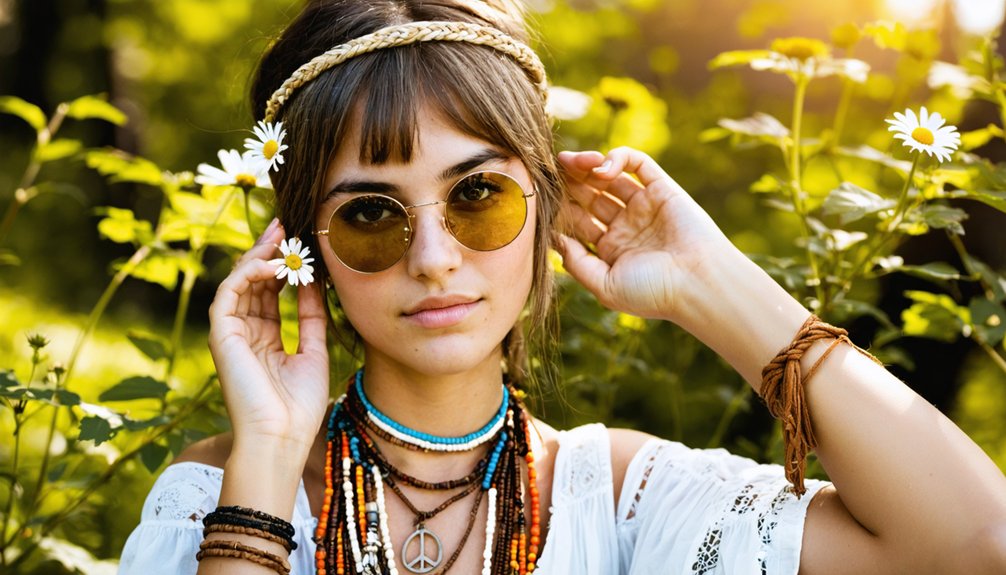
Accessories within hippie culture carried the same ideological weight as clothing and grooming, transforming ordinary adornments into deliberate countercultural declarations. You’d layer beaded necklaces alongside peace bracelets, nature inspired jewelry, and bohemian earrings to construct meaning through accumulation.
Hippie accessories weren’t decoration — they were declarations, layered with meaning, resistance, and identity worn deliberately on the body.
Flower crowns and headband styles framed the face as a canvas for botanical symbolism, while vintage scarves doubled as both ornamentation and practical statement pieces.
Layered accessories communicated collective values rather than individual vanity. Consider these defining elements:
- Beaded necklaces signaled spiritual connectivity across cultures
- Peace bracelets externalized anti-war ideology through wearable form
- Flower crowns embodied the flower child identity directly
- Vintage scarves rejected mass-produced fashion systems entirely
Each accessory functioned as wearable philosophy, encoding resistance, naturalism, and communal identity simultaneously.
Why Bare Feet and Sandals Were a Political Statement
Footwear choices in hippie culture operated as loaded political gestures, not mere aesthetic preferences. When you stripped away formal shoes, you rejected capitalist conformity outright. The barefoot revolution declared solidarity with marginalized communities globally, signaling that material accumulation held no personal authority over you.
Sandal symbolism carried equally subversive weight. Choosing minimalist footwear over structured, manufactured shoes connected you directly to anti-war protests and counter-institutional resistance. Sandals referenced ancient, cross-cultural traditions, deliberately contrasting corporate America’s rigid dress expectations.
Comfort-prioritized footwear also reinforced hippie philosophy practically. Without heels elevating you artificially, you remained grounded, literally and ideologically. You weren’t performing status through clothing; you were dismantling it.
Every barefoot step or leather sandal strap communicated deliberate non-participation in dominant cultural systems demanding conformity through appearance.
Why No Two Hippie Outfits Ever Looked the Same
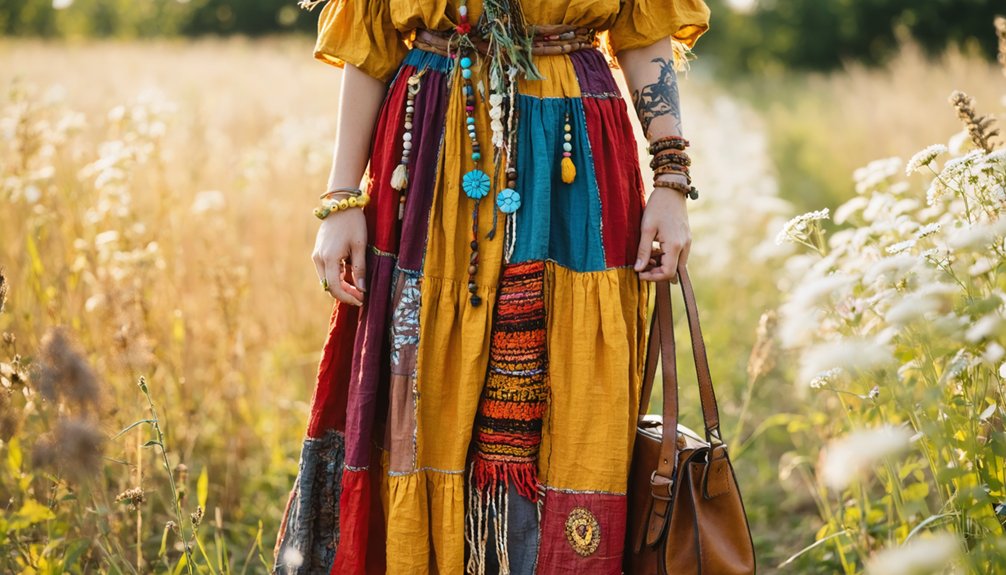
Hippie fashion resisted replication because individuality operated as its foundational principle. You’d find eclectic influences shaping every outfit differently, making personal style a deliberate act of identity representation.
Self sewn garments reinforced DIY fashion‘s cultural significance, allowing artistic freedom to override commercial uniformity.
Key factors driving unconventional combinations included:
- Individual expression through mixed fabrics, prints, and silhouettes
- Community impact via shared aesthetic values without enforced uniformity
- Cultural borrowing from Indian textiles, folk traditions, and natural materials
- Handcrafted construction that embedded personal narrative into each piece
You weren’t following trends—you were authoring them.
This approach transformed clothing into lived philosophy, where no garment duplicated another because no two people carried identical experiences worth expressing.
How the 1960s Flower Child Look Shaped Today’s Boho Style
When you trace today’s boho aesthetic back to its origins, you find the 1960s flower child movement at its core, where flowy silhouettes, floral prints, and earthy tones first established the visual language that modern bohemian fashion still speaks.
The hippie rejection of structured clothing in favor of light fabrics, loose fits, and natural styling gave boho its foundational ethos—one that prioritized individual expression over conformity.
You can see these enduring influences in contemporary boho’s continued reliance on lace details, silk tunics, layered beads, and sandals, all of which carry the unmistakable fingerprints of their 1960s predecessors.
Boho Fashion’s Hippie Roots
The 1960s flower child aesthetic didn’t just define a decade—it laid the structural foundation for today’s bohemian fashion. When you trace modern boho’s DNA, you’ll find vintage influences embedded in every silhouette and textile choice.
Key hippie elements that directly shaped bohemian aesthetics include:
- Flowy silhouettes shifted from bell-bottoms and muumuus into contemporary loose-fit designs
- Natural fabrics like silk and linen maintained their cultural relevance across decades
- Floral and earthy prints preserved the flower child’s visual language
- Minimal footwear and accessory layering evolved into boho’s signature stacked-jewelry aesthetic
You’re fundamentally witnessing an unbroken sartorial lineage. The counterculture’s rejection of structured norms didn’t disappear—it transformed, giving modern bohemian fashion its rebellious yet refined identity.
Enduring Flower Child Influences
The bohemian evolution didn’t emerge accidentally. Designers continuously reinterpret those original sartorial rebellions—barefoot minimalism becomes artisan sandals, hand-sewn Indian fabrics become luxury linen—transforming protest into aesthetic currency.
Understanding this lineage matters analytically: today’s boho isn’t merely nostalgic borrowing. It’s a sophisticated recontextualization of garments once worn to challenge systems, now repositioned within the very commercial structures they originally opposed.
Frequently Asked Questions
Where Did Hippies Typically Shop for Their Unique Clothing in the 1960S?
You’d typically find hippies sourcing their distinctive garments from thrift stores and vintage boutiques, where they’d uncover affordable, unconventional pieces that challenged mainstream consumerism, enabling authentic self-expression through repurposed fabrics, Indian imports, and creatively self-sewn designs.
How Much Did a Typical Hippie Flower Child Outfit Cost in the 1960S?
You’d find vintage pricing remarkably affordable, as clothing accessibility defined hippie culture. Self-sewn dresses, thrifted muumuus, and Indian fabrics cost mere dollars, empowering you to craft authentic, innovative ensembles without straining budgets, democratizing bohemian fashion considerably.
Which Famous Musicians Most Influenced the Hippie Flower Child Fashion Movement?
Coincidentally, Janis Joplin, Jimi Hendrix, and The Beatles shaped musical influences and iconic styles you’d recognize instantly. Their flowy silhouettes, floral prints, and beaded accessories transformed counterculture expression into a globally celebrated, analytically significant fashion revolution.
Were There Regional Differences in Hippie Flower Child Fashion Across America?
Yes, you’d notice regional influences shaping distinct cultural variations—San Francisco’s earthy bohemian layers differed from New York’s edgier interpretations, while Southern communities integrated folk-inspired textiles, reflecting how geography actively transformed hippie flower child fashion across America.
Did Hippie Fashion Differ Between Men and Women in the 1960S?
Swipe right on gender expression: you’d find hippie fashion evolution blurred boundaries boldly. Men grew long hair and beards; women went braless in flowy silhouettes. Both shared bell-bottoms, floral prints, beads, and sandals equally.
References
- https://youandmie.com/2012/01/19/60s-flower-child-sewing-through-the-decades-for-prp/
- https://www.chelseakray.com/blog/2024/4/30/flower-child
- https://www.spiritofchange.org/late-blooms-from-the-flower-children-the-60s-hippies-speak-out/
- https://www.britannica.com/topic/The-Flower-Children-2101574/Anatomy-of-a-Subculture
- https://www.gettyimages.com/photos/1960s-flower-child
- https://www.istockphoto.com/photos/1960s-flower-child