When you borrow anime aesthetics without understanding their cultural roots, you risk reducing layered Japanese symbolism to hollow costumes. Cultural appropriation in anime cosplay distorts original meanings, reinforces harmful stereotypes, and sexualizes Asian women through exoticized tropes. It fractures cosplay communities by sparking online backlash, platform bans, and ideological conflicts. These consequences ripple far beyond individual costumes, reshaping how entire cultures get perceived globally — and there’s much more to unpack here.
Key Takeaways
- Cultural appropriation in anime cosplay strips Japanese symbols of their layered meanings, reducing them to surface-level aesthetics for commercial gain or social media clout.
- Appropriative cosplay reinforces harmful stereotypes, reducing complex cultural identities into caricatures and perpetuating exoticized, hypersexualized narratives of Asian and brown women.
- Sexualizing cultural symbols compounds appropriation harms by transforming meaningful iconography into objectified spectacle, distorting cultural perceptions.
- Online backlash against culturally appropriative cosplay escalates into viral conflicts, including harassment campaigns, platform bans, and death threats.
- Affected communities bear the burden of navigating and correcting manufactured cultural simulacra that misrepresent their identities in real daily life.
What Does Cultural Appropriation Actually Mean in Anime Cosplay?
Cultural appropriation in anime cosplay sits at a contentious crossroads where celebration and exploitation blur into one another. When you adopt Japanese aesthetics — whether it’s kawaii fashion or anime character designs — without acknowledging their cultural roots, you risk stripping away cultural authenticity.
This isn’t just about costumes; it’s about power dynamics embedded in representation.
Identity preservation becomes critical here. Japanese cultural symbols, from sacred manga archetypes to stylized aesthetics, carry layered meanings that transcend their visual appeal.
When you reduce these symbols to cosmetic choices — often for commercial gain or social media clout — you distort their original context.
Understanding cultural appropriation in cosplay demands interdisciplinary thinking: anthropological awareness, historical sensitivity, and genuine engagement with the communities whose cultures you’re borrowing from.
How Cosplay Became a Global Cultural Exchange
When you trace cosplay’s trajectory, you find it’s never been a purely Japanese export—it’s a living cultural hybrid shaped by global fandoms, local aesthetics, and cross-border creative borrowing.
Across Asia especially, you’ll see young cosplayers drawing from Korean, Chinese, and Japanese media simultaneously, complicating any clean narrative about where influence begins or ends.
This pan-Asian creative exchange reveals that cosplay functions less as a one-way cultural transmission and more as a dynamic negotiation of identity, representation, and belonging across multiple cultural frameworks.
Cosplay’s Global Cultural Roots
How did a distinctly Japanese fan practice transform into a global cultural phenomenon? When you trace cosplay‘s roots, you’ll find it emerging from Japan’s Comiket conventions in the 1970s, where fans prioritized cultural authenticity by embodying beloved characters through meticulous costume recreation. That intimate fan ritual has since crossed every conceivable border.
Today, you’re witnessing cosplay function as a sophisticated vehicle for identity expression across vastly different cultural landscapes. From Lima’s anime conventions to Seoul’s character cafés, participants actively reinterpret Japanese aesthetics through their own cultural frameworks.
This isn’t passive consumption—it’s dynamic hybridization. Young cosplayers in Peru, Indonesia, and Nigeria aren’t simply mimicking Japanese culture; they’re negotiating complex intersections between their heritage and adopted fandoms, creating entirely new cultural vocabularies that challenge straightforward appropriation narratives.
Cross-Cultural Anime Adoption
Anime’s migration beyond Japan’s borders didn’t happen passively—it moved through deliberate acts of cultural adoption, translation, and reinterpretation that transformed a niche fan practice into a genuinely transnational phenomenon.
When you trace cosplay’s expansion across Latin America, Southeast Asia, and Europe, you’ll find that artistic influence rarely travels in one direction. Communities in Peru, Indonesia, and the Philippines didn’t simply consume Japanese aesthetics—they actively remixed them within local frameworks, producing hybrid expressions that complicate clean appropriation narratives.
Cultural authenticity, then, isn’t a fixed origin point you either respect or violate; it’s a negotiated outcome shaped by who’s adapting, why, and within what social context.
Understanding cross-cultural anime adoption demands you move beyond binary thinking and engage with cosplay as a dynamic site of transnational identity construction.
Pan-Asian Creative Exchange
Beyond Japan’s borders, cosplay has evolved into a medium of pan-Asian creative exchange that disrupts simplistic West-to-East cultural flow narratives. You’re witnessing young creators across South Korea, China, Indonesia, and the Philippines drawing inspiration from one another, reshaping what cultural authenticity means in a regionalized context.
This lateral exchange complicates appropriation discourse considerably. When a Filipino cosplayer reimagines a Chinese-inspired anime character, they’re navigating layered histories of colonial influence, regional solidarity, and artistic expression simultaneously. These interactions don’t fit neatly into dominant/subordinate cultural frameworks.
What emerges is a hybrid creative ecosystem where ethnic representation becomes contested terrain. You’ll find that cosplay’s global reach demands more precise analytical tools—ones that account for intra-Asian dynamics rather than defaulting to Western-centric appropriation models.
When Does Cosplay Become Cultural Appropriation?
Determining when cosplay crosses into cultural appropriation requires examining intent, context, and impact simultaneously. You must consider whether your portrayal reduces cultural authenticity to mere aesthetics, stripping symbols of their original significance.
Cosplay crosses into appropriation when intent, context, and impact reduce cultural authenticity to hollow aesthetics.
Ethical representation demands that you research source material deeply rather than commodifying surface-level visuals for personal gain or entertainment.
Key indicators emerge when cosplay reinforces harmful stereotypes, sexualizes cultural symbols, or distorts sacred meanings for wider audiences. You’re appropriating rather than appreciating when commercial motives override genuine engagement with the culture’s complexity.
The distinction sharpens further when affected communities themselves signal harm.
Ultimately, you navigate appropriation by centering accountability—actively listening to cultural stakeholders, acknowledging power dynamics, and continuously interrogating whether your creative choices respect or exploit the communities whose traditions you’re engaging.
Stereotyping and Sexualization in Culturally Appropriative Cosplay
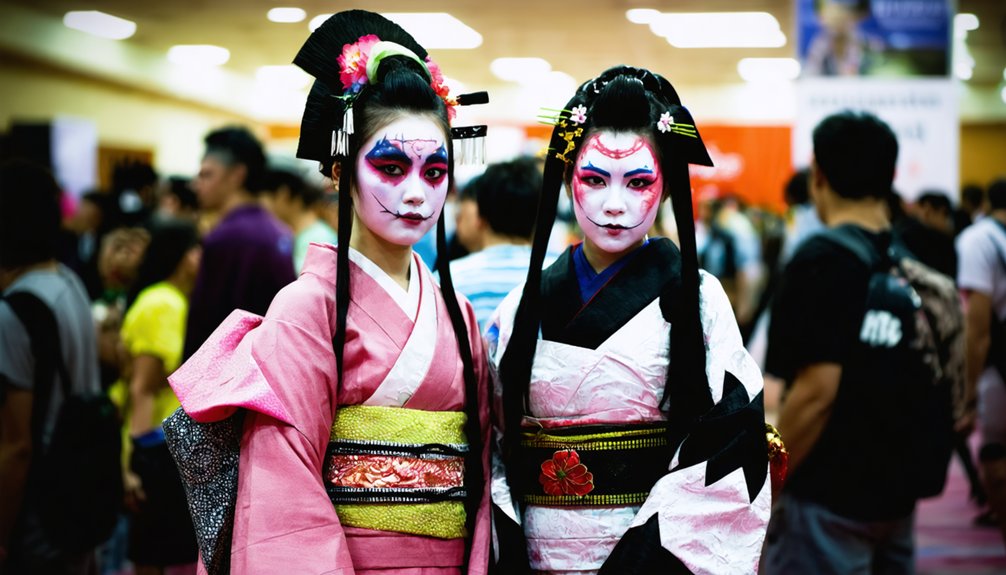
When you engage in culturally appropriative cosplay, you risk reinforcing harmful stereotypes that reduce complex cultural identities to surface-level caricatures. These caricatures often frame brown and Asian women as inherently exotic or sexual.
You often see this dynamic play out when cosplayers adopt “belly dancer” aesthetics or hypersexualized anime tropes. This strips these symbols of their original cultural context and amplifies objectifying narratives.
In doing so, you contribute to a broader misrepresentation of Asian women’s identities. This flattening of their lived experiences into a consumable, fetishized image serves your aesthetic goals at the expense of authentic cultural understanding.
Reinforcing Harmful Cultural Stereotypes
Cultural appropriation in anime cosplay doesn’t just borrow aesthetics—it often distorts them in ways that reinforce damaging stereotypes, particularly around race and gender. When you strip cultural symbols from their context, you reduce complex identities into consumable caricatures.
Sexualized portrayals of Asian and brown women in cosplay perpetuate exoticized narratives that misrepresent entire communities.
Without cultural sensitivity, these portrayals normalize harmful tropes rather than challenge them. Authentic representation requires you to engage critically with source material, understanding what symbols mean within their original cultural framework.
The commercial incentive behind many cosplays accelerates this distortion—prioritizing aesthetic appeal over accuracy.
Recognizing these patterns positions you to contribute to more responsible creative practices, ones that celebrate cultural exchange without reducing marginalized communities to flattened, stereotyped imagery.
Sexualizing Cultural Symbols
Sexualizing cultural symbols in cosplay compounds the harms of appropriation by transforming meaningful iconography into objectified spectacle. When you reduce Japanese cultural aesthetics to provocative costumes, you strip away cultural authenticity, replacing nuanced meaning with exoticized fantasy.
This dynamic disproportionately affects representations of Asian and brown women, reinforcing stereotypes that frame them as inherently sexual objects rather than complex cultural agents.
Consider how “belly dancer” costumes function within cosplay spaces—they collapse distinct cultural traditions into a singular, eroticized visual shorthand.
Your artistic expression carries responsibility; when commercial incentives override respectful representation, wider audiences develop distorted cultural perceptions.
The sexualization of cultural symbols doesn’t just misrepresent source material—it actively perpetuates harmful hierarchies that position marginalized cultures as consumable aesthetics rather than living, dynamic traditions deserving genuine intellectual engagement.
Misrepresenting Asian Women’s Identity
Stereotyping in culturally appropriative cosplay doesn’t merely misrepresent Asian women—it actively reconstructs their identity through a colonial gaze that flattens ethnic complexity into consumable tropes. When you reduce Asian femininity to exoticized, hypersexualized archetypes, you’re eroding cultural authenticity and replacing nuanced lived experience with curated fantasy.
This distortion operates systemically: cosplayers performing “kawaii” aesthetics without contextual grounding perpetuate reductive identity representation that audiences then internalize as legitimate cultural truth. The downstream effect is measurable—broader publics misread Asian women’s actual social realities through these filtered, commodified lenses.
Anime’s original character complexity gets stripped into surface-level signifiers: doe eyes, submissive postures, decorative femininity. You’re not celebrating culture; you’re manufacturing a simulacrum that Asian women must then navigate, challenge, and repeatedly correct in everyday spaces.
The Real Backlash Cosplayers Face for Cultural Appropriation Online
When cosplayers step into online spaces wearing Japanese-inspired aesthetics or using terms like “kawaii,” they often face swift and severe consequences.
The digital landscape amplifies every perceived misstep, turning cultural sensitivity debates into viral flash points. You’re not just risking criticism—you’re risking coordinated retaliation:
- Mass reporting campaigns that trigger platform bans
- Death threats targeting cosplayers accused of misrepresenting representation authenticity
- Japanese commentators actively labeling specific cosplays as direct appropriation of “kawaii culture”
These aren’t isolated incidents. They reflect a structurally embedded tension between global fandom participation and cultural ownership.
Platforms become battlegrounds where cosplayers navigate algorithmic punishment alongside community hostility. Understanding this backlash requires recognizing how digital ecosystems magnify cultural conflicts, transforming what begins as creative expression into contested ideological territory.
How Cultural Appropriation Distorts the Source Culture’s Original Meaning
Beyond the immediate backlash cosplayers face online, cultural appropriation inflicts a subtler but equally damaging harm: it strips source cultures of their original meaning.
When you reduce sacred anime and manga symbolism to pure aesthetic appeal, you’re practicing symbolic misinterpretation—detaching cultural markers from their lived context. The general public then absorbs these distorted versions as authentic representations.
Cultural authenticity demands more than visual accuracy; it requires understanding the social, historical, and artistic frameworks behind what you’re portraying. When commercial motives drive cosplay choices, that deeper understanding gets sacrificed.
You end up amplifying a hollow copy while the original meaning fades from public consciousness. Over time, this distortion reshapes how entire cultures are perceived, replacing nuanced identity with simplified, often exoticized imagery.
How Cultural Appropriation Fractures the Cosplay Community’s Inclusivity
Cultural appropriation controversies don’t just damage individual cosplayers—they fracture the communal fabric that makes cosplay meaningful in the first place. When cultural authenticity becomes weaponized, community boundaries collapse into fault lines. You’ll notice these pressures manifest in concrete ways:
- Body shaming intersects with appropriation accusations, creating compounded social penalties
- Safe spaces erode when fear of cultural missteps overrides creative expression
- Younger participants face intensified scrutiny, suppressing genuine engagement
These fractures aren’t incidental—they’re structural. Mass reporting campaigns and coordinated banning reflect how quickly community policing transforms into exclusion.
You’re witnessing a paradox: a subculture built on imaginative identity adoption simultaneously policing identity boundaries. Without frameworks that distinguish respectful engagement from exploitation, the cosplay community risks replacing inclusivity with surveillance-driven conformity that ultimately serves no cultural tradition authentically.
Is Cosplay Cultural Appropriation or Cultural Appreciation?
The line separating cultural appropriation from cultural appreciation in cosplay isn’t fixed—it shifts depending on intent, power dynamics, and community reception. When you engage with anime aesthetics, you’re steering through a complex intersection of cultural authenticity and artistic interpretation.
Appreciation emerges when you research source material deeply, acknowledge its cultural origins, and avoid reducing sacred symbols to costume elements.
Appropriation occurs when commercial gain overrides genuine respect, or when your portrayal reinforces harmful stereotypes about Asian women or ethnic minorities.
Cosplay functions as cultural hybridization—a globally negotiated exchange where Japanese soft power intersects with diverse consumer identities.
You must critically examine your motivations, recognize existing power imbalances, and actively engage with affected communities.
The distinction ultimately lives in your demonstrated accountability and willingness to listen.
How to Cosplay Across Cultural Boundaries Respectfully
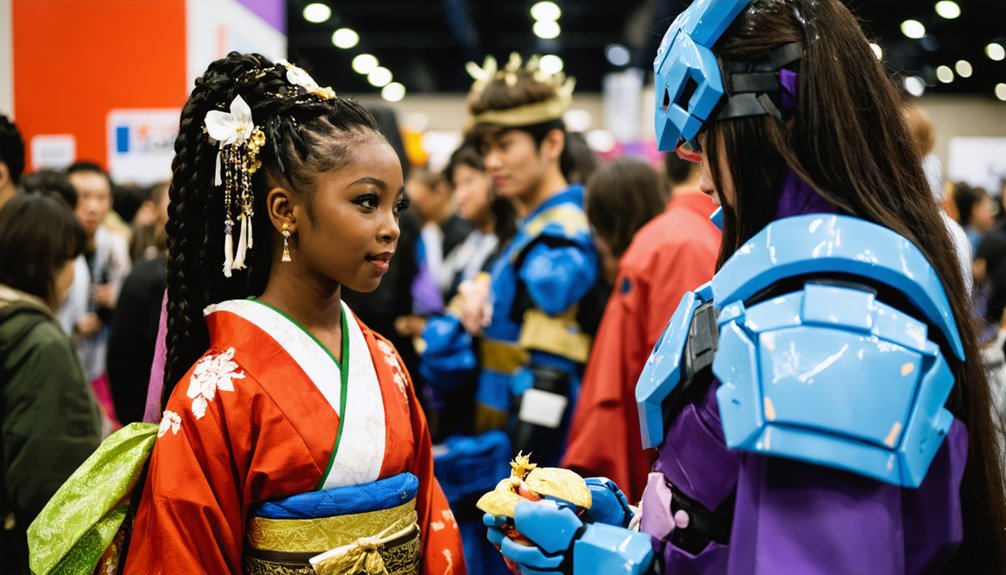
Knowing where appreciation ends and appropriation begins gives you a foundation, but acting on that knowledge requires concrete practice. Ethical cosplay demands intentional choices rooted in cultural sensitivity rather than aesthetic convenience.
Apply these principles before committing to a culturally specific costume:
- Research thoroughly — understand the cultural symbols you’re adopting, separating sacred significance from surface aesthetics.
- Engage authentically — connect with communities from the source culture, prioritizing their voices over dominant beauty standards.
- Represent accurately — avoid sexualizing or exoticizing cultural elements, particularly portrayals reinforcing stereotypes about Asian or Brown women.
Cosplay’s role as cultural hybridization carries real responsibility. You’re not just wearing a costume; you’re participating in a global exchange that either distorts or honors the culture inspiring your portrayal.
Frequently Asked Questions
Can Cultural Appropriation in Cosplay Have Legal Consequences for Cosplayers?
Generally, you won’t face direct legal implications for cosplay cultural appropriation, but you’re risking platform bans and community backlash. Practicing cultural sensitivity can protect you from account suspensions, death threats, and reputational damage within cosplay spaces.
How Do Anime Creators Themselves Feel About Foreign Cosplayers Representing Their Work?
Many anime creators welcome your foreign cosplay, valuing creative authenticity and global reach. They’re generally appreciative when you demonstrate cultural sensitivity, seeing your representation as proof of their work’s innovative, cross-cultural impact and soft power.
Does Cultural Appropriation in Cosplay Differ Across Various Age Demographics?
Yes, you’ll find that generational perspectives shape these debates considerably. Younger demographics embrace cultural hybridization innovatively, while age-related sensitivities among older communities drive stricter boundaries around authentic representation, reflecting evolving interdisciplinary understandings of identity and cultural exchange.
How Do Cosplay Competition Judges Handle Entries Involving Potential Cultural Appropriation?
When you enter competitions, judges typically evaluate cultural sensitivity and respectful representation by examining your intent, accuracy, and context. They’re increasingly adopting interdisciplinary frameworks, balancing creative innovation against potential stereotyping or distortion of the appropriated culture’s significance.
Are There Organizations Specifically Dedicated to Addressing Cultural Appropriation in Cosplay?
Like needles in a haystack, you’ll find few organizations solely dedicated to this cause, but you’ll discover communities actively promoting cultural sensitivity and ethical considerations, bridging cosplay’s creative spirit with responsible, interdisciplinary dialogue around appropriation issues.
References
- https://www.youtube.com/watch?v=nUCnS93S8IE
- https://www.vice.com/en/article/black-cosplay-japanese-anime-tiktok/
- https://www.youtube.com/watch?v=bHDRBmo3tSs
- https://digitalcommons.lib.uconn.edu/gs_theses/315/
- https://www.thepopverse.com/cosplay-cultural-appropriation-cosplayers-costume
- https://www.dimsumdaily.hk/ani-com-fair-highlights-hong-kongs-growing-influence-in-asias-cosplay-and-gaming-scenes/
- https://dl.tufts.edu/downloads/xw42nm17k
- https://www.atlantis-press.com/article/126006349.pdf
- https://open.library.ubc.ca/media/stream/pdf/24/1.0067114/1
- https://www.reddit.com/r/NoStupidQuestions/comments/jiejw9/if_a_nonasian_person_dresses_up_as_an_asian_anime/