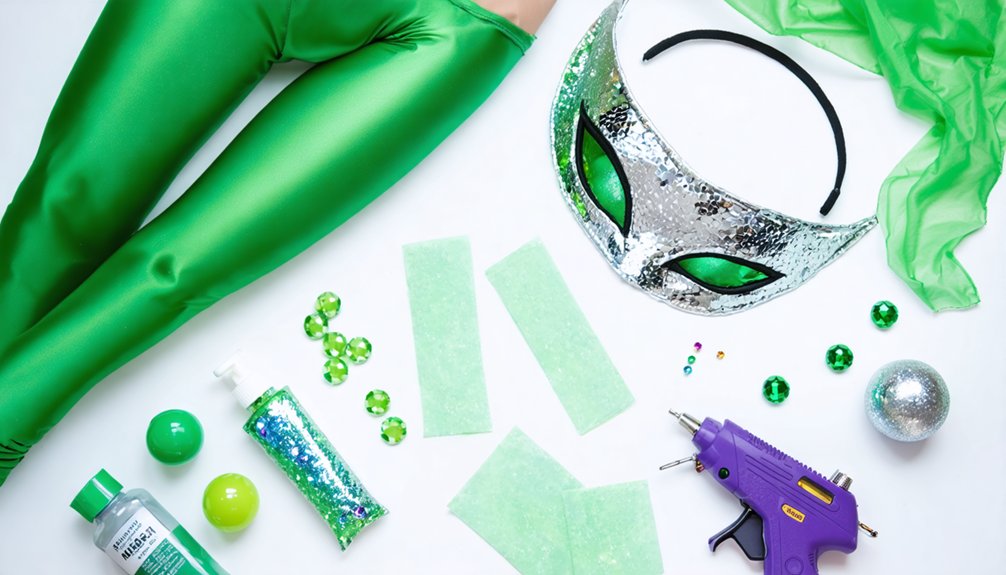
For a DIY alien costume, you’ll need a metallic bodysuit in green, silver, or black as your base layer. Grab craft foam, cardboard, and upholstery foam for structural pieces like headgear and armor. Hot glue, fabric glue, and industrial Velcro hold everything together. Finish surfaces with gesso, metallic spray paint, or LED strips for an otherworldly glow. Raid your recycling bin for old CDs and bottle caps—there’s plenty more to discover ahead.
Key Takeaways
- A green, silver, or black bodysuit serves as the foundational layer, with metallic silver spandex or lamé adding an otherworldly shimmer.
- Cardboard, craft foam sheets, and upholstery foam provide structural support for alien headgear, shoulder armor, and body-conforming pieces.
- Hot glue, fabric glue, and industrial Velcro straps securely bond materials while elastic bands maintain structural integrity throughout the costume.
- Repurposed materials like old CDs, bottle caps, and aluminum foil create iridescent, low-cost decorative textures for an authentic alien appearance.
- LED strips or battery-powered fairy lights embedded into the costume produce striking bioluminescent effects that enhance the alien aesthetic.
The Core Fabrics Every DIY Alien Costume Needs
When building a DIY alien costume, your fabric choices determine the final visual impact more than any other single decision. Start with a green, silver, or black bodysuit as your foundational layer, then layer metallic silver spandex or lamé fabric over it to achieve that unmistakable otherworldly shimmer.
Fabric choices make or break an alien costume—start with a bold bodysuit, then layer metallic lamé for instant otherworldly impact.
These two materials work together to create dynamic color combinations that catch light and signal extraterrestrial origin immediately.
Felt sheets in black and white add structural contrast without bulk, making them ideal for detail work around edges and panels. Spandex offers stretch and comfort, while metallic lamé delivers visual intensity.
Selecting fabrics with complementary textures and finishes lets you build depth into the costume’s surface, elevating it beyond a simple single-fabric construction into something genuinely striking.
Cutting and Shaping Tools That Make Construction Easier
Five cutting tools cover nearly every construction task you’ll encounter when building an alien costume. Standard scissors handle fabric and paper efficiently, while a rotary cutter paired with a cutting mat delivers crafting precision for clean, straight edges.
Master detailed trimming on foam using an X-acto knife, which gives you control that scissors can’t match. A craft knife with ergonomic handles reduces fatigue during extended shaping foam sessions, letting you carve foam board insulation for head and spine structures accurately.
Pipe cleaners and wire round out your toolkit for bending antennae into precise configurations.
Prioritize tool safety by keeping blades sharp, since dull edges require excess force and reduce cutting techniques accuracy. Multi tool usage across materials keeps your project organization tight and your workflow streamlined throughout construction.
Foam and Structural Materials That Shape Your Alien Look
Foam transforms flat fabric into three-dimensional alien architecture, giving your costume the structural depth that fabric alone can’t achieve. Selecting the right foam types determines how convincingly your alien silhouette reads from a distance.
- Upholstery sheet foam shapes rounded shoulders and tails with flexible, compressible density.
- Foam board insulation lets you carve rigid head structures and spine ridges with precision.
- Craft foam sheets handle smaller decorative protrusions without adding unnecessary weight.
Each foam type serves a distinct structural support role. Upholstery foam bends without cracking, making it ideal for body-conforming pieces.
Each foam type plays a distinct role—upholstery foam bends without cracking, making it perfect for body-conforming costume pieces.
Foam board insulation accepts X-acto knife carving cleanly, producing sharp architectural edges.
Craft foam layers bond easily with hot glue, letting you build complex surface textures quickly and efficiently.
Best Glues and Fasteners to Hold Your Alien Costume Together
Three adhesives handle the majority of alien costume construction: hot glue, fabric glue, and liquid nails. Each offers distinct adhesive strength and material compatibility suited to specific components.
Hot glue delivers fast drying time and strong fabric bonding for foam-to-fabric connections, though its heat resistance limits use near LED lighting. Apply it in short bursts to control weight considerations on larger panels.
Fabric glue suits lightweight layering with repositionable options during early assembly stages. Its flexible cure makes it ideal for spandex and metallic lamé where rigidity fails.
Liquid nails handles heavy foam board bonding with industrial-grade adhesive strength. Use precise application methods—thin beads, even pressure—for clean joins.
Reinforce all seams using fastening techniques like industrial Velcro straps and elastic bands, ensuring structural integrity throughout wear.
Metallic and Glowing Finishes for Your DIY Alien Costume
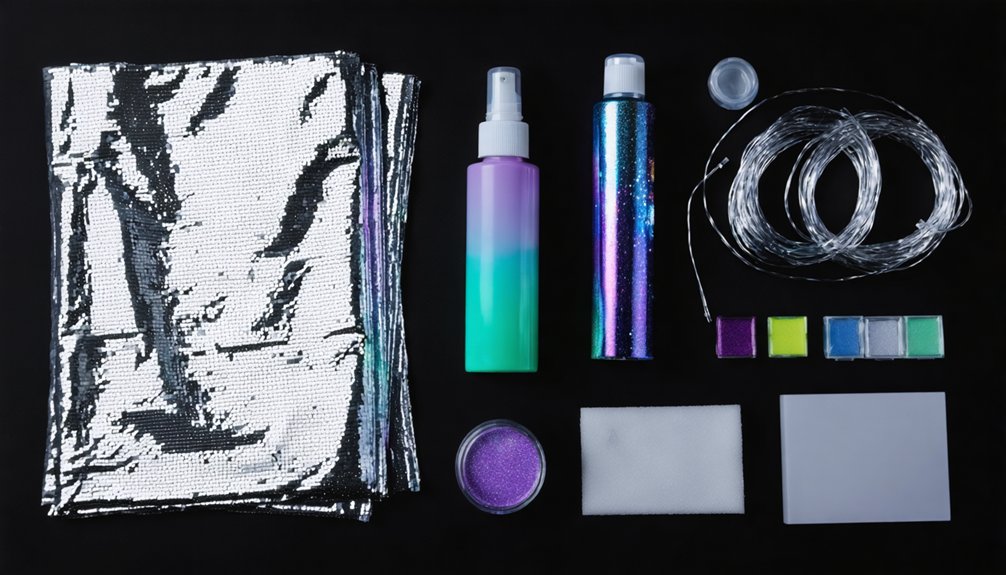
To achieve an authentic alien aesthetic, you’ll want to combine metallic fabrics like silver lamé or spandex with acrylic or fabric paint to create a cohesive, otherworldly surface.
Apply metallic spray paint or nail polish over foam and felt components to unify the texture across different materials.
For glowing effects, integrate LED strip lights beneath translucent fabric layers and accent surface details with holographic stickers, sequins, or glitter to maximize light reflection.
Metallic Fabric and Paint
Metallic fabrics and paints are two of the most effective materials for achieving an otherworldly finish on your DIY alien costume. Lamé and spandex blends deliver a dynamic metallic texture that moves with your body while maintaining luminous effects under various lighting conditions.
For painted details, acrylic or fabric paint combined with metallic spray finishes creates precise, durable accents.
Key material choices include:
- Silver or holographic lamé fabric for full-body shimmer and reflective movement
- Metallic acrylic fabric paint for hand-painted scale patterns, veining, or anatomical details
- Metallic spray paint for even, wide-coverage application on foam structural components
Layering these materials strategically amplifies your costume’s visual impact, ensuring both fabric and painted surfaces interact cohesively to produce a convincingly extraterrestrial appearance.
LED and Glitter Effects
Glowing and glittering effects elevate your alien costume from visually striking to genuinely otherworldly. For LED placement, you’ll want to embed small battery-powered LED strips along seams, spine ridges, or eye sockets to create a bioluminescent appearance.
Secure them with hot glue, ensuring wiring stays concealed beneath fabric layers. Cold-toned white or green LEDs reinforce an extraterrestrial aesthetic most effectively.
For glitter application, use fabric glue rather than standard craft adhesive to prevent flaking during movement. Apply fine holographic glitter over painted surfaces while the glue remains tacky, concentrating heavier coverage on high-visibility areas like shoulders and chest panels.
Holographic stickers and sequins complement glitter layers, adding dimensional light-catching texture. Together, LEDs and glitter transform flat metallic surfaces into dynamic, space-inspired visual statements.
Budget-Friendly Household Items for DIY Alien Costume Parts
You don’t need a big budget to build a convincing alien costume—milk jugs, cardboard boxes, and newspaper can serve as structural components for helmet and head construction.
Repurpose old CDs as iridescent decorative panels, bottle caps as surface details, and aluminum foil as a lightweight metallic casing for costume parts.
With scissors, hot glue, and basic craft supplies, you can transform these low-cost household finds into polished, otherworldly costume elements.
Repurposed Household Materials
When building an alien costume on a budget, everyday household items can serve as surprisingly effective raw materials. Repurposed containers like milk jugs and plastic bottles become structural head components, while used cardboard and scrap metal create rigid costume frameworks.
- Old electronics and vintage accessories supply metallic textures, circuit board aesthetics, and worn components that enhance extraterrestrial authenticity.
- Recycled fabrics from worn clothing provide base layers, padding material, and dimensional surface detailing without additional cost.
- Repurposed containers and scrap metal pieces transform into alien headgear, chest armor, and decorative accents through basic cutting and adhesive techniques.
You’ll find that bottle caps, old CDs, and newspaper offer unexpected decorative versatility. These materials deliver convincing otherworldly visual effects while keeping your costume construction budget-conscious and resourcefully innovative.
Cardboard and Paper Crafting
Cardboard and paper take household repurposing even further, offering rigid yet lightweight building materials that cut, score, and fold into precise costume components.
Through strategic cardboard crafting, you’ll construct alien head structures, shoulder armor, and spine ridges with remarkable dimensional accuracy. Single-wall corrugated cardboard delivers ideal strength-to-weight ratios, while double-wall variants support heavier decorative elements without buckling.
Paper techniques expand your fabrication toolkit considerably. Newspaper layers soaked in papier-mâché paste create organic, curved surfaces ideal for cranial protrusions and facial features.
Craft paper, when scored along parallel lines, produces clean geometric panels mimicking extraterrestrial exoskeleton plating. You’ll seal finished pieces with gesso before painting, ensuring acrylic adhesion across all surfaces.
Both materials accept spray paint, metallic finishes, and glitter applications without structural compromise.
Low-Cost Decorative Finds
Everyday household items offer five standout decorative finds that’ll transform your alien costume without straining your budget.
You’ll discover upcycled materials and thrift store finds that deliver striking visual impact through simple DIY techniques.
- Old CDs and bottle caps serve as low cost accessories, creating iridescent surface textures when hot-glued strategically across your costume.
- Aluminum foil and newspaper provide lightweight structural creative embellishments, shaping into scales, panels, or dimensional surface details.
- Battery-powered fairy lights deliver affordable lighting options, threading through fabric layers to produce a bioluminescent alien glow effect.
Apply these costume assembly tips using budget friendly tools you already own.
Raid kitchen drawers, recycling bins, and thrift store shelves for unconventional components.
Each upcycled material adds technically precise, innovation-driven detailing that elevates your alien costume’s authenticity remarkably.
Frequently Asked Questions
How Long Does It Typically Take to Complete a DIY Alien Costume?
You’ll typically spend 10–20 hours on your DIY costume timeline, depending on complexity. Follow alien costume tips: plan material prep, foam carving, fabric cutting, and finishing separately to innovate efficiently and achieve precise, detail-oriented results.
Can Children Safely Wear DIY Alien Costumes Made With These Materials?
Yes, children can wear these costumes safely if you prioritize costume safety by swapping hazardous materials for child-friendly material alternatives—replace sharp wires, toxic paints, and small decorative pieces with rounded pipe cleaners, non-toxic acrylics, and secured, age-appropriate embellishments.
How Do You Store a Finished Alien Costume Without Damaging It?
Store your finished alien costume using these costume preservation tips: hang metallic fabrics loosely, wrap foam parts in acid-free tissue, and utilize breathable garment bags as smart storage solutions to prevent crushing, moisture damage, and material degradation.
Are These Alien Costume Materials Safe for People With Skin Allergies?
Some materials may trigger reactions, so you’ll want to prioritize skin allergy considerations. Choose hypoallergenic materials like pre-washed cotton liners, latex-free adhesives, and nickel-free fasteners to create an innovative, skin-safe alien costume confidently.
Which Alien Costume Materials Are Reusable for Future Costume Projects?
You’ll find spandex, metallic lamé, and felt are excellent reusable fabric choices. LED lights, Velcro, and sequins serve as durable costume embellishments. Foam sheets, pipe cleaners, and acrylic paints also shift seamlessly into future innovative projects.
References
- https://prettylifegirls.com/2024/10/how-to-make-an-alien-costume/
- https://thejulieart.com/super-fun-diy-alien-costume-ideas/
- https://thisisladyland.com/diy-space-costumes-step-by-step/
- https://www.dhgate.com/blog/how-to-make-an-alien-costume-for-halloween-step-by-step-guide-c/
- https://www.crazecosplay.com/blogs/costumes-ideas/do-it-yourself-alien-costume-ideas-2024
- https://www.youtube.com/watch?v=ALHqwghohMw
- https://www.housewitheva.com/diy-alien-costume-ideas/
- https://www.instructables.com/DIY-Alien-Halloween-Costume/
- https://www.youtube.com/watch?v=d2a8TuAnc8c
- https://www.unknownbrewing.com/diy-alien-costume/