Your ogre mask looks realistic because your brain’s fusiform face area fires automatically, pattern-matching brow ridges, jaw planes, and cheekbones before skepticism activates. Flexible latex transfers your real muscle tension, sculpted wrinkles follow natural crease lines, and seamless blending eliminates visible boundaries between prosthetic and skin. Lighting angle, viewer distance, and precise fit all collapse the gap between costume and creature. Keep going to understand exactly how each element works together.
Key Takeaways
- Flexible latex conforms to facial contours, transferring muscle movement so expressions animate the mask naturally instead of appearing static.
- Custom life-cast fitting eliminates gaps and misalignment, keeping the prosthetic flush against critical zones like the brow ridge and jawline.
- Sculpted surface details like wrinkles, pores, and asymmetry trigger the brain’s face-detection system, signaling biological authenticity automatically.
- Seamless blending and layered paint unify prosthetics with skin, eliminating visible boundaries and adding realistic depth through color variation.
- Proper directional lighting at 45° enhances sculpted wrinkles, while viewer distance beyond three feet prevents edges from resolving clearly.
Why Humans Are Wired to Believe a Realistic Ogre Mask
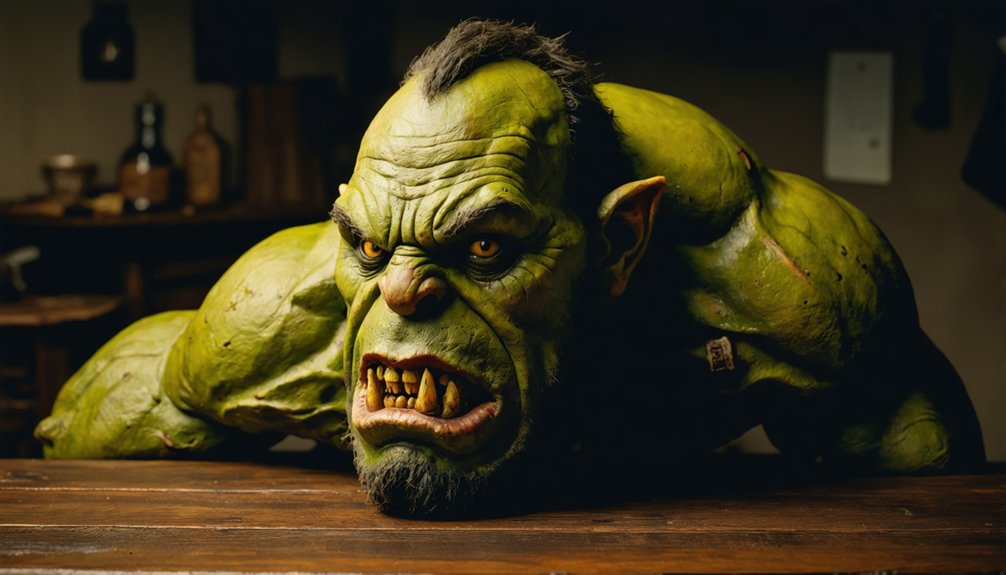
Your brain processes faces faster than almost any other visual input, and that hardwired reflex is exactly what a well-built ogre prosthetic exploits. You’re not consciously choosing to believe the illusion—your fusiform face area fires automatically, pattern-matching familiar anatomical landmarks like brow ridges, jaw planes, and eye sockets.
Your brain doesn’t choose to believe the illusion—it simply does, before logic ever gets a vote.
When those features align convincingly, your skepticism drops before it activates.
This is the myth busting reality behind why quality costume accessories outperform cheap rigid masks. A flat mask disrupts familiar facial geometry. Prosthetics preserve it.
When sculpted wrinkles, asymmetry, and correctly proportioned features hit your visual cortex, it reads *creature*, not *costume*. Your mirror neurons even respond to subtle muscular shifts beneath flexible latex, reinforcing biological authenticity.
The ogre doesn’t fool your logic—it bypasses it entirely.
Prosthetics vs. Flat Masks: What the Difference Looks Like on Your Face
Once your brain’s face-detection system locks onto familiar anatomical landmarks, the physical structure delivering those landmarks determines how long the illusion holds.
A flat mask sits away from your skin, creating a dead air gap that kills muscle movement. Your cheek tenses, but the surface doesn’t respond. The illusion fractures immediately.
Prosthetics adhere directly to your contours. Flexible latex transfers subtle facial tension into the sculpted surface, so expressions read as genuine. Brow ridges shift. Jawlines react. The ogre moves because *you* move.
Prosthetic durability also outlasts rigid masks under performance stress, resisting cracking during extended wear. Flat masks, by contrast, demand careful mask storage between uses because their shape degrades without proper support. Prosthetics distribute that structural responsibility across your living face instead.
How Sculpted Details Make an Ogre Mask Look Alive
Sculpted wrinkles, asymmetric folds, and exaggerated brow ridges do the heavy anatomical work that paint alone can’t accomplish. When you’re designing fantasy characters, surface topology carries the biological logic your audience reads instinctively.
A heavy jawline with irregular tension lines signals age and mass. Fang placement that shifts the mouth’s natural symmetry signals predator anatomy. Your brow structure, pushed forward and thickened, reshapes your human silhouette into something genuinely monstrous.
In serious costume design, the sculpt functions like an architectural plan. Every crease has to follow muscle direction, every fold needs a shadow pocket. Pre-painted depth in those recesses means the finished surface reads as skin rather than material. Your audience’s face-detection system fills in the rest, accepting the creature as real.
Why Flexible Materials Let Your Ogre Mask Move Naturally
When you apply flexible latex prosthetics, the material conforms directly to your facial contours, allowing underlying muscle contractions to push through and register on the surface.
A custom-fit sculpt built from a life-cast of your face guarantees each piece sits flush without gaps or slippage that would break the illusion mid-expression.
Your eyes and mouth remain open and fully functional, so the two most expressive zones of your face continue driving readable emotion through the ogre’s constructed features.
Flexible Materials Follow Muscles
Flexible latex conforms directly to your facial contours, so every time you tighten your jaw or raise your brow ridge, the prosthetic moves with the underlying muscle rather than against it. Unlike rigid shells, latex stretches proportionally, transmitting muscular tension through the material surface as a visible, readable expression.
Your orbicularis and zygomaticus muscles still drive the geometry of your face, and the prosthetic amplifies rather than suppresses those signals. This principle connects even to mythical origins of ogre design, where creatures needed expressive menace, not frozen vacancy.
Consider how an ogre diet of raw, heavy material shaped brutish jaw musculature in folklore illustrations — your prosthetic’s sculpted jawline references that anatomy. When fit is precise, flexible materials become a second skin rather than a separate object.
Custom Fit Preserves Expression
A life-cast built from your exact facial geometry is what separates a prosthetic that reads as creature from one that reads as costume. When sculptors map your cheekbones, orbital ridges, and jaw angles before shaping the mythical features, every gore texture lands precisely where your underlying musculature can push against it.
That contact transfers real facial tension into the silicone or latex surface above, so a smirk or snarl distorts the ogre’s skin convincingly rather than sliding across it. Loose-fitting pieces resist this transfer entirely, producing lag and buckling that breaks the illusion instantly.
A precision fit also keeps seam edges flush against your skin, eliminating the telltale gap that signals fabrication. Ultimately, your expression drives the creature’s expression because the geometry beneath and above share the same spatial reference.
Eyes And Mouth Move
Silicone and latex bend because their molecular structure allows elastic deformation without tearing, and that property is what keeps your ogre face alive during performance.
When you open your mouth or narrow your eyes, the prosthetic stretches across the underlying muscle movement instead of resisting it. That compliance is central to cosmetic effects that read as biological rather than mechanical.
Your orbicularis oculi contracts, and the surrounding silicone follows without buckling. The same happens at the lip corners when you speak.
Material durability compounds this advantage because repeated flexion doesn’t degrade the piece mid-performance.
Designers keep eye apertures and mouth openings precisely cut so your most expressive facial zones stay unobstructed.
The result is a creature face that transmits genuine emotion through sculpted, painted material rather than suppressing it.
Why the Fit of Your Ogre Mask Changes Everything
When your ogre mask fits precisely against your facial contours, the flexible latex moves with your muscle contractions instead of fighting against them, keeping the surface tension consistent and the illusion intact.
A custom sculpt built from a life-cast of your face places each prosthetic piece exactly where your underlying anatomy supports it, eliminating the gaps and shifts that expose a mask as separate from your skin.
You’ll notice the difference immediately: a well-fitted piece tracks your expressions cleanly, while a loose one buckles, lifts at the edges, and breaks the creature’s face into disconnected components.
Flexible Materials Allow Movement
Flexible latex and silicone prosthetics work because they conform directly to your facial contours rather than floating above them like a rigid shell. When your muscles contract, the material stretches with them, translating real expression through sculpted ogre anatomy. That mechanical responsiveness is what separates a convincing creature face from a stiff, lifeless prop.
Material durability matters here because flexible compounds must survive repeated movement without tearing at thin edges or creasing permanently. Silicone holds up longer under stress while maintaining color consistency across extended wear, meaning your green tones don’t shift or fade mid-performance.
Custom-fit pieces built from a life-cast press against your specific facial planes, eliminating the gaps where rigid masks fail. That contact transfers muscle tension directly into the prosthetic surface, keeping expressions readable and the illusion structurally intact.
Custom Fit Enhances Realism
Material flexibility only delivers full realism when the prosthetic actually fits your face. In costume design, poor fit creates gaps, lifting edges, and visible misalignment that instantly breaks the illusion. A life-cast solves this by mapping your exact facial geometry, letting each piece sit flush against your contours.
Custom fit matters across three critical zones:
- Brow ridge — A precisely fitted brow piece moves when you raise your eyebrows, transmitting muscle tension directly into the prosthetic surface.
- Jawline — Tight jaw fit prevents shifting during speech, keeping your fanged anatomy stable and believable.
- Cheekbones — Flush cheek placement eliminates shadow gaps that reveal layered edges.
In fantasy art, this anatomical accuracy is what separates a creature character from a costume piece wearing a face.
Green Paint and Blending Turn Separate Pieces Into One Face

Once the prosthetic pieces are set against your skin, green paint and careful blending transform that collection of separate latex components into a single, unified creature face.
You’re layering pigment strategically, not just coating surfaces. Base green establishes the dominant tone, while darker shades press into micro wrinkles and fold lines, creating the depth that makes sculpted anatomy read as real skin.
Color blending along prosthetic edges eliminates the seam boundary between latex and bare skin, so your eye registers one continuous surface instead of assembled parts.
Highlight tones lift cheekbones and brow ridges, reinforcing three-dimensional structure.
Every stroke works toward optical cohesion. When the palette stays consistent across your cowl, prosthetics, and exposed skin, the creature stops looking constructed and starts looking grown.
How Lighting and Distance Make Your Ogre Mask More Convincing
Paint and blending unify the surface, but lighting and distance determine whether that surface holds up under scrutiny. Soft, directional light reduces harsh shadows that expose seam edges, while low ambient light lets texture variation read as genuine skin depth rather than sculpted foam.
Distance compresses fine detail, making gradations between prosthetic pieces and bare skin appear continuous.
Use these conditions strategically:
- Position light sources at 45-degree angles to cast shadows into sculpted wrinkles, reinforcing depth without flattening color harmony across the face.
- Maintain viewer distance beyond three feet to prevent the eye from resolving individual edge lines between pieces.
- Avoid direct overhead fluorescent light, which flattens texture variation and exposes inconsistent surface sheen between painted and unpainted zones.
Your Performance Is What Makes an Ogre Mask Believable

Lighting and distance carry the illusion only so far—your facial tension, timing, and physical commitment are what sustain it at close range.
Myth busting starts here: passive wearing kills even the best costume design. Prosthetics respond to muscle movement beneath them, so deliberate tension in your jaw, brow, and cheeks pushes wrinkles and folds into positions the sculptor intended.
Hold a snarl and the silicone reads menace. Relax completely and the piece goes slack, exposing its artificial weight.
Time your movements slowly and heavily—ogres carry mass. Let your eyes track with predatory stillness rather than nervous speed.
Every micro-expression you generate transmits through flexible latex to the surface. The mask amplifies your intention; it doesn’t replace it. Your performance is the final layer.
How to Choose an Ogre Mask Built for Real Realism
Choosing the right ogre mask means prioritizing construction method over surface appearance. Flexible latex prosthetics outperform rigid masks because they move with your face, preserving expression clarity. Look for multi-piece designs with sculpted brow ridges, jawlines, and ears that reshape your silhouette convincingly.
- Check texture variation — Realistic pieces include layered wrinkles, pores, and asymmetric folds. Uniform surfaces read as artificial under close lighting.
- Verify color matching capability — The mask should accept additional paint layers so you can blend it precisely against your skin tone and costume palette.
- Confirm adhesive compatibility — Edges must bond cleanly to skin using latex adhesive, eliminating visible seams where prosthetic meets face.
Construction quality, fit precision, and paintable surfaces separate convincing ogre effects from cheap theatrical shortcuts.
Frequently Asked Questions
How Long Does Applying a Realistic Ogre Prosthetic Typically Take?
Applying your realistic ogre prosthetic typically takes two to four hours. You’ll carefully place each piece, blend seams, and layer green paint—following smart ogre mask maintenance and costume design tips guarantees your innovative creature transformation holds up perfectly.
Can Ogre Prosthetics Be Safely Reused After the First Application?
You can give your ogre costume a second life, but careful cleaning’s essential. Mythical creatures’ prosthetics degrade with reuse—adhesive residue weakens edges, flexible latex loses integrity, and paint details fade, compromising your seamless, innovative transformation.
What Adhesives Work Best for Securing Ogre Prosthetic Pieces Securely?
For latex safety, you’ll want medical-grade spirit gum or Pros-Aide—they grip prosthetic edges firmly while allowing clean adhesive removal without tearing surrounding skin, keeping your ogre pieces secured through intense performances and expressive movement.
Are Realistic Ogre Masks Safe for People With Latex Allergies?
If you’ve got a latex allergy, you’ll want to explore silicone-based prosthetics for your Mythical creature costumes. They’re safer alternatives that still deliver hyper-realistic results for Ogre costume ideas without triggering reactions.
How Do You Properly Store an Ogre Mask Between Uses?
Store your ogre mask in a cool, dry space away from sunlight. You’ll protect mask customization details and costume accessories by stuffing it lightly, keeping its sculpted shape intact between innovative, high-impact performances.
References
- https://www.reddit.com/r/toptalent/comments/mjmht9/this_ogre_costume_with_top_talent_makeup_to_build/
- https://www.youtube.com/watch?v=fLS7pMud5_Y
- https://www.syracuse.com/news/2014/03/how_does_a_skinny_kid_become_a_big_green_ogre_first_sit_still_for_two_hours_vide.html
- https://www.youtube.com/watch?v=LkquR9ndzsA
- https://www.youtube.com/watch?v=_e-aH9DJLtc
- https://houseofhauntz.com/ogre-latex-half-mask-fanged-monster-costume/
- https://www.wgbh.org/culture/performing-arts/2024-09-12/how-a-makeup-artist-transforms-a-human-into-an-ogre-for-shrek-the-musical
- https://www.reddit.com/r/classicwow/comments/lt8el6/incredible/
- https://www.facebook.com/movieandes/posts/why-didnt-peter-jackson-use-prosthetics-for-the-orcs-in-the-hobbit-movies-couldn/469279448992193/?locale=es_LA
- https://shop.tiktok.com/us/pdp/creepy-alien-ogre-latex-mask-for-halloween-soft-breathable/1732310818040549571