The Han Dynasty silk robe from Mawangdui was reconstructed because its fragile condition made physical display and handling too risky. After 2,000 years, it had suffered severe creasing, material loss, fiber breakdown, and staining. You can’t safely study a textile this compromised without risking further damage. Digital reconstruction using 3D imaging and AI-assisted modeling preserves the original while allowing detailed analysis of its printing, painting, and elite craftsmanship — and there’s far more to uncover about what this robe actually reveals.
Key Takeaways
- The robe suffered severe damage, including creasing, material loss, and staining, making safe physical display impossible.
- Reconstruction reduces handling of the fragile original, preventing further fiber loss, creasing, and environmental damage.
- Digital modeling allows researchers to study the robe’s techniques and symbolism without risking the original artifact.
- AI-assisted reconstruction reveals the robe’s original appearance, enabling comparison with its current degraded state.
- Reconstruction preserves the robe’s cultural, historical, and symbolic significance for future scholarly research and public understanding.
What Is the Han Dynasty Silk Robe and Where Was It Found?
The Han Dynasty silk robe unearthed from Mawangdui’s Han Tomb 1 in Changsha stands as the earliest known silk garment to combine printing and painting techniques on a single fabric. Excavated in 1972, it represents a convergence of technological innovation and refined craftsmanship that defined Western Han textile production.
When you examine its origins, you’ll recognize it as more than burial attire—it’s direct evidence of elite fashion, advanced dyeing methods, and sophisticated tailoring.
Mawangdui itself functions as a critical repository of silk cultural relics, elevating this robe’s cultural significance beyond regional history.
Its unique construction method, merging two distinct decorative techniques, makes it irreplaceable for understanding how ancient Chinese artisans pushed material boundaries and achieved levels of textile finesse rarely paralleled in the ancient world.
How Damage and Time Made the Original Robe Impossible to Display
Although ancient silk survives burial conditions better than most organic materials, two millennia of aging had left the Mawangdui robe in a state that made safe, full display fundamentally impossible.
You’re looking at a garment that had suffered severe creasing, material loss, staining, and elasticity breakdown — each condition compounding the next.
Material preservation demands you minimize handling, control environmental exposure, and avoid mechanical stress on weakened fibers.
Displaying the robe in its damaged form wouldn’t just risk further deterioration; it’d strip the garment of its cultural symbolism, reducing a landmark artifact to an unreadable fragment.
Researchers recognized that continued exhibition of the fragile original accelerated degradation without delivering meaningful visual or scholarly return, making reconstruction not optional, but necessary for responsible stewardship of this irreplaceable textile record.
Why This Robe Is the Earliest Known Printed and Painted Silk Garment in China
What makes this robe historically decisive isn’t just its age — it’s the specific combination of techniques it carries. You’re looking at the earliest confirmed silk garment in China that merges printing and hand-painting on a single textile. That distinction gives it an outsized role in both cultural heritage documentation and textile preservation strategy.
What makes this robe decisive isn’t its age — it’s the techniques it carries, unrepeated anywhere else in history.
Here’s what sets it apart:
- It predates all other known printed-and-painted silk garments found in China.
- It originates from Mawangdui’s Han Tomb 1, excavated in 1972.
- It demonstrates advanced Western Han mastery of dyeing, printing, and pigment application.
- It redefines the known timeline of Chinese textile innovation.
When you reconstruct a garment this singular, you’re not restoring fabric — you’re anchoring an entire chapter of material history.
What the Original Robe’s Condition Revealed About Ancient Silk Fragility
When researchers examined the original robe after excavation, its condition told a precise story about how ancient silk degrades over millennia. You can see in the documented findings that aging had caused significant creasing, material loss, and a measurable reduction in the fabric’s sheen and elasticity.
These weren’t cosmetic flaws—they were structural indicators of silk’s inherent vulnerability under long-term burial conditions.
Understanding this degradation pattern directly informed textile preservation strategies. Researchers recognized that continued handling or display would accelerate deterioration, threatening the robe’s cultural significance as China’s earliest printed and painted silk garment.
The original condition fundamentally functioned as a case study, revealing precise stress points where ancient silk fails. That technical knowledge justified pursuing digital reconstruction as both a preservation solution and a more reliable research resource.
How Researchers Used Digital Imaging and AI to Reconstruct the Robe
To address the limitations imposed by the robe’s fragile state, researchers deployed a reconstruction pipeline combining three-dimensional imaging, AI-assisted texture synthesis, and digital modeling. This approach delivered both historical accuracy and detailed digital restoration without stressing the original artifact.
The process produced several key outputs:
- A digital rendering of the robe’s weathered current state
- A reconstructed visualization of its original 2,000-year-old appearance
- A wearable clothing model demonstrating drape and proportion
- A digital scene display for museum presentation
You can see how each layer of technology addressed a specific gap in physical preservation. AI-assisted texture synthesis recovered lost surface detail, while 3D imaging captured structural geometry.
Together, they transformed an endangered relic into a stable, interactive research and exhibition resource.
What Reconstruction Revealed About Han Printing, Painting, and Tailoring
By revealing the robe’s original surface detail, the reconstruction exposed the sophisticated interplay between printing and hand-painting techniques that defined the garment’s visual program. You can now identify where artisans applied block-printed motifs first, then layered hand-painted details to refine contours and add chromatic depth. This sequencing wasn’t previously visible on the damaged original.
Tailoring analysis confirmed precise, intentional pattern placement across seams, indicating that cutters worked in coordination with decorators. That level of craft integration carries enormous cultural significance, demonstrating that Western Han textile production operated as a coordinated, design-conscious system rather than isolated technical steps.
For researchers, these findings validate advanced preservation techniques that prioritize data extraction before further material degradation occurs. You’re fundamentally recovering manufacturing intelligence that two millennia of burial had nearly erased permanently.
How the Robe’s Design Reflects Elite Han Dynasty Craftsmanship
When you examine the robe’s construction, you’ll find that its rare combination of block printing and hand-painting on a single garment sets it apart as a technically advanced artifact within Han textile production.
The tailoring itself reflects elite standards, with precise cutting and assembly methods that required specialized skill and careful material management.
You can recognize in these features a deliberate integration of aesthetic ambition and technical control that defined high-status Han craftsmanship.
Rare Printing And Painting
Among the most significant features of the Han Dynasty silk robe is its rare combination of printing and painting techniques on a single garment—a distinction that makes it the earliest known example of its kind found in China. You can see how craftsmen deliberately layered both methods to achieve sophisticated visual effects rooted in color symbolism and cultural symbolism.
Reconstruction revealed four critical design elements:
- Printed geometric patterns establishing structured visual rhythm
- Hand-painted motifs adding organic detail impossible to replicate mechanically
- Chromatic layering encoding color symbolism tied to Han cosmology
- Compositional hierarchy reflecting cultural symbolism associated with elite burial status
Together, these techniques confirm that Han artisans weren’t simply decorating fabric—they were engineering garments that communicated social identity, cosmological belief, and remarkable technical mastery within a single textile surface.
Elite Tailoring Techniques
The robe’s tailoring reveals a level of craftsmanship that goes far beyond basic garment construction. You can see how Han artisans engineered each seam and panel to achieve an almost weightless drape, demonstrating that elite tailoring wasn’t purely decorative.
It carried cultural symbolism, signaling the wearer’s social rank and ritual identity within Han court culture.
Reconstruction lets you analyze precise cutting angles, fabric layering, and join techniques that ancient tailors mastered without modern tools. These choices weren’t accidental.
They reflect deliberate textile symbolism embedded in garment structure itself, where form and meaning operated together.
Digital modeling reveals proportions and construction logic that the damaged original obscures. You gain technical insight into how Han Dynasty craftsmen translated sophisticated aesthetic values directly into functional, wearable architecture.
How the Reconstructed Robe Is Protecting the Original From Further Damage
Because ancient silk degrades rapidly under physical handling and environmental exposure, creating a digital and physical reconstruction of the Han Dynasty robe directly reduces the stress placed on the 2,000-year-old original. You can think of the reconstruction as a preservation shield—it absorbs research and display demands so the fragile artifact doesn’t have to.
The reconstruction acts as a preservation shield—absorbing research and display demands so the fragile original doesn’t have to.
The reconstruction actively protects the original by:
- Eliminating repeated unfolding, which causes irreversible creasing and fiber loss
- Replacing direct exhibition, preventing light and humidity from stripping the robe’s remaining sheen
- Enabling study of cultural symbolism and artistic techniques without physical contact
- Providing 3D digital models researchers can manipulate safely
This innovation-driven approach keeps the original stable while ensuring its knowledge remains fully accessible.
What the Robe’s Reconstruction Reveals About Han Silk Technology
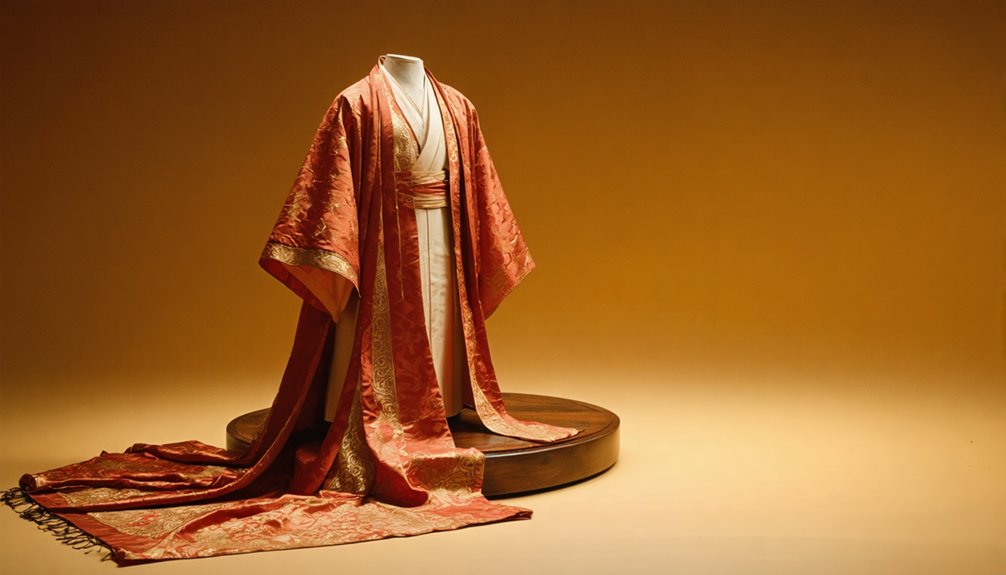
When you examine the reconstructed robe, you see direct evidence that Han artisans had already mastered a rare combination of block printing and hand-painting on a single silk garment.
The reconstruction reveals that craftsmen achieved extraordinary lightness and structural finesse in the fabric itself, qualities that modern weavers have struggled to replicate even with advanced tools.
You can trace these technical achievements back to the Western Han period, confirming that sophisticated textile production wasn’t a later development but an established craft more than 2,000 years ago.
Ancient Printing and Painting
Discovered in Han Tomb 1 at Mawangdui, the silk robe stands as the earliest known Chinese garment to combine printing and painting techniques on a single fabric—a distinction that makes its reconstruction especially significant for textile scholars.
By analyzing the robe, you’ll uncover how Han artisans layered methods to achieve complex textile patterns with deep cultural symbolism.
The reconstruction reveals four key technical insights:
- Block printing defined repeating decorative motifs across the silk surface
- Hand-painting added refined detail that printing alone couldn’t achieve
- Color application demonstrated precise dye control at a microscopic level
- Pattern placement reflected intentional design logic tied to elite status
Together, these techniques confirm that Han textile innovation wasn’t accidental—it was systematic, sophisticated, and deliberately expressive.
Lightweight Silk Craftsmanship
The reconstruction of the Han silk robe exposes just how far Western Han textile technology had advanced—producing fabric so light and refined that it challenged what researchers once assumed was achievable with ancient looms.
When you examine the reconstruction data, you’ll see evidence of textile innovation that required extraordinary loom control, thread tension mastery, and material precision. Han weavers achieved near-translucent weight without sacrificing structural integrity—a technical balance that modern specialists struggled to replicate.
The robe wasn’t just functional clothing; it carried cultural symbolism tied to elite identity and burial ritual. Reconstruction reveals the deliberate engineering behind that symbolism.
You’re fundamentally looking at a civilization that understood how material refinement could communicate status, sophistication, and artistic mastery simultaneously through a single garment.
How 3D Imaging Is Giving Mawangdui’s Silk Robe a Second Life
Buried for over two millennia, the Mawangdui silk robe emerged from Han Tomb 1 in 1972 in a state too fragile for conventional display or hands-on research. Its historical context demanded innovation. 3D imaging now delivers precisely that, generating detailed digital reconstructions that capture both its weathered condition and its original appearance.
Buried for millennia, the Mawangdui silk robe now lives again through 3D imaging — fragile history, digitally preserved.
The cultural significance becomes fully accessible without risking further material loss.
The technology enables researchers and visitors to:
- Examine texture, pattern, and tailoring through interactive 3D models
- Compare current degraded states against AI-reconstructed original appearances
- Study printing and hand-painting techniques without handling the original
- Engage with virtual reality scene displays for deeper contextual understanding
This approach transforms an endangered relic into a stable, research-ready resource while protecting the irreplaceable original indefinitely.
Frequently Asked Questions
Who Funded the Digital Reconstruction Project of the Han Dynasty Silk Robe?
The available knowledge doesn’t specify who funded the project. What you should note is that it’s driven by historical significance and cultural preservation goals, with the Hunan Museum leading this technically innovative reconstruction effort.
Are Physical Replicas of the Robe Available for Purchase or Loan?
Like rare blueprints, the knowledge base doesn’t confirm physical replicas are available for purchase or loan. You’d need to contact the Hunan Museum directly, as historical accuracy and material authenticity standards likely govern any replica distribution decisions.
How Many Other Garments Were Found Alongside the Robe at Mawangdui?
The knowledge provided doesn’t specify how many garments accompanied the robe. You’ll find that Mawangdui’s ancient textiles represent a vast cultural preservation achievement, so consulting Hunan Museum’s detailed excavation records would give you precise inventory figures.
Which Specific Museums Outside China Have Displayed the Reconstructed Robe?
The available knowledge doesn’t specify which museums outside China have displayed the reconstructed robe. You’d need to research that directly. Still, its historical preservation and cultural significance make it a globally sought-after innovation in textile heritage.
How Long Did the Full Digital Reconstruction Process Take to Complete?
The available knowledge doesn’t specify how long the full digital reconstruction took. You’ll find that historical techniques and digital restoration methods were combined innovatively, but no precise timeline’s confirmed within the current documentation of this preservation project.
References
- https://www.hnmuseum.com/en/content/printed-and-painted-floss-silk-padded-gauze-robe
- https://news.cgtn.com/news/2025-05-17/Intelligent-digital-technology-revives-ancient-silk-garment-1Ds1os31TtS/p.html
- http://www.ecns.cn/news/cns-wire/2024-08-23/detail-ihefmfnr0573076.shtml
- http://whhlyt.hunan.gov.cn/whhlyt/Museum/202205/t20220523_24630662.html
- http://whhlyt.hunan.gov.cn/whhlyt/english/News/Updates/202406/t20240614_33327960.html
- https://www.globaltimes.cn/page/202505/1334421.shtml
- http://www.yunnangateway.com/html/2024/culture2023_0528/110096.html
- https://www.hnmuseum.com/en/aboutus/“tanyuan-initiative”-2024-recreating-splendid-grace-thousand-year-old-han-dynasty-brocades
- https://rosecampau.com/suzhou-silk-museum/
- https://sg.trip.com/moments/theme/poi-hunan-provincial-museum-77595-exhibitions-990362/