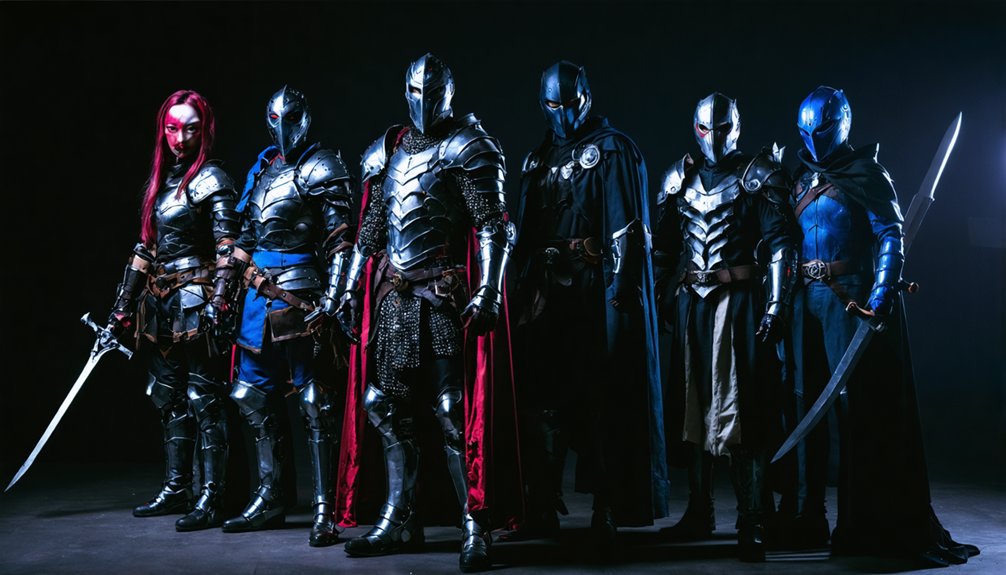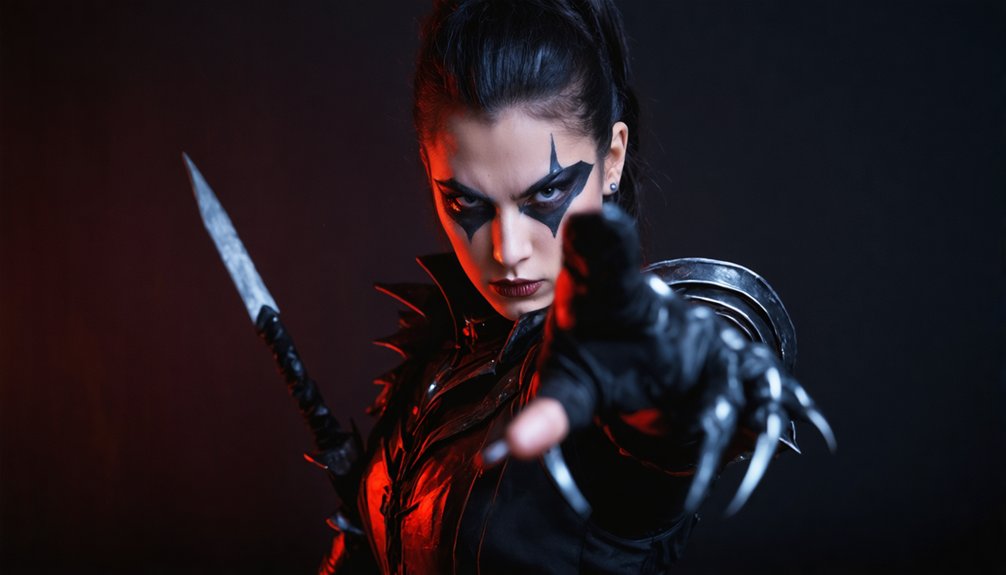
Pulling off a convincing villain cosplay demands more than a dark costume. You’ll need to master voice modulation, using a slow, deliberate baritone with sinister pauses for maximum menace. Command physical space with a wide stance, purposeful gestures, and deliberate strides. Choose structured leather in black or deep crimson, and select props like a weathered staff to reinforce your character’s presence. Internalize your villain’s trauma and wounds—the techniques ahead will sharpen every detail.
Key Takeaways
- Master voice modulation using slow, deliberate tones, sinister pauses, and precise inflection to create a psychologically menacing vocal identity.
- Command physical space through wide stances, purposeful strides, and sudden stillness to project dominance and intimidation.
- Develop your villain’s backstory by exploring personal trauma and wounds that authentically shape their worldview and motivations.
- Use strategic gestures like steepled fingers, slow pointing, and extended arms to reinforce calculated intelligence and threat.
- Choose costume colors like black and deep crimson, paired with structured materials and meaningful props, to visually amplify menace.
Master Your Villain’s Backstory Before You Perform
Before stepping into character, you’ll need to deeply understand your villain’s backstory and psychological makeup. Backstory exploration isn’t optional — it’s the foundation of a convincing performance.
Dig into your character’s personal trauma, identifying the specific wounds that shaped their destructive worldview. Motivational analysis helps you answer the critical question: *why* does your villain act this way?
Every villain’s cruelty has roots. Uncover the trauma beneath their destruction to understand the *why* driving their darkest choices.
Selfishness, betrayal, or obsession all manifest differently in movement and dialogue. Psychological depth separates forgettable performances from unforgettable ones.
Use character journaling to document your villain’s internal voice — their fears, desires, and justifications. Write entries from their perspective regularly.
Additionally, stereotype identification lets you pinpoint recognizable traits audiences expect, giving you a baseline to either honor or strategically subvert for greater impact.
Strike the Perfect Villain Cosplay Stance
Your body language communicates your villain’s power before you ever speak a word, so stand tall with a slight forward lean to project dominance and authority.
Keep your hands purposeful — clasp them behind your back to exude control, or let them rest at your sides, poised and ready.
Command the space around you with a wide, grounded stance that forces attention your way and signals that you own every inch of the room.
Master Dominant Body Posture
Commanding a room as a villain starts with mastering dominant body posture. Your body language communicates power before you speak a single word. Stand tall, leaning slightly forward to project dominance and authority. Keep your arms relaxed yet deliberate — clasped behind your back or poised at your sides, ready to strike.
Adopt a wide stance to ground yourself physically, signaling control over your space. Cross your arms strategically to amplify dramatic tension during key moments. Every movement should reflect your character’s psychological depth, transforming physical choices into storytelling tools.
Avoid fidgeting or nervous gestures, as they undermine intimidation. Practice each pose in full costume to guarantee fluid, confident execution.
Precision in posture transforms a good cosplay performance into an unforgettable villain portrayal audiences won’t soon forget.
Perfect Sinister Hand Gestures
Hands are your most expressive storytelling tools as a villain cosplayer. Every deliberate movement carries gesture significance that amplifies your character’s menacing presence.
Try clasping your hands slowly behind your back to project cold authority, or steeple your fingers together to radiate calculated intelligence.
Master the art of sinister symbolism through controlled, purposeful movements. A slow, deliberate point toward someone signals dominance and threat. Dragging fingertips across surfaces suggests possessiveness and predatory awareness.
Avoid nervous, erratic movements that undermine your villain’s confidence.
Practice restraint — the most unsettling gestures are often the subtlest ones. A villain who barely moves their hands but does so with precise intention creates more psychological impact than exaggerated flailing.
Refine each gesture until it feels instinctive and authentically threatening.
Command Space With Stance
Stance transforms your entire villain cosplay from costume to character. Plant your feet wider than shoulder-width apart, creating an unmovable foundation that radiates an intimidating demeanor.
Stand tall with a deliberate forward lean, signaling dominance without aggression. Your powerful presence depends on intentional weight distribution. Shift 60% of your weight onto your dominant foot, allowing controlled, predatory movement in any direction.
Keep your chin slightly elevated, forcing others to look up at you. Avoid passive positioning — crossed arms should feel calculated, not defensive.
Every adjustment you make must communicate authority. Roll your shoulders back, elongate your spine, and let stillness become your weapon. Master this foundation before layering in hand gestures, and your villain’s physicality will command every space you enter.
Build a Villain Voice That Commands the Room
Three key vocal elements—pitch, tone, and inflection—define a villain’s voice and separate a forgettable cosplay from a chilling performance. Master voice modulation techniques by dropping your register, slowing your cadence, and weaponizing silence. Incorporate vocal warm ups before every performance to sharpen projection and precision.
- Picture a slow, deliberate baritone that rumbles like distant thunder.
- Envision a sharp, clipped inflection that makes every word feel like a threat.
- Imagine a sinister pause before delivering a punchline that freezes the room.
- Visualize a controlled sneer woven into each syllable.
- Conjure a spine-chilling cackle that starts low and crescendos with menace.
Record every practice session to identify weaknesses and refine your vocal identity ruthlessly.
Choose Costume Colors and Materials That Signal Villain
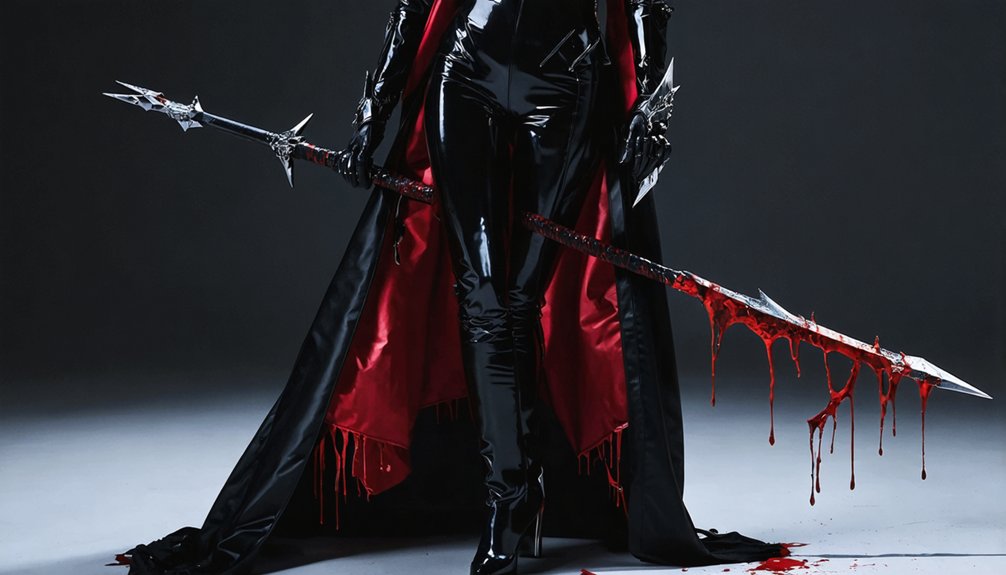
Once your voice locks in the character, your costume’s visual language must reinforce that threat. Color psychology drives immediate audience perception, so lean into blacks, deep crimsons, and corrupted purples — each signals danger, authority, and moral decay before you speak a single word.
Avoid bright, warm hues unless you’re subverting expectations deliberately.
Costume symbolism extends beyond color into material choice. Structured leather projects control and aggression, while shredded or asymmetrical fabrics communicate chaos and unpredictability. Metallic accents add an air of cold precision.
Layer textures intentionally — matte base layers against glossy overlays create visual tension that mirrors your villain’s internal conflict.
Every material decision must serve the character’s psychological profile. When color, texture, and silhouette align, your costume communicates menace before you even move.
Pick Props That Strengthen Your Villain Cosplay Performance
- Wield a weathered staff or scepter that communicates ancient authority and prop significance.
- Carry a glowing artifact that pulses with energy, signaling supernatural power.
- Use a torn, blood-stained map suggesting calculated, obsessive planning.
- Display a chained locket representing your villain’s corrupted emotional core.
- Grip a cracked mask that hints at hidden identity and psychological complexity.
Select props that survive full convention days while maintaining structural integrity and audience interaction safety.
Craft a Villain Catchphrase Worth Remembering

Your props command attention, but your words leave a permanent mark. Catchphrase creation requires deliberate precision—every word must amplify your villain’s core motivation.
Start by identifying what your character fundamentally wants: power, revenge, chaos, or control. Build your memorable phrases around that singular obsession.
Keep it short, rhythmic, and loaded with menace. Three to seven words hit hardest. Avoid generic declarations and instead craft something specific to your villain’s worldview.
Test different versions aloud, recording each attempt to evaluate cadence, weight, and impact.
Deliver your catchphrase consistently throughout the event, adjusting vocal intensity based on context. Whisper it during tense exchanges, project it during dramatic moments.
That contrast creates unforgettable impressions. Your catchphrase isn’t decoration—it’s your villain’s psychological signature.
Improvise Like a True Villain Would
Preparation gives you structure, but improvisation reveals whether you’ve truly internalized your villain. When unexpected moments arise, embody chaos deliberately—let your character’s psychology dictate every spontaneous response.
Improvise dialogue that stays true to your villain’s worldview, not your own comfort zone.
- Respond to audience questions with your villain’s signature condescension or theatrical menace.
- Pause dramatically before answering, letting tension build like a predator sizing up prey.
- Twist innocent comments into sinister observations that reflect your character’s warped perspective.
- Use unexpected interruptions as opportunities to assert dominance through physical repositioning.
- React to environmental chaos—spills, loud noises, crowds—as your villain would, not as yourself.
Your most memorable convention moments won’t come from rehearsed lines. They’ll emerge from authentic, character-driven instinct.
Use Grand Movement and Eye Contact to Hold the Room

When you move, make it count — sweep across the stage with deliberate, wide strides that claim every inch of space around you.
Lock eyes with specific audience members to create an unsettling, personal tension that draws the entire room into your character’s power.
Every gesture you make, from a slow point to a sweeping arm raise, should feel calculated and theatrical, reinforcing the villain’s dominance over the scene.
Command Space With Movement
Commanding a room as a villain cosplayer starts with deliberate, grand movement that signals authority and intent. Your costume dynamics should amplify every motion, transforming simple steps into powerful statements that drive audience engagement.
- Sweep across the stage with slow, calculated strides that force eyes to follow your trajectory.
- Pivot sharply toward your audience, letting your cape or coat dramatically emphasize the turn.
- Extend your arms wide during monologues to visually dominate the surrounding space.
- Pause mid-movement to create tension, locking eyes with specific audience members before continuing.
- Use sudden stillness after large gestures to contrast motion with menacing control.
Every movement must feel intentional. Erratic or timid motion breaks character immediately.
Own each step, each pause, each turn — your physical command tells the story before you speak a single word.
Lock Eyes With Intensity
Eye contact is your most powerful tool for establishing dominance in a room — use it deliberately, not randomly. Your intense gaze communicates threat, intelligence, and control before you speak a single word. Lock onto one person for three to five seconds, then shift with purpose — never dart your eyes nervously.
Practice a piercing stare by slightly narrowing your eyes and lowering your brow, projecting calculated menace rather than cartoonish anger. Your engaging presence depends on making each audience member feel personally targeted.
Combine this with slow, deliberate movement to amplify tension.
Develop formidable focus by rehearsing sustained eye contact in a mirror until it feels natural in costume. When you master this technique, the entire room responds — conversations stop, cameras raise, and your villain commands every space you enter.
Own Every Grand Gesture
Grand gestures transform a static costume into a living, breathing character that commands the room’s full attention. Your powerful presence depends on intentional movement that telegraphs dominance and unpredictability.
Every dramatic flair you deploy should feel deliberate, calculated, and unmistakably villainous—turning your enthralling performance into an unforgettable experience.
- Sweep your arm across your body slowly, as if dismissing an entire kingdom
- Point sharply at a specific audience member to create immediate, personal tension
- Spread both arms wide, claiming the surrounding space as your territory
- Turn your back deliberately, then spin around with sudden intensity
- Raise one fist overhead during a monologue to punctuate your character’s ultimate declaration
Own the silence between gestures—that’s where true menace lives.
Practice Your Villain Cosplay Performance in Full Costume
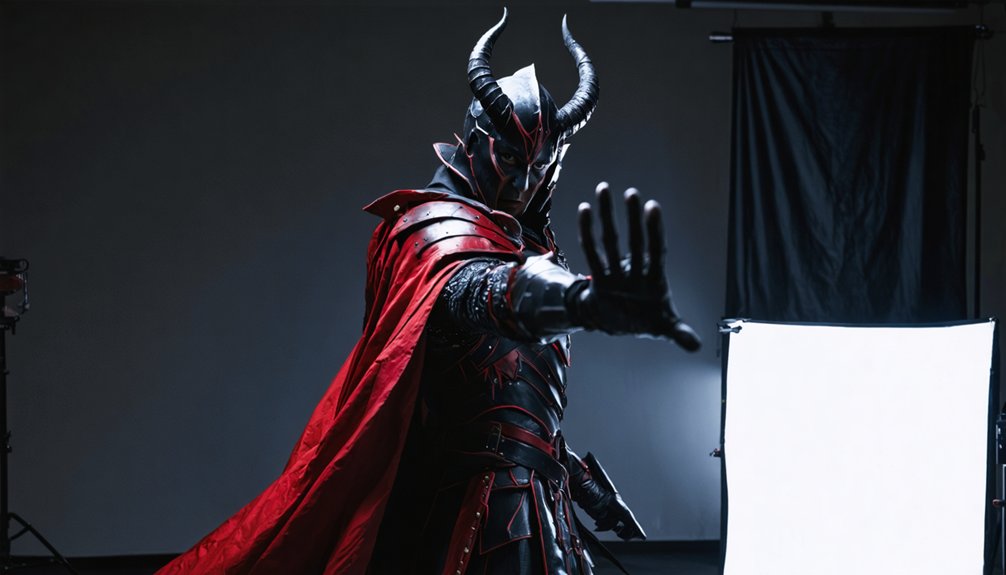
Slip into your full costume early and start rehearsing long before the actual event. Wearing your complete ensemble during practice reveals critical costume mobility issues you won’t anticipate otherwise. Can you crouch menacingly? Can you pivot dramatically without tripping? Identify these constraints now, not on the convention floor.
Use rehearsal time to refine character nuances — the subtle head tilt, the deliberate pause before delivering a threatening line, the cold stare that silences a crowd. These details separate memorable performances from forgettable ones.
Record every session. Review the footage critically, noting where movements feel awkward or unconvincing. Show recordings to a trusted person who’ll give honest feedback.
Gradually increase your rehearsal audience size to build confidence and sharpen your villain’s presence under real pressure.
Build Villain Cosplay Confidence by Starting Small
Before you take your villain to a packed convention floor, test your performance on smaller, lower-stakes audiences. Gradual exposure eliminates performance anxiety and strengthens your character connection through a reliable feedback loop.
- Practice before a mirror, using visualization techniques to inhabit your villain’s mindset completely.
- Perform for a trusted support network—friends or family who’ll provide honest, positive reinforcement.
- Film each session for self-reflection, identifying precise moments where your presence weakens.
- Take small steps by performing at intimate local events before scaling to larger venues.
- Track your confidence boost incrementally, measuring improvements against previous recorded performances.
Each controlled environment sharpens your instincts, tightens your mechanics, and transforms hesitation into commanding, deliberate menace that captivates any crowd size.
Frequently Asked Questions
How Do I Handle Negative Reactions From Audiences During My Villain Performance?
Stay in character and embrace negative reactions as part of your villain’s narrative. You’ll transform audience engagement into powerful performance feedback by using improvisation techniques, adjusting your vocal tone, and channeling criticism into your character’s menacing authenticity.
Can Children Safely Interact With Villain Cosplayers at Conventions?
Yes, children can safely interact with you. Your villain portrayal shouldn’t terrify them into a lifetime of nightmares—always soften your child safety approach by breaking character, kneeling to their level, and maintaining a warm, reassuring smile.
What Mental Health Boundaries Should Villain Cosplayers Maintain After Performing?
After performing, you’ll need emotional detachment rituals to separate yourself from the character. Implement self-care practices like journaling, mindfulness, and designated “decompression time” to reset your mental state and prevent character psychology from bleeding into your personal identity.
How Do I Collaborate With Hero Cosplayers for Staged Villain Encounters?
Coordinate with hero cosplayers by scripting villain dynamics beforehand, establishing clear hero interactions, and rehearsing staged conflicts. You’ll want to synchronize movements, agree on safety boundaries, and improvise dialogue authentically to captivate audiences during encounters.
Are There Villain Cosplay Competitions Specifically Designed for Beginners?
Like a young dragon entering its first lair, you’ll find beginner-friendly villain cosplay competitions at local comic cons. Follow competition guidelines carefully, apply beginner tips from online communities, and you’ll forge your competitive path confidently.
References
- https://starstruckpanda.com/villain-cosplay-performance-and-acting-tips/
- https://www.wikihow.com/Act-Evil
- https://starstruckpanda.com/cosplay-as-your-favorite-anime-villain/
- https://www.youtube.com/watch?v=PA_nd6Fw0ZI
- https://www.jessifitflowz.com/blog/pose-like-a-villain-6-villain-poses-that-slay
- https://www.morphsuits.com/blog/villain-outfits/
- https://horrorchronicles.com/horror-cosplay-and-acting/
- https://www.youtube.com/watch?v=p-tzOgMMlBc
- https://www.instagram.com/reel/DUeHpxLiIXU/
- https://jlbeecosplay.wordpress.com/2018/10/04/my-cosplay-tips-and-tricks-performance/