
Effective LARP combat strategies start with your stance, weapon choice, and movement working together as one system. You’ll want to angle your torso, bend your knees, and drive all movement from your hips and feet. Match your weapon to your role, whether that’s holding a line or flanking. Time your blocks late, target high-percentage zones, and use diagonal footwork to control spacing. Master these fundamentals first, and everything else clicks into place.
Key Takeaways
- Maintain a shoulder-width stance with bent knees and angled torso to maximize mobility, balance, and defensive coverage during combat.
- Move diagonally at 45-degree angles instead of retreating straight back to disrupt opponent targeting and control spacing.
- Master 3-5 fundamental strikes through slow, deliberate repetition until they become automatic muscle memory responses.
- Block at the moment of strike commitment, not during load-up, while tracking the opponent’s weapon hand.
- Assign clear team roles—shield fighters, reach weapons, and skirmishers—and use choke points to neutralize larger enemy groups.
Why Your Fighting Stance Determines Every LARP Fight
Your stance is the foundation everything else is built on — before a strike lands, before a block is timed, before a step is taken, your stance has already decided how well you can execute any of it.
Your stance decides everything — long before the first strike is thrown or the first step is taken.
Get your foot positioning right first. Place your feet shoulder-width apart or slightly wider, knees bent, weight balanced. That base gives you explosive movement without sacrificing stability.
Posture alignment comes next. Don’t present your body square to your opponent — angle your torso. You’ll dodge more efficiently, defend more effectively, and reduce your exposed profile.
Move diagonally at 45-degree angles rather than straight back when creating distance. Sideways repositioning beats retreating every time.
Combine your hips and feet when dodging — bending at the waist kills your visibility and puts you at greater risk.
Choose the Right LARP Weapon for Your Combat Role
Choosing the wrong weapon doesn’t just limit your effectiveness — it actively works against you. Match your weapon to your combat role before anything else.
If you’re holding a line, shorter weapons paired with a shield give you control and coverage. If you’re flanking or skirmishing, reach weapons let you strike while maintaining safe distance.
Close-quarters pressure demands grip adaptability along the shaft without sacrificing body coverage.
Weapon customization isn’t cosmetic — it shapes how you move, defend, and engage. Factor in weight, length, and handling before committing.
Costume coordination matters too, since your gear should support mobility, not restrict it. A visually cohesive kit that also performs tactically gives you both authenticity and competitive advantage.
Choose deliberately, because your weapon defines your entire combat function.
How to Build a Stable LARP Fighting Stance
Before you throw a single strike, your stance determines everything that follows. Plant your feet shoulder-width apart, bend your knees, and angle your torso—never stand square to your opponent. A flat-on presentation invites clean hits and kills your mobility.
Keep your weight balanced so you can move diagonally, using 45-degree steps to enter and exit range without telegraphing your intent. Retreat sideways rather than straight back—it’s tactically smarter and harder to chase.
Your larp costume affects your movement range, so test your stance while wearing full kit before any engagement. Poor footwork breaks role playing immersion faster than almost anything else—stumbling mid-fight pulls everyone out of the experience.
Drive movement from your hips and feet, never bend at the waist, and stay upright and aware at all times.
Master These Basic LARP Strikes Before Anything Else
Before you experiment with combinations or advanced techniques, you need to lock in a small set of foundational strikes and repeat them until they’re automatic.
Focus on a controlled swing that travels roughly half an arm’s length, keeping your grip firm but relaxed so the weapon stays manageable rather than rigid.
Muscle memory built through slow, deliberate repetition will carry you further in live combat than speed or complexity introduced too early.
Essential Strikes For Beginners
Mastering a small set of core strikes will take you further than scrambling to learn dozens of techniques at once. Start with three to five fundamental strikes and drill them slowly until muscle memory takes over. Deliberate repetition builds cleaner mechanics than rushing toward speed or complexity.
Keep your swing distance controlled, traveling roughly half an arm’s length per strike. Overreaching kills your balance and exposes you. Whether you’re wielding a sword styled after historical armor or a glowing replica of magical artifacts, the same mechanical discipline applies.
Grip firmly without crushing. Locked wrists reduce adaptability mid-exchange. Prioritize strikes targeting the torso and weapon arm first, since these are the highest-percentage targets in live combat. Build your foundation here before layering anything else.
Building Muscle Memory First
Knowing which strikes to throw means nothing if your body can’t execute them under pressure. Slow, deliberate repetition builds the neural pathways that make strikes automatic when adrenaline spikes.
Pair this with stamina management so fatigue doesn’t collapse your form mid-fight.
Drill these fundamentals before adding combinations:
- Repeat each strike at half-speed until form holds consistently
- Practice grip transitions to support weapon maintenance and extend usability
- Train footwork alongside strikes, never isolate upper body mechanics
- Use stamina management drills—short bursts with controlled recovery intervals
- Reset to proper stance after every repetition to reinforce default positioning
Muscle memory compounds. Every clean repetition makes your next fight sharper. Skip this foundation and even advanced combinations will break down exactly when precision matters most.
Blocking Tactics That Close Every Gap in Your Defense

Blocking in LARP isn’t just about stopping hits—it’s about timing each block to the moment a strike is actually going to land, so you don’t open gaps by reacting too early.
You also can’t focus solely on one attack line, because opponents will exploit whatever you leave exposed, making full-body coverage a non-negotiable priority.
Pair your shield and weapon intentionally, using one to cover your upper body and the other to handle low strikes, so your defense operates as a unified system rather than two uncoordinated tools.
Timing Your Blocks
When you block too early, you telegraph your defense and hand your opponent the opening they need to redirect and land a clean hit. Timing awareness and reaction speed separate reactive fighters from tactical ones.
Block at the moment of commitment, not the moment of movement, using these principles:
- Wait until the strike is fully committed before engaging your block
- Track your opponent’s weapon hand, not their eyes or shoulders
- Keep your block tight to avoid creating secondary gaps
- Reset your defensive position immediately after each block
- Combine foot movement with your block to exit the danger line
Staying disciplined about when you block, rather than just how, keeps your opponent from reading your patterns and exploiting them.
Full-Body Defense Coverage
Timing your blocks keeps your opponent from redirecting, but a well-timed block against the wrong line still gets you hit. Full-body defense coverage means you’re actively assigning protection zones rather than reacting randomly.
Split the work between your shield and weapon. Use your shield for upper-body coverage and your weapon to intercept low strikes. This distribution closes gaps that a single tool can’t cover alone.
Don’t let armor upgrades replace active defense. Better gear reduces damage, but it won’t compensate for unguarded lines.
Similarly, consistent weapon maintenance keeps your blocking tool responsive, preventing grip failures mid-exchange.
Stay aware of your full silhouette, not just the strike coming at your face. Opponents exploit tunnel vision. Cover every zone deliberately, and you remove the easy openings they’re counting on.
Shield And Weapon Synergy
Shield and weapon synergy turns two separate tools into one continuous defensive system. With proper shield synchronization and weapon coordination, you eliminate the gaps opponents exploit.
Apply these principles to unify your defense:
- Use your shield for upper-body coverage while your weapon guards your lower line
- Time your blocks to when strikes are actually landing, not when they’re loading
- Keep your weapon active during shield blocks so opponents can’t predict your next move
- Rotate your shield angle to redirect incoming strikes rather than absorbing them flat
- Reposition laterally when an exchange turns unfavorable instead of staying locked in
When both tools operate as a single system, your defense becomes harder to read, harder to penetrate, and markedly more adaptive under pressure.
How to Use Range and Spacing to Control LARP Fights
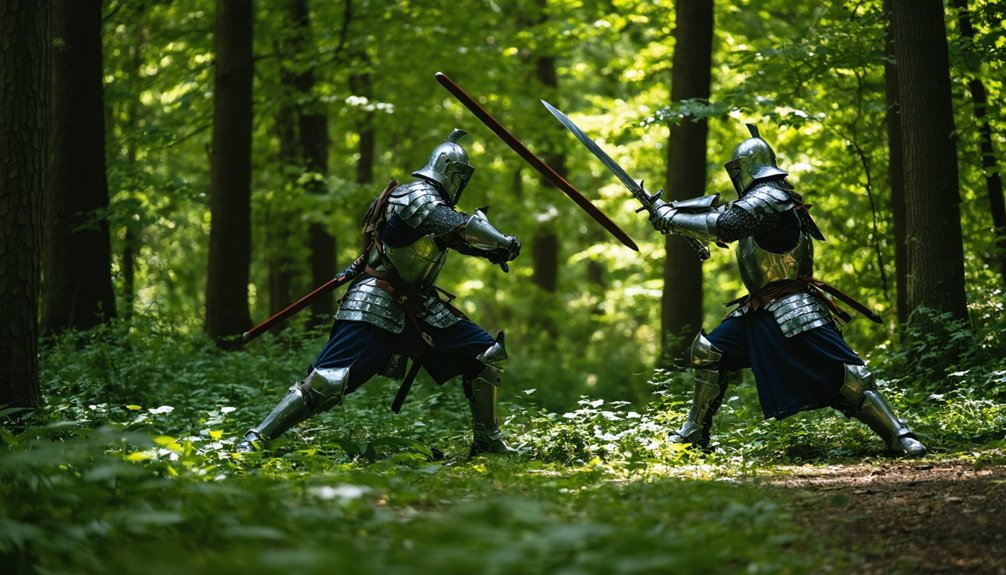
Controlling the distance between you and your opponent is one of the most decisive skills in LARP combat. Distance management determines whether your weapon reach works for or against you.
Distance management is the foundation of LARP combat. Master it, and your weapon becomes an advantage rather than a liability.
With a polearm or long weapon, you’re strongest when you keep opponents at the outer edge of your range. Let them close that gap, and you lose your primary advantage immediately.
Use diagonal movement to enter and exit range rather than stepping straight forward or backward. Sideways repositioning disrupts your opponent’s targeting while keeping you mobile.
If someone pushes inside your reach, shift your grip along the shaft to adapt. In group engagements, range discipline also prevents being flanked or surrounded.
Master spacing first, and every other tactical decision becomes considerably easier to execute.
Movement Tactics That Beat Larger LARP Groups
Range discipline keeps you competitive against a single opponent, but when numbers work against you, spacing alone won’t save you. You need movement tactics that exploit gaps, timing, and positioning.
Apply these principles against larger groups:
- Use silent footwork to reposition without telegraphing your next angle of attack.
- Execute strategic ambushes by isolating one opponent before their allies can respond.
- Move diagonally at 45-degree angles instead of retreating straight backward.
- Strike briefly, disengage immediately, and reset from an unexpected direction.
- Identify and hold choke points to compress enemy numbers into manageable engagements.
Every move you make should create local superiority before reinforcements arrive. You’re not fighting the whole group simultaneously — you’re engineering moments where their numbers temporarily don’t matter.
How to Run Small-Unit Tactics in Team LARP Battles

When your unit fights as a coordinated team rather than a loose collection of individuals, you multiply your effectiveness without adding a single fighter. Assign clear roles immediately: shield users anchor the front line, reach weapons attack through gaps, and skirmishers exploit flanks.
Group coordination breaks down when too many voices issue commands. Limit leadership to two or three designated callers and train everyone to respond instantly.
Leverage terrain advantages by funneling opponents through choke points like doorways or narrow passages, compressing their numbers to match yours. Use rally points to regroup after disruptions before enemy formations recover.
Pair shield fighters with polearm users so each covers the other’s vulnerabilities. Small units win through disciplined role execution, not headcount.
Frequently Asked Questions
How Do LARP Combat Rules Differ Between Various Event Organizations?
You’ll find that rules vary considerably across organizations—some restrict medieval armor ratings, others regulate weapon types differently. Always research your specific event’s rulebook so you’re adapting your tactical approach and innovative combat strategies accordingly before arriving.
What Safety Gear Is Required Before Participating in LARP Combat?
You’ll need to check your event’s safety protocols before stepping onto the field. Required protective equipment typically includes padded armor, closed-toe footwear, and groin protection, varying by organization, so confirm specifics with your event coordinators beforehand.
How Should Beginners Find Local LARP Groups to Practice Combat With?
Search Meetup, Facebook Groups, and Reddit’s LARP communities to find local groups. You’ll discover events where costume authenticity and role-playing techniques matter. Attend open practices systematically, observe combat formats, and integrate yourself strategically into active training circles.
Can Existing Martial Arts Training Translate Directly Into LARP Fighting?
Your martial arts training won’t translate directly, but it’s a strong foundation. Adapt your footwork and timing to medieval weapon techniques, refine combat endurance training, and systematically rebuild muscle memory around LARP-specific striking distances and defensive rules.
How Are Hits Judged or Scored During Competitive LARP Combat Events?
Rules vary widely, yet hit zones and scoring methods stay consistent: you’ll track strikes to valid body regions, with clean contact counting as points or wounds, turning every exchange into a tactical, measurable duel.
References
- https://www.reddit.com/r/LARP/comments/smj4ax/how_can_i_improve_my_larp_sword_fighting_and_axe/
- https://www.youtube.com/watch?v=fFot_Sh1hXU
- https://forums.profounddecisions.co.uk/t/larp-and-combat/5684
- https://www.reddit.com/r/LARP/comments/a2osqj/mixed_unit_tactics/
- https://www.reddit.com/r/LARP/comments/1hoion7/larp_tactics_for_big_battles/
- https://www.youtube.com/watch?v=13ON4sfUZlQ
- https://www.youtube.com/watch?v=vh0KO6MR1cg
- https://www.youtube.com/watch?v=TpDrEVS7dUE