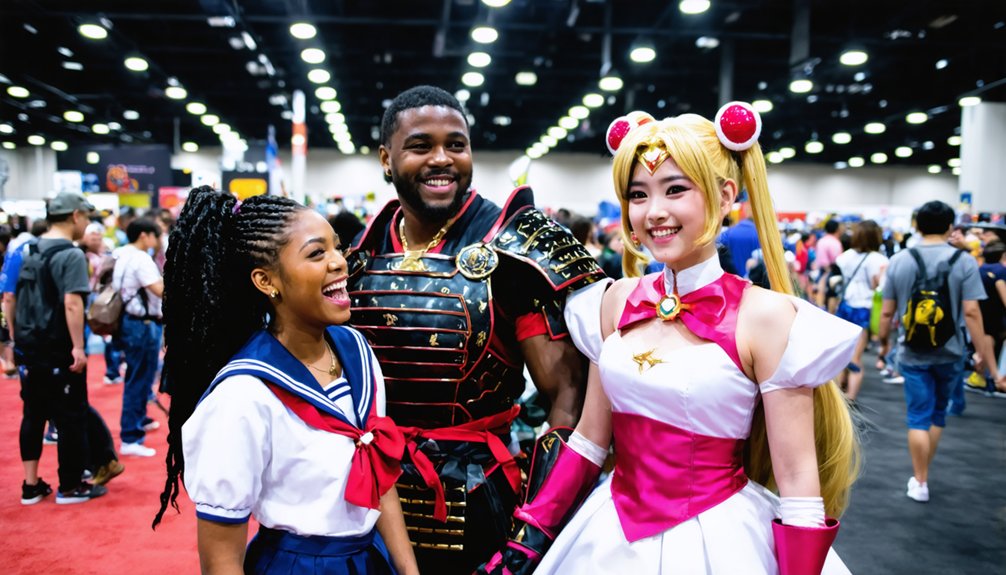
Embracing cultural diversity in cosplay fandom means recognizing that convention spaces are still mostly White (81.2%), leaving Latinx, Black, and Asian cosplayers steering through subtle marginalization. You’ll find that minority cosplayers aren’t just participating—they’re actively reshaping fandom narratives, reclaiming cultural identity, and building community where mainstream media falls short. Cosplay becomes a powerful tool for visibility, pride, and storytelling. There’s far more to uncover about how these communities are transforming fandom from the inside out.
Key Takeaways
- Cosplay fandom remains predominantly White (81.2%), highlighting significant opportunities for greater cultural diversity and inclusion within these spaces.
- Latinx cosplayers actively reimagine characters through cultural lenses, using cosplay as visibility, empowerment, and counter-narrative tools against media underrepresentation.
- Cultural fusion in costumes allows cosplayers to integrate personal heritage, transforming underrepresented narratives into meaningful community storytelling and folklore.
- Diversity initiatives like panels often fail to create structural change, as deeper hierarchies and privilege within fandom spaces remain largely unchallenged.
- Authentic cultural representation requires community-led initiatives and anti-racism frameworks to build genuinely inclusive, equitable cosplay environments for all participants.
Who Actually Shows Up to Cosplay Events?
Cosplay events draw a crowd that’s mainly White (81.2%), with Latino/Hispanic (5.1%), Asian (4%), Mixed race (6.2%), and African-American (0.8%) participants rounding out the demographic picture.
Cosplay skews heavily White at 81.2%, leaving rich demographic diversity still largely untapped at events.
The average cosplayer starts at 21.28 years old and brings roughly 6.77 years of experience to the floor.
These numbers reveal an opportunity you can’t ignore. Cultural representation remains uneven, meaning diverse voices and perspectives are still underutilized within the community.
When you actively engage cosplayers from different backgrounds, you unlock richer creative collaboration that pushes the art form forward.
Education levels across participants mirror the general population, signaling that cosplay attracts thoughtful, capable people.
You have the chance to champion inclusive spaces where every demographic feels empowered to show up, create boldly, and shape fandom culture together.
The Real Motivations Behind Cosplay Participation
When you ask cosplayers why they participate, the answers center on fun, creativity, and connection — much like joining a band or a sports team.
You’ll find that embodying a beloved character lets you explore personal identity while channeling genuine artistic expression.
You also build real community by sharing those experiences with friends and fellow fans who understand your passions.
Fun and Creative Expression
At its core, cosplay is about having fun—much like playing in a band or joining a sports team. When you step into a character, you’re engaging in creative storytelling that transcends simple imitation. You’re building something personal, meaningful, and uniquely yours.
Cosplay also invites cultural fusion, letting you weave your own heritage into beloved characters and narratives that mainstream media often overlooks. You’re not just wearing a costume—you’re crafting an identity that reflects who you’re and what you love.
Whether you’re driven by creativity, community, or self-exploration, cosplay meets you where you are. It’s a space where your LGBTQIA+ identity, cultural background, or personal passions don’t compete—they collaborate, producing something richer than any single story could tell alone.
Identity and Social Connection
Beyond the joy of creative expression, what pulls people back to cosplay year after year runs deeper—it’s about identity and connection. When you step into a character, you’re not just wearing a costume; you’re exploring who you’re and who you want to be.
For Latinx cosplayers and other marginalized communities, cultural authenticity becomes a powerful act. You’re reclaiming visibility that mainstream media consistently denies you.
Cosplay lets you infuse your heritage into beloved characters, making community representation tangible rather than theoretical.
The social bonds formed at conventions reinforce this. Whether you’re part of the LGBTQIA+ community or *exploring* ethnic identity, cosplay connects you with others who understand that shared experience.
You belong here—your identity matters, and this community reflects that.
Why Latinx Cosplayers Claim Space in a White-Dominant Fandom
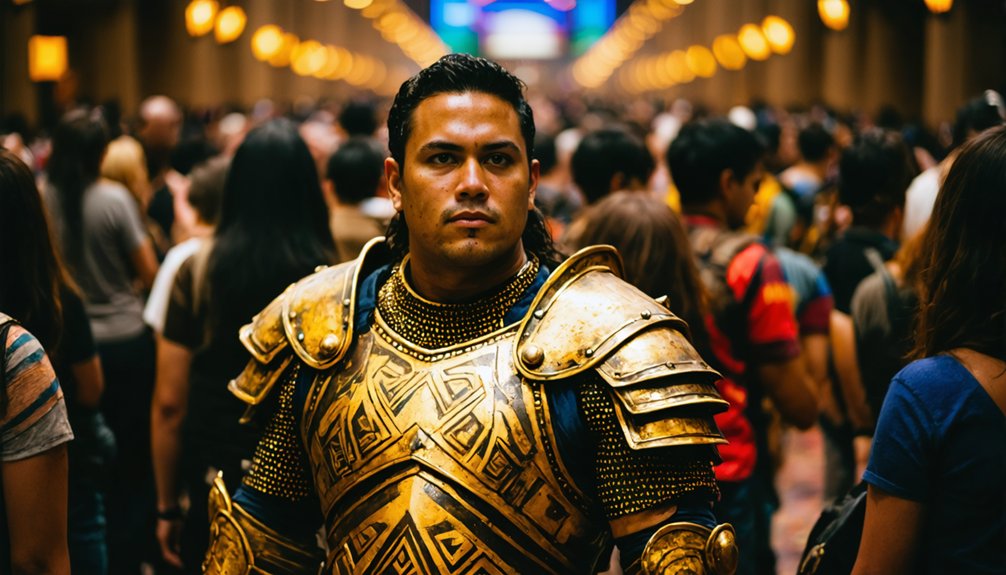
Despite making up 19% of the U.S. population, Hispanic and Latino individuals saw only 5.8% of speaking characters in mainstream film and television in 2022. That gap doesn’t just sting — it signals erasure.
19% of the population. 5.8% of the screen. The numbers don’t lie — that’s erasure.
LatinX cosplayers respond by claiming space in convention halls, transforming costumes into acts of cultural visibility.
When you infuse a beloved character with your heritage — through color choices, accessories, or storytelling — you’re not simply cosplaying. You’re reshaping the narrative.
You’re telling fandom who actually belongs here.
This practice fuels community empowerment, building solidarity among those navigating a predominantly White subculture.
Cosplay becomes a creative declaration: your culture isn’t a footnote. It’s central, vibrant, and worth celebrating — even when mainstream media hasn’t caught up yet.
How Cosplay Becomes a Tool for Cultural Pride
When you slip into a costume that echoes your cultural roots, you’re doing something far more than dressing up — you’re asserting that your heritage belongs in fandom. Cosplay lets you transform representation gaps into visible, living statements of cultural heritage.
Consider that Hispanic and Latino characters held only 5.8% of speaking roles in mainstream media in 2022, despite comprising 19% of the U.S. population. That imbalance pushes many Latinx cosplayers to reimagine beloved characters through their own cultural lens, infusing costumes with symbolism, textiles, and traditions that mainstream storytelling ignores.
You’re not just honoring a character — you’re expanding what that character can mean. In doing so, you’re actively reshaping fandom into a space where diverse identities aren’t tolerated; they’re celebrated.
What Racial Marginalization Still Looks Like at Conventions
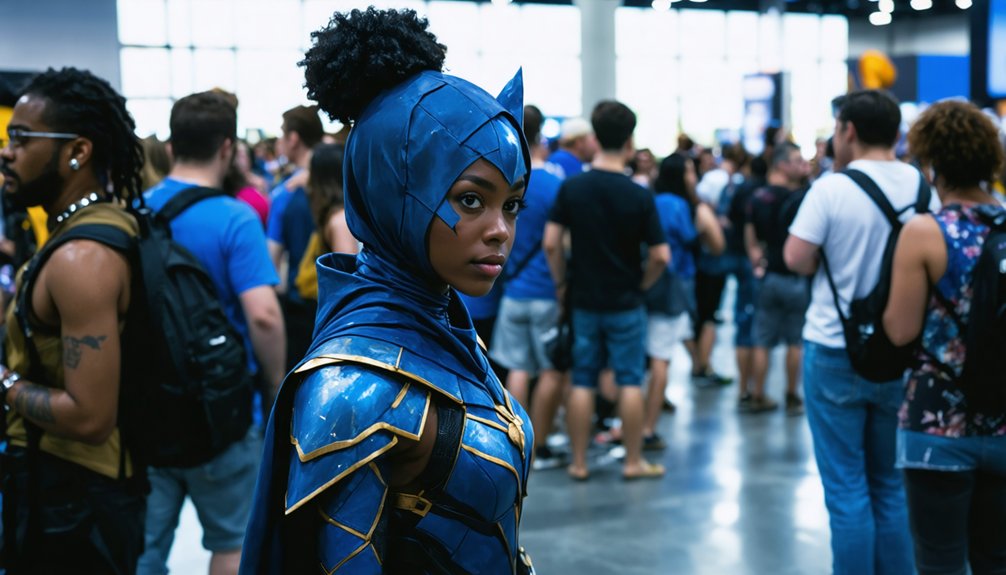
Cosplay’s power as a vehicle for cultural pride is real — but stepping into a convention hall can quickly reveal the limits of fandom’s supposed inclusivity. Systemic bias and cultural erasure don’t always announce themselves loudly — they operate subtly, shaping who feels welcome.
Here’s what racial marginalization still looks like today:
- Whiteness remains centered — diversity discussions rarely dismantle existing privilege structures.
- Minority cosplayers carry extra burdens — you’re expected to subvert marginalization while maneuvering through it simultaneously.
- Social and cultural capital follow racial lines — recognition isn’t distributed equally.
- Representation gaps persist — Hispanic/Latino characters held only 5.8% of speaking roles in 2022 despite representing 19% of the U.S. population.
Acknowledging these realities isn’t pessimism — it’s the first step toward building conventions that genuinely include everyone.
How Diversity Discussions Fail Minority Cosplayers
Conventions talk about diversity — but talking isn’t the same as dismantling. When you’re a minority cosplayer, you’ve likely noticed how diversity panels and inclusion statements rarely translate into structural change. White attendees continue reproducing privilege unconsciously, while you’re expected to perform subversion just to belong.
Representation gaps don’t disappear because a convention adds a diversity panel to its schedule. Cultural authenticity gets celebrated on stage yet dismissed in practice when marginalized cosplayers face subtle erasure on the convention floor.
You deserve spaces where inclusion isn’t performative. Real progress requires conventions to actively challenge the hierarchies sustaining racial and gender stratification — not simply acknowledge they exist.
Until then, diversity discussions risk becoming another mechanism that maintains the very barriers they claim to address.
Cosplay as Folklore for Communities Mainstream Media Ignores
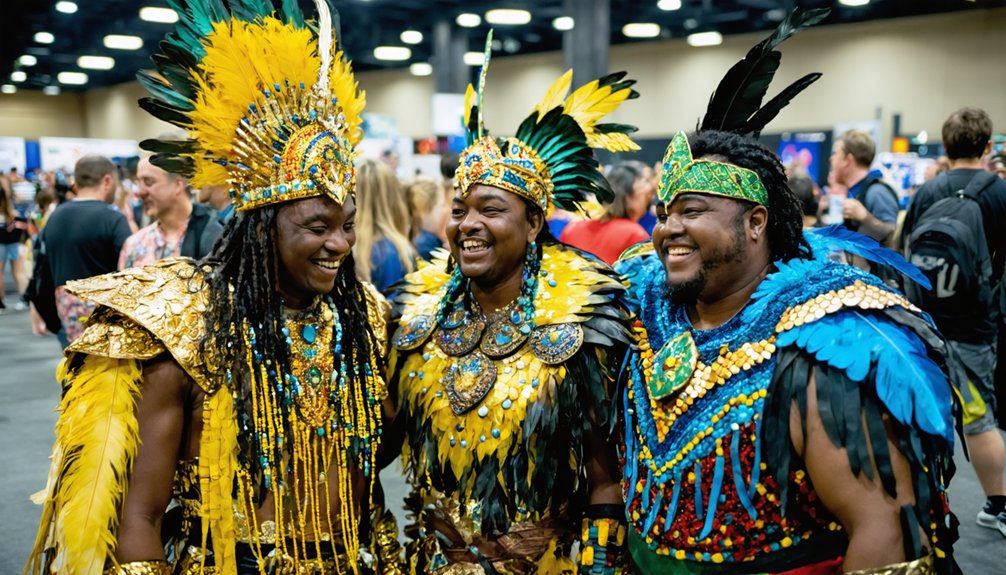
Beyond the failures of convention spaces, something more powerful takes shape in the practice itself. Cosplay transforms popular culture into folklore adaptation, giving communities mainstream media ignores a vibrant language for cultural storytelling.
When you cosplay, you’re participating in a living tradition that:
- Converts underrepresented narratives into accessible community expression
- Infuses beloved characters with authentic cultural heritage
- Creates liminal spaces where identity experimentation thrives openly
- Builds collective meaning outside mainstream media’s limited scope
For Latinx cosplayers especially, this matters deeply. With Hispanic/Latino characters representing only 5.8% of speaking roles despite comprising 19% of the US population, cosplay becomes your counter-narrative tool. You’re not just wearing a costume—you’re actively reshaping whose stories get told and how communities recognize themselves within fandom.
LGBTQIA+ Identity Expression in Cosplay Fandom
When you step into a cosplay space, you’re entering an environment where LGBTQIA+ identities can be explored and expressed freely through character embodiment.
You’ll find that the liminal nature of conventions creates room for gender experimentation and self-discovery that everyday spaces often don’t allow.
Whether you’re cosplaying a character whose identity mirrors yours or one that lets you explore something new, fandom communities actively support that journey.
Cosplay Enables LGBTQIA+ Expression
Cosplay’s liminal space offers LGBTQIA+ individuals a powerful outlet for identity exploration and expression that everyday life often doesn’t allow. Convention floors become transformative stages where queer visibility thrives and gender performance breaks free from societal constraints.
You’ll find cosplay uniquely empowers LGBTQIA+ participants by:
- Exploring gender identity through costume choices that reflect your authentic self
- Building community with others who share similar lived experiences and intersectional identities
- Challenging binary norms by reimagining characters across gender expressions and sexual identities
- Practicing self-acceptance in a supportive environment before translating that confidence into everyday life
These opportunities don’t just enrich individual experiences—they reshape fandom culture itself, pushing conventions toward more inclusive spaces where every identity receives genuine celebration and recognition.
Fandom Spaces Foster Identity Exploration
Fandom spaces don’t just welcome LGBTQIA+ individuals—they actively cultivate environments where identity exploration becomes possible on your own terms. When you step into a convention, you’re entering a liminal space where identity performance becomes a creative act rather than a social risk.
Cosplay amplifies this freedom by intertwining cultural representation with personal expression. You’re not simply wearing a costume—you’re authoring a version of yourself that mainstream spaces rarely accommodate. Ethnographic research confirms that cosplayers leverage these community spaces to explore gender, sexuality, and cultural identity simultaneously.
For LGBTQIA+ cosplayers *navigating* intersecting identities, fandom offers something uniquely powerful: visibility without judgment. You can embody characters that resonate with your authentic self, transforming convention floors into active sites of meaningful, community-supported self-discovery.
What Latinx and Minority Cosplayers Need From Global Fandom Spaces
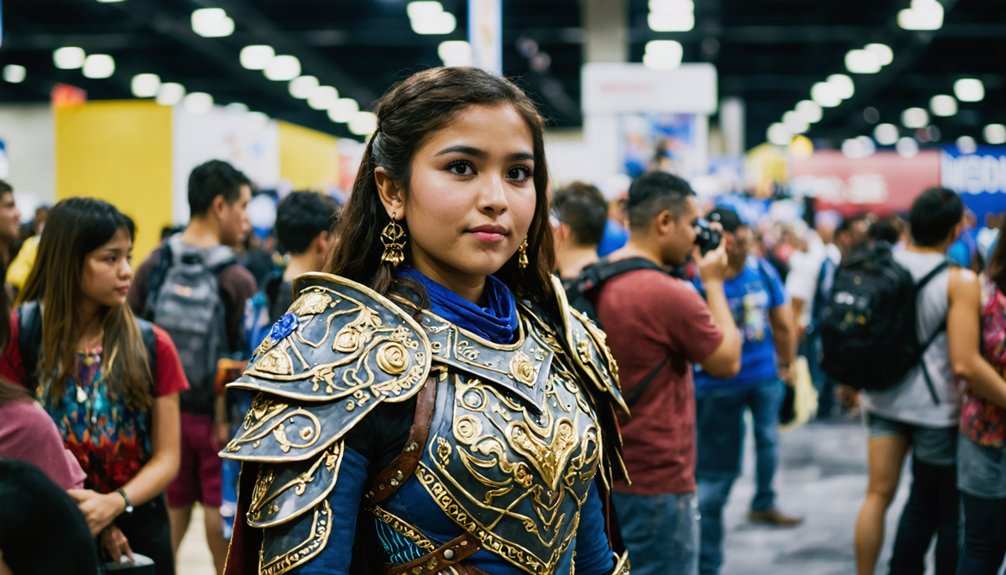
Though global fandom spaces have grown increasingly connected, Latinx and minority cosplayers still navigate systems that center Whiteness while sidelining their cultural identities. Shifting power dynamics requires intentional structural change, not just surface-level inclusion.
Fandom’s growing connectivity means little if its systems still center Whiteness and push minority voices to the margins.
You can advocate for what truly matters by demanding:
- Authentic cultural representation in mainstream media and convention programming
- Equitable visibility for Latinx and minority cosplayers in competitions, panels, and spotlights
- Anti-racism frameworks embedded into convention policies, not just diversity statements
- Community-led spaces where marginalized cosplayers shape narratives on their own terms
These aren’t optional additions—they’re necessities. When fandom communities actively dismantle privilege structures, they create environments where everyone’s cultural identity fuels creativity rather than becomes a barrier to belonging.
Frequently Asked Questions
How Does Cosplay Participation Impact Mental Health Among Minority Communities?
When you’re part of a minority community, cosplay’s community support can boost your mental health awareness by offering belonging, identity expression, and a safe space where you’re celebrated, not marginalized.
What Role Do Cosplay Competitions Play in Reinforcing Racial Hierarchies?
Competing carries complex consequences—you’ll notice cosplay competitions can reinforce racial hierarchies through cultural appropriation and racial stereotypes, where whiteness gains social capital while marginalized cosplayers face biased judging, underscoring the need for intersectional, equitable evaluation standards.
How Do Convention Organizers Financially Benefit From Diversity Marketing Efforts?
You’ll find that convention organizers leverage diversity initiatives to drive economic growth by attracting broader audiences, boosting ticket sales, and securing sponsorships—yet these efforts don’t always dismantle existing racial hierarchies within fandom spaces.
What Specific Costume Choices Reflect Cultural Pride Among Latinx Cosplayers?
Like a vibrant tapestry woven from ancestral threads, you’ll find Latinx cosplayers blending cultural authenticity into beloved characters through traditional attire—infusing costumes with indigenous patterns, folkloric textiles, and heritage-inspired designs that boldly counteract mainstream media’s chronic underrepresentation.
How Do Online Fandom Spaces Differ From In-Person Convention Experiences Culturally?
Online fandom spaces let you build community representation globally, breaking geographic barriers, while in-person conventions offer embodied cultural authenticity through direct interaction. You’ll find both uniquely amplify Latinx voices, though conventions sometimes reinforce existing privilege structures.
References
- https://intensitiescultmedia.com/wp-content/uploads/2013/07/expressions-of-fandom-findings-from-a-psychological-survey-of-cosplay-and-costume-wear-robin-s-rosenberg-and-andrea-m-letamendi.pdf
- https://www.scribd.com/document/292633302/Cultural-Dynamics-of-Cosplay-and-Doujinshi
- https://www.dailydot.com/pop-culture/fandom/psychology-cosplay-survey-results/
- https://mars.gmu.edu/server/api/core/bitstreams/1565b4a0-daf9-4e6b-b882-7338d4b5523a/content
- https://www.comicsbeat.com/eventbrite-survey-conventions-have-achieved-gender-parity-but-some-still-feel-unwelcome/
- https://etheses.whiterose.ac.uk/id/eprint/25835/1/AMB Final thesis PDF (1).pdf
- https://www.jams.media/en/ajjm_2019/pdf/tanaka_toko.pdf
- https://fansconference.org/dRuZ33A/wp-content/uploads/2013/07/Cosplay-A-Transnational-Fan-Community-by-Karen-Heinrich.pdf
- https://scispace.com/pdf/embodying-cosplay-fandom-communities-in-the-usa-o1s99lq5kk.pdf
- https://netlibrary.aau.at/obvuklhs/content/titleinfo/7643412/full.pdf