To match contact lens colors to your character, start by analyzing official artwork for precise eye color data, then identify whether the tones are warm or cool. Cross-reference your skin undertones—warm skin pairs with amber or hazel lenses, while cool undertones suit blue, gray, or violet. Match lens diameter to the character’s eye style and test everything under convention lighting. There’s more to getting it exactly right.
Key Takeaways
- Analyze official character artwork to identify precise eye colors, including warm or cool undertones, before selecting your cosplay lenses.
- Match lens colors to your skin undertones: warm undertones suit amber or hazel, while cool undertones suit blue, gray, or violet.
- Choose lens diameter based on character style: 14–14.2mm for realistic characters, 14.5–15mm for anime, and 16mm+ for doll-eye effects.
- Test lenses under bright expo-style lighting at least one week before the event to evaluate color accuracy and comfort.
- Coordinate eye makeup, including shadow and eyeliner, to complement your lenses without competing with their color or effect.
How To Match Cosplay Lens Color To Your Character’s Official Design
Matching your cosplay lens color to a character’s official design requires examining three core visual attributes: eye shade, pupil style, and brightness level.
Start by analyzing official artwork to extract precise color data, since character design often uses stylized hues that don’t translate directly to standard lens catalogs. Apply color theory principles when bridging that gap—identify whether the eye color carries warm or cool undertones, then cross-reference with your skin undertones and costume harmony requirements.
Stylized character hues rarely match standard lens catalogs—bridge the gap with color theory and undertone analysis.
Lighting conditions at conventions dramatically shift lens appearance, so test your selection under bright, simulated expo lighting before committing.
Your aesthetic goals should also reflect character personality—a fierce warrior demands bolder eye enhancement than a soft-spoken protagonist. Strategic lens selection elevates visual impact and guarantees your entire look reads authentically from stage distance.
How Does Your Skin Tone Change Which Lens Colors Work?
Skin tone directly influences which lens colors create harmony versus visual conflict on your face. Start with skin undertone analysis to identify whether you’re warm, cool, or neutral.
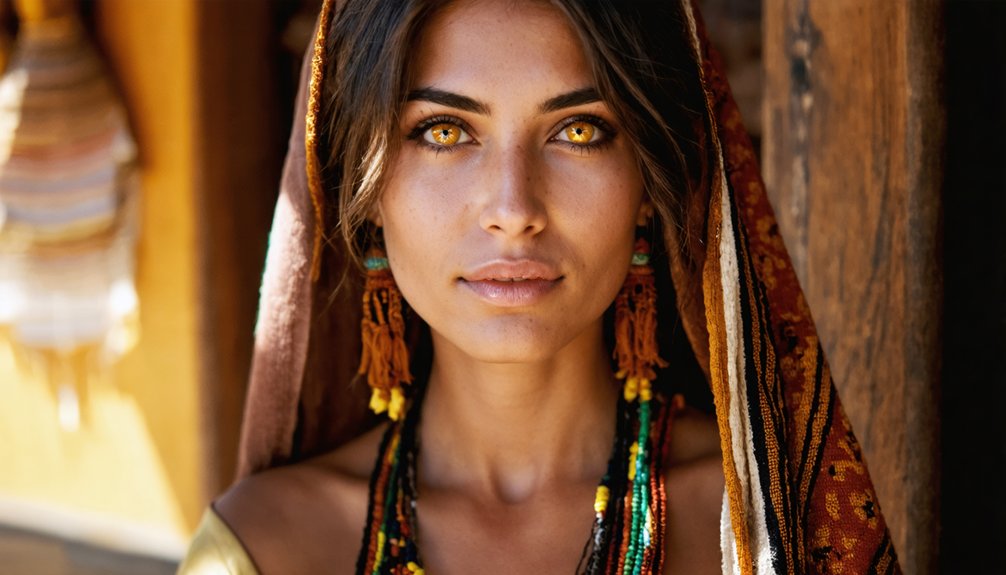
Warm undertones, indicated by golden or yellowish hues, pair effectively with hazel, honey, or amber lenses. Cool undertones, reflected through pink or bluish hues, complement blue, gray, violet, or green options. Neutral undertones support broad lens color experimentation across virtually any palette.
Use the jewelry test as a reliable diagnostic tool — gold flatters warm undertones while silver enhances cool ones. Applying this framework prevents mismatched combinations that distort your overall cosplay aesthetic.
Once you’ve identified your undertone category, you can strategically select lenses that enhance both your natural complexion and your character’s intended visual identity.
Which Lens Colors Complement Your Costume’s Color Palette?
When selecting contact lens colors for cosplay, you’ll want to pull directly from your costume’s dominant color palette to create a unified look.
If your outfit features deep blues and silvers, matching your lenses to those hues reinforces visual cohesion rather than creating competing focal points.
Avoid pairing warm-toned lenses with cool-dominant costumes, as the clash can undermine the overall aesthetic impact of your character portrayal.
Matching Lens To Costume
Choosing the right lens color for your costume starts with identifying the dominant hues in your outfit’s color palette. Once you’ve pinpointed those tones, select lenses whose color intensity aligns with your character theme rather than competing against it.
Warm-toned costumes pair effectively with amber or honey lenses, while cooler palettes benefit from violet, blue, or gray options.
Consider lighting effects specific to your event environment, since expo hall brightness can shift how lens materials appear on camera versus in person.
Coordinate your makeup to reinforce the lens choice, ensuring visual impact stays cohesive. Before committing, conduct trial runs to perform a thorough comfort assessment and confirm eye safety standards are met.
Make aesthetic adjustments based on real-world performance, not assumptions alone.
Avoiding Color Clashes
Beyond matching lens intensity to your costume’s theme, you’ll also need to identify which specific color combinations actively clash and which ones create visual harmony.
Color theory provides a structured framework for achieving lens harmony within your character palette. Complementary colors—opposites on the color wheel—create high contrast techniques that amplify lens impact, while analogous combinations deliver softer aesthetic alignment.
Color psychology directly influences how audiences perceive your character’s emotional tone, making thematic consistency vital. You’ll want to evaluate color perception under expo lighting, since artificial environments shift hues unexpectedly.
Avoid pairing warm-toned lenses with cool-dominant costumes unless intentionally creating visual tension. Prioritizing visual balance between your lens selection and costume materials guarantees your overall look achieves precise, purposeful aesthetic alignment rather than unintentional discord.
What Lens Diameter Matches Your Character’s Eye Style?
When selecting your lens diameter, you’ll want to match the enlargement level to your character’s eye style.
With 14.0mm–14.2mm delivering natural enhancement for realistic human characters.
If you’re cosplaying an anime character, you’ll need 14.5mm–15.0mm lenses to replicate that signature wide-eyed enlargement effect.
For doll-eye transformations requiring the most dramatic impact, opt for 16mm+ lenses that create an exaggerated, oversized iris appearance.
Natural Enhancement Diameter Range
Lens diameter directly shapes how dramatically your eyes read on camera and in person, so matching it to your character’s eye style is a technical decision that affects the entire look.
For characters with realistic, human-proportioned eyes, natural enhancement through a controlled lens diameter is the right approach.
Choose this range when your character requires:
- Subtle iris expansion that reads as authentically human rather than stylized
- Defined color payoff without exaggerating the limbal ring beyond natural proportions
- Consistent wearability across long convention hours without visual fatigue
A 14.0mm–14.2mm lens diameter delivers natural enhancement by widening the iris slightly while preserving anatomical believability.
It’s the technically precise choice for grounded, realistic characters who don’t rely on exaggerated eye size for their identity.
Anime-Style Enlargement Options
Anime characters typically feature eyes that are disproportionately large relative to realistic human anatomy, so replicating that aesthetic requires a lens diameter that pushes well past the natural enhancement range. For authentic anime eye styles, you’ll want lenses between 14.5mm and 15.0mm. This range amplifies the iris-to-white ratio, producing the signature dolled-out look central to character eye shapes in manga-inspired designs.
Leverage lens contrast techniques by selecting high-pigmentation lenses that maximize color saturation effects under expo lighting. Darker limbal rings printed onto the lens edge sharpen definition and intensify the enlargement illusion further.
If you’re portraying characters with particularly dramatic eyes, 15.0mm remains your practical ceiling before comfort compromises become significant. Always prioritize oxygen-permeable materials at this diameter to maintain corneal health during extended wear.
Dramatic Doll-Eye Selection
For the most extreme enlargement effects, 16mm+ lenses deliver the dramatic doll-eye transformation that hyper-stylized characters demand.
When you’re targeting intense character expression, these lenses create unmatched lens contrast against your natural iris, making your eyes visually dominant in any setting.
Apply these doll eye techniques strategically:
- Select 16mm+ diameters for characters with impossibly wide, dramatic effects that defy realistic proportions.
- Maximize lens contrast by pairing bold, saturated colors against deeper skin tones for heightened visual intensity.
- Coordinate eye makeup with heavy liner and false lashes to reinforce the enlarged silhouette convincingly.
These lenses aren’t subtle tools — they’re architectural statements.
Confirm oxygen-permeable materials support extended wear, since achieving authentic character expression should never compromise your eye health.
How To Choose Between Natural Enhancement and Full Anime Enlargement
Whether you’re aiming for subtle realism or full anime-style drama, the diameter of your contact lenses determines how transformative your final look will be.
For natural vs. dramatic decisions, start by analyzing your character’s eye design closely. Natural enhancement lenses, typically 14.0mm–14.2mm, slightly define the iris without altering your fundamental appearance. Full anime enlargement lenses, ranging from 14.5mm–15.0mm, create the wide-eyed intensity essential for high-impact cosplay characters.
Lens comfort should factor heavily into your selection, especially for extended wear at conventions. Larger diameters can reduce oxygen flow if material quality is compromised.
Always prioritize high-oxygen-permeable materials regardless of size. Conduct a trial session before your event to confirm both aesthetic accuracy and physical comfort under prolonged wearing conditions.
Are The Cosplay Lenses You’re Buying Actually Safe?
How carefully you vet your lens source could mean the difference between a flawless cosplay and a serious eye injury. Lens safety isn’t optional—it’s foundational to protecting your eye health.
Vetting your lens source carefully isn’t optional—it’s the line between a flawless cosplay and a serious eye injury.
Prioritize these three critical factors:
- FDA approval and seller reputation — Only purchase from verified retailers selling clinically tested lenses with confirmed material quality standards.
- Moisture retention and irritation prevention — Confirm oxygen-permeable materials that sustain comfort assessment throughout extended wear without compromising corneal health.
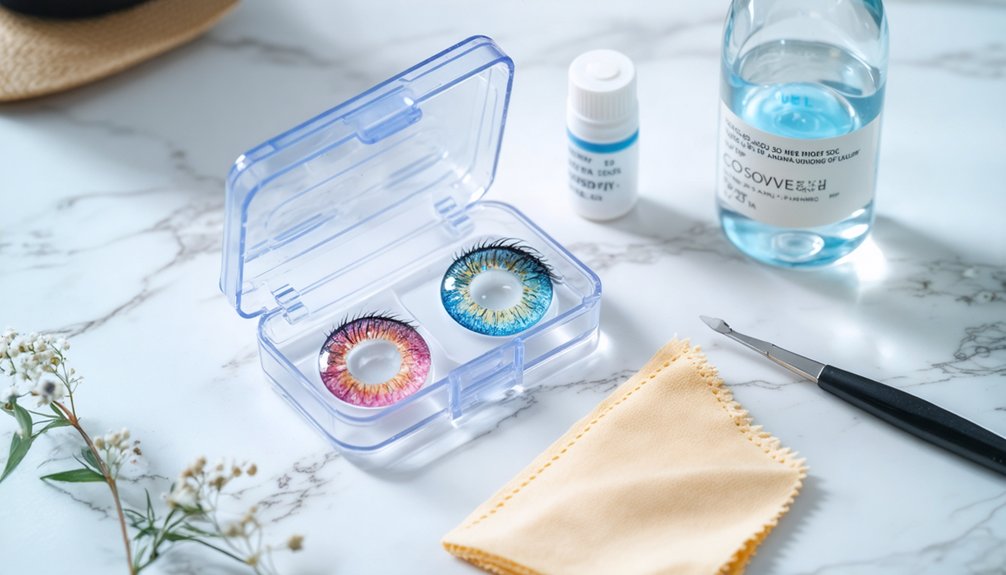
- Hygiene practices and trial fitting — Clean lenses using manufacturer-approved solutions and complete a trial fitting before your event.
Skipping these steps risks corneal abrasions, infections, or permanent vision damage.
You’re investing in your cosplay’s visual impact—don’t let compromised lenses destroy both your look and your long-term eye health.
How To Test Cosplay Lens Colors Before the Convention
Once your lenses pass the safety check, testing their visual performance before convention day prevents costly last-minute surprises. Schedule a trial testing session at least one week prior, wearing your lenses for four to six hours to evaluate lens comfort and monitor eye health responses.
Photograph yourself under varied lighting effects—natural, fluorescent, and LED—to assess accurate color perception and visual impact across environments. This reveals how lens durability holds under extended wear conditions.
Simultaneously practice lens cleaning routines to build consistency and prevent contamination. Coordinate your full makeup application during the trial to confirm makeup coordination enhances rather than conflicts with your iris color.
Analyze photos critically to guarantee your chosen lenses authentically support character expression, making real-time adjustments before the convention demands perfection.
Eye Makeup Choices That Make Your Lens Color Stand Out
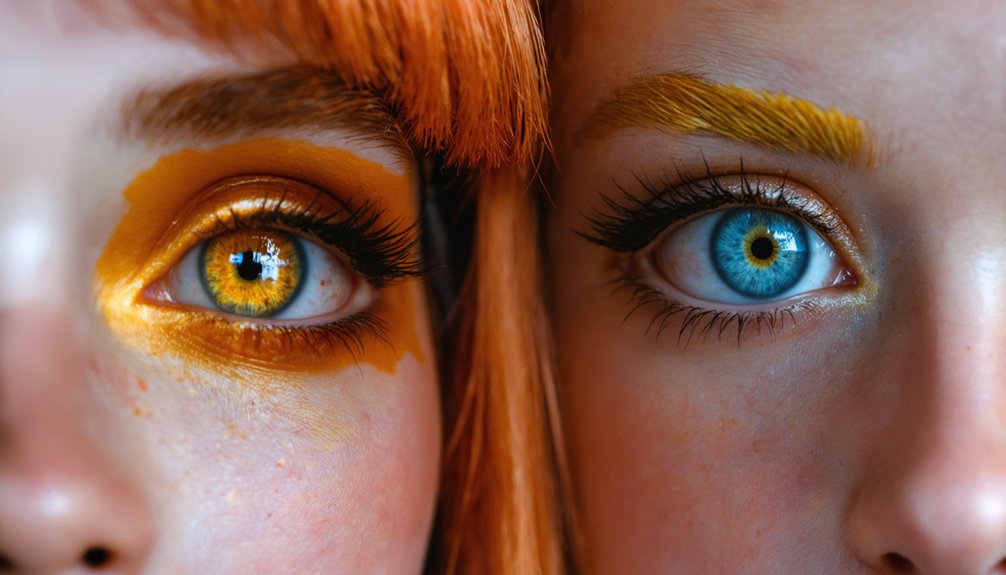
Eye makeup amplifies your lens color when you apply it with intentional contrast and coordination. Strategic makeup blending, brow definition, and foundation matching create a unified canvas that makes your lenses the focal point.
Eye makeup transforms your lens color into a statement when applied with purposeful contrast and strategic coordination.
- Intensify depth — Apply complementary eye shadow tones and eyeliner styles that frame your iris, pulling attention directly to your lens color.
- Elevate dimension — Use mascara techniques alongside highlight placement and contouring tips to sculpt your eye area, making colored lenses appear larger and more vivid.
- Balance the face — Coordinate blush application and lip color to echo your lens hue without competing with it, creating full-face harmony.
These targeted techniques guarantee your lenses command attention under any convention lighting condition.
Why Your Cosplay Lens Color Looks Off: And How To Fix It
When your cosplay lens color looks off, it’s usually because of a mismatch between the lens tint, your natural eye color, and the lighting conditions around you.
Low lens brightness dulls character expression, while insufficient color saturation weakens costume contrast. You’ll need to assess your skin undertone to confirm you’re selecting a hue that creates genuine color harmony rather than visual conflict.
Poor eye enlargement choices can also distort aesthetic balance, making lenses appear unnatural against your facial proportions. Test lighting effects under expo-accurate conditions before your event.
Prioritize lens comfort alongside appearance, since discomfort causes squinting that disrupts your overall look. Adjust makeup intensity, revisit diameter sizing, and verify that your lens opacity matches the character’s reference art precisely.
Frequently Asked Questions
Can Colored Contact Lenses Be Worn Over Prescription Lenses Simultaneously?
You can’t wear colored contacts over prescription lenses simultaneously. Instead, you’ll want prescription-tinted lenses that merge both lens types, offering diverse color combinations while correcting your vision safely and innovatively in a single, comfortable solution.
How Long Can Cosplay Lenses Safely Stay in During One Wear?
Sure, wear them for 24 hours straight—said no eye doctor ever! For safe wear duration, you should limit cosplay lenses to 8 hours maximum, follow lens safety tips, and remove them immediately if discomfort occurs.
Do Cosplay Lenses Expire Faster When Stored in Certain Climates?
Yes, extreme heat and humidity accelerate your cosplay lenses’ degradation. You’ll compromise lens longevity if storage conditions aren’t controlled. Store them in a cool, dry environment to maintain solution integrity and extend their safe usability.
Can Two Different Colored Lenses Be Worn for Heterochromia Characters?
Yes, you can wear two different colored lenses to achieve heterochromia effects. This lens color pairing technique enhances character authenticity by replicating mismatched irises accurately. Make certain you’re selecting comfortable, FDA-approved lenses for each individual eye.
Are Cosplay Lenses Suitable for People With Sensitive or Dry Eyes?
Why risk discomfort at your biggest event? If you’ve got sensitive or dry eyes, you can still wear cosplay lenses—prioritize high moisture retention materials and conduct sensitivity testing beforehand to guarantee all-day comfort.
References
- https://blog.hapakristin.us/personal-color-matching-colored-contacts
- https://ojotrend.com/blogs/news/colored-contacts-character-cosplay
- https://contactlenshq.com/colored-contact-lenses-colors/
- https://houseofcoco.net/how-to-coordinate-your-cosplay-contact-lenses-with-your-hair-color-and-style/
- https://www.contactsamerica.com/vision/how-to-choose-colored-contact-lenses-that-match-your-skin-tone/
- https://www.lens.me/blog/how-to-choose-the-best-colored-contacts-for-your-eyes
- https://www.youtube.com/watch?v=GE1Y5wH7XME
- https://www.lens.com/eyestyle/makeup-fashion/the-beauty-guide-for-colored-contact-lenses/
- https://www.lens.com/halloween-contact-lenses/
- https://tolytolly.com/blogs/new-1/what-are-cosplay-contact-lenses-beginners-guide