Famous cosplay photographers like Eurobeat Kasumi inspire posing creativity because they’ve developed distinct visual languages built around character authenticity. They study fandom lore, iconic stances, and source material to craft poses that casual shooters miss entirely. You’ll notice their work translates personality, tension, and backstory into a single frame through deliberate angles, lighting, and body language. Exploring their techniques reveals a deeper system for transforming cosplay photography into genuine character storytelling.
Key Takeaways
- Famous cosplay photographers introduce innovative posing styles that challenge conventional approaches, pushing creative boundaries and inspiring others to experiment boldly.
- Studying their unique composition techniques reveals new ways to frame characters, enhancing visual storytelling and dynamic image creation.
- Their angle experimentation demonstrates how perspective shifts can dramatically transform a cosplay subject’s presence and narrative impact.
- Analyzing their post-production techniques shows how editing choices amplify mood, inspiring photographers to explore creative visual enhancement methods.
- Their influential work establishes recognizable posing standards that motivate cosplay photographers to develop distinctive, original creative signatures.
How Top Cosplay Photographers Nail Character-Accurate Poses
Nailing character-accurate poses starts long before the camera clicks. You’ll want to study fandom wikis, screenshots, and source material to identify each character’s iconic stances. Analyze their personality — dynamic fighters require tension-filled positions, while stoic characters demand stillness and weight.
Capturing character-accurate poses begins with deep research — study screenshots, wikis, and source material before the shoot ever starts.
Examine costume details closely. Specific props, armor pieces, or accessories dictate hand placement and body tension, so your direction should highlight those elements intentionally. A misaligned prop breaks character authenticity immediately.
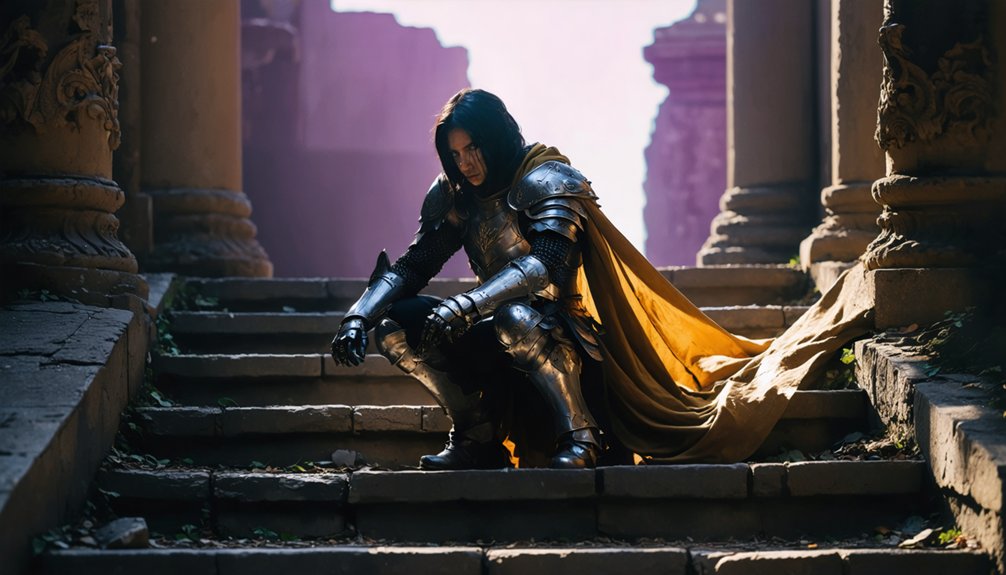
Environmental storytelling strengthens every shot. Match your shooting location to the character’s lore — fitting backgrounds reinforce mood and deepen narrative impact without requiring extensive post-editing.
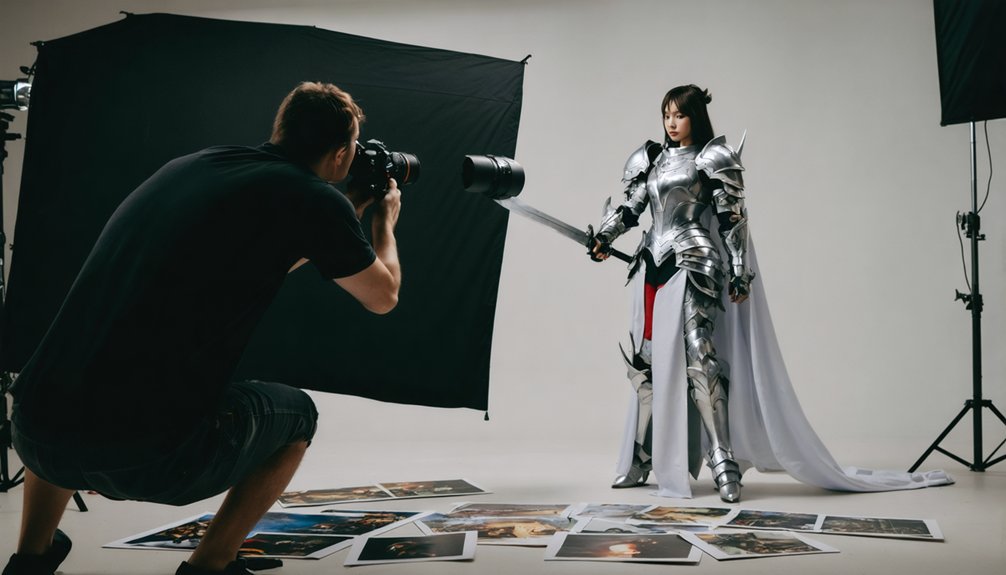
Before shooting, discuss goals directly with your cosplayer. You’re responsible for translating 3D positioning into compelling 2D compositions, so communicate clearly, direct confidently, and experiment with unconventional angles that transform accurate poses into genuinely striking images.
Why Knowing Your Character Makes Every Pose More Convincing
When you research your character’s personality, backstory, and behavioral traits, you transform generic posing into precise, lore-accurate storytelling that resonates with fellow fans.
You’ll find that matching your stance, expression, and body tension to your character’s canonical moments creates an undeniable authenticity that elevates the photograph beyond simple costume display.
Your props aren’t accessories—they’re narrative anchors that dictate how you hold your body, where your weight shifts, and how convincingly you inhabit the character’s world.
Researching Character Personality Deeply
Capturing a character’s essence starts long before you pick up your camera or step into costume. You’ve got to dig into who the character is — their motivations, emotional range, and behavioral patterns. Study fandom wikis, episode screenshots, and official artwork to decode their typical stances and expressions.
Costume accuracy matters here too. Understanding specific design elements helps you determine which poses highlight those details most effectively. A warrior’s armor demands a powerful, grounded stance; a scholar’s robes suggest stillness and contemplation.
Environmental storytelling deepens this further. When you understand a character’s world, you instinctively recognize which backdrops reinforce their narrative. That contextual knowledge transforms a simple pose into something emotionally resonant.
Researching personality isn’t optional — it’s the technical foundation every compelling cosplay photograph is built on.
Matching Poses To Lore
Character lore is your posing blueprint. When you understand a character’s backstory, powers, and personality, every stance becomes intentional rather than accidental. You’re not just wearing a costume—you’re embodying a narrative.
Use fandom insights to decode how your character stands during combat, rest, or emotional tension. A stoic warrior holds stillness differently than a chaotic trickster. These distinctions transform generic poses into character-specific storytelling.
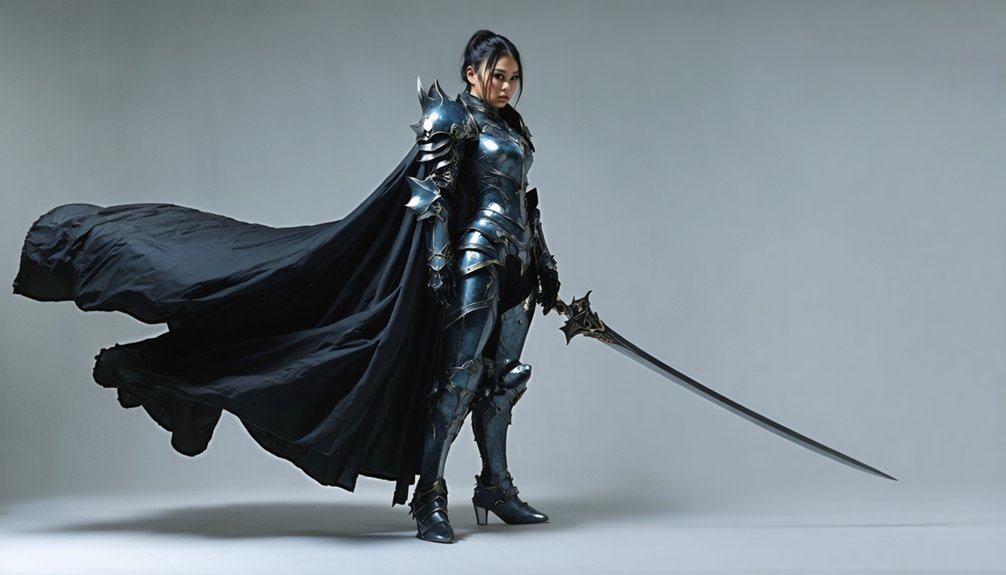
Costume accuracy reinforces this process. When your gear matches canonical details, specific poses naturally highlight those elements—a cape that flows during a powerful stance, armor that reads correctly under a dramatic angle.
Study screenshots, official artwork, and wiki references before your shoot. You’ll arrive knowing exactly which postures communicate your character’s essence, giving your photographer precise direction to execute something genuinely compelling.
Props Reinforce Character Authenticity
Props don’t just complete a costume—they anchor your body into character-specific tension. When you grip a weapon, shield, or artifact with intentional force, your entire posture shifts authentically. That physical commitment signals character ownership beyond cosplay makeup and costume craftsmanship alone.
Study how your character actually holds their prop. A warrior’s sword demands different hand tension than a mage’s staff. That distinction transforms a generic stance into a recognizable, lore-accurate moment.
Photographers use props to dictate hand placement, weight distribution, and body lean, eliminating guesswork during direction. Let the prop’s size and function inform your pose organically.
A heavy prop justifies braced legs; a delicate prop invites precise, controlled finger positioning. Props fundamentally become technical posing tools, reinforcing character authenticity through deliberate physical storytelling.
How Photographer-Cosplayer Communication Unlocks Better Poses
When photographer and cosplayer align on a shared vision before the shoot begins, the resulting poses feel intentional rather than accidental. Discuss costume details and environmental context during pre-shoot planning so both parties understand the narrative each frame must deliver.
Pre-shoot alignment transforms accidental snapshots into intentional storytelling through shared costume and environmental understanding.
You should clearly communicate your desired shots, eliminating poses that feel unnatural or uncomfortable. Trust your photographer’s directional instincts since 3D positioning often translates poorly into 2D without technical correction.
Photographers carry responsibility for guiding accurate angles, but you carry responsibility for honest feedback. This mutual exchange unlocks dynamic poses neither party would’ve reached independently.
Establishing cheerful, relaxed energy between both collaborators produces authentic performances rather than stiff imitations. Treat each shoot as a creative dialogue, and your final images will reflect that precision-driven artistic partnership.
Angle Tricks That Make Cosplay Photos Look Bigger and Bolder
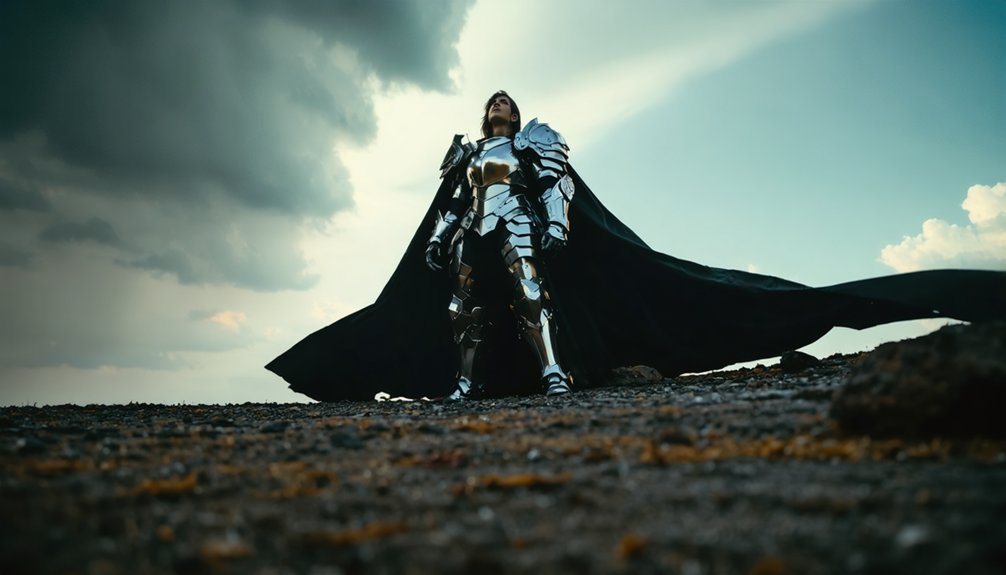
Angle selection transforms an ordinary cosplay shot into a visually commanding image that amplifies your character’s presence. Dynamic angles redefine your subject’s scale and authority within the frame.
Shooting upward makes shorter cosplayers embody towering characters convincingly, while downward angles compress oversized props into controlled, powerful compositions.
You’ll want to experiment with perspective tricks that push beyond standard eye-level framing. Position your camera low and tilt slightly to create imposing silhouettes against dramatic skies.
Back-lighting combined with steep angles introduces lens flare that intensifies action poses authentically.
Don’t treat every location as a flat backdrop. Use architectural lines, staircases, and overhead structures to guide the viewer’s eye toward your subject strategically.
Each angle adjustment reshapes how boldly your character commands the photograph.
Lighting Techniques That Make Cosplay Poses Come Alive
When shooting outdoors, you’ll find that natural light preserves your costume’s true colors far better than a camera flash ever will.
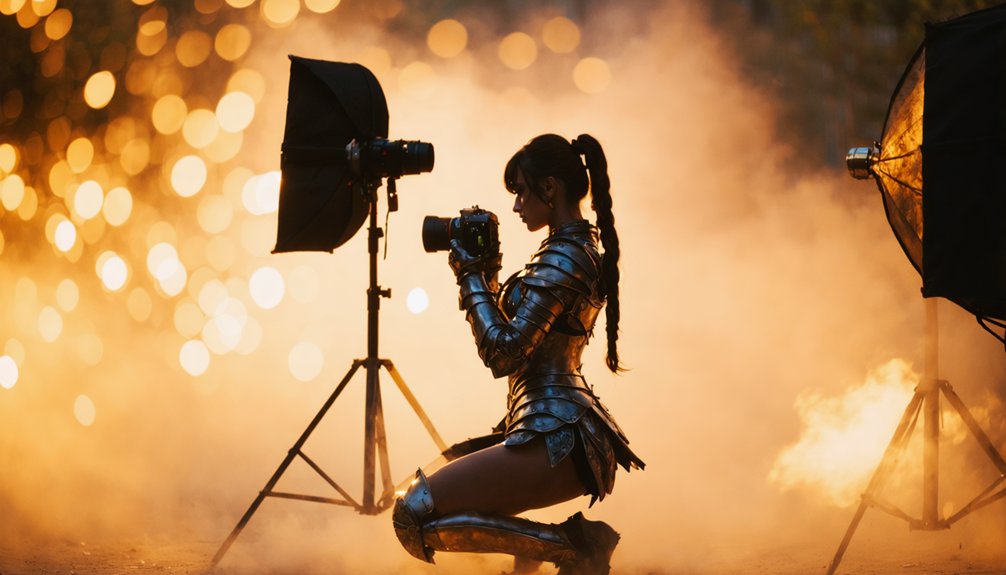
Position your cosplayer against the sun to harness backlighting, producing lens flare and a dramatic glow that electrifies action poses.
You can then sculpt shadows deliberately across the frame to define muscle lines, prop edges, and emotional tension within the composition.
Natural Light Preserves Color
Natural light preserves a costume’s true color palette in ways that built-in camera flash simply can’t match, since artificial bursts flatten tones and wash out carefully crafted fabric details.
When you’re shooting outdoors or near large windows, you’ll maintain color harmony across every fabric layer while revealing natural textures that synthetic lighting destroys.
Use natural light strategically by:
- Positioning your cosplayer facing soft, diffused daylight for even tone distribution
- Avoiding harsh midday sun that creates unflattering shadows on detailed costumes
- Shooting during golden hour to amplify warm costume colors dramatically
- Using reflectors to bounce natural light into shadowed costume areas
- Identifying overcast conditions as ideal for saturated, consistent color rendering
You’ll capture authentic visual storytelling that honors the cosplayer’s craftsmanship precisely.
Backlighting Creates Dramatic Effect
While soft daylight keeps colors honest, backlighting deliberately bends reality in ways that serve cosplay’s theatrical nature perfectly. Position your light source directly behind your cosplayer, letting it rim their silhouette and create depth that flat frontal lighting can’t achieve.
Lens flare becomes your creative tool here. When you’re capturing action or power poses, intentional flare amplifies character dynamics, suggesting energy, motion, or supernatural force radiating from within the costume itself.
You’ll want to expose for your subject’s face, letting the background blow out slightly. This technique isolates costume details against luminous halos, drawing immediate attention to specific design elements that define the character.
Experiment with your angle relative to the light source. Slight shifts dramatically change how flare interacts with fabric textures, metallic accessories, and translucent costume materials.
Shadows Define Pose Mood
Shadows don’t merely fill space—they sculpt it, transforming a flat pose into something dimensional and emotionally charged. Shadow play defines whether your character feels menacing, melancholic, or triumphant. You control that narrative through deliberate mood lighting placement.
Master these shadow techniques to elevate your cosplay poses:
- Position your light source at sharp angles to carve dramatic contrast across facial features and costume texture
- Use negative fill to deepen shadows intentionally, amplifying a character’s darker personality traits
- Experiment with practical light sources—candles or streetlights—for organic shadow behavior
- Let shadows obscure partial elements, creating mystery and drawing focus toward key costume details
- Layer foreground shadows over your subject to add environmental depth without complex setups
Balanced shadows validate your creative vision and communicate emotion precisely where color and pose alone cannot.
How to Turn Any Location Into a Character-Perfect Backdrop
Even the most mundane location can become a character-perfect backdrop once you train your eye to read environments the way a storyteller would. Scan for textures, lines, and structures that echo your character’s world. A rusted fence becomes a dystopian boundary; a sunlit alley transforms into a cinematic threshold.
Use environmental storytelling deliberately — position the cosplayer so the surroundings reinforce their narrative rather than compete with it. Let costume details guide your framing. Intricate armor deserves clean, contrasting backgrounds; flowing fabric benefits from dynamic, wind-swept open spaces.
Climb structures to introduce verticality. Use walls as props. Align your angle so architecture appears intentional, not accidental. Every location holds potential — you simply need to reframe how you’re seeing it.
Why Fandom Knowledge Gives Cosplay Photographers a Creative Edge
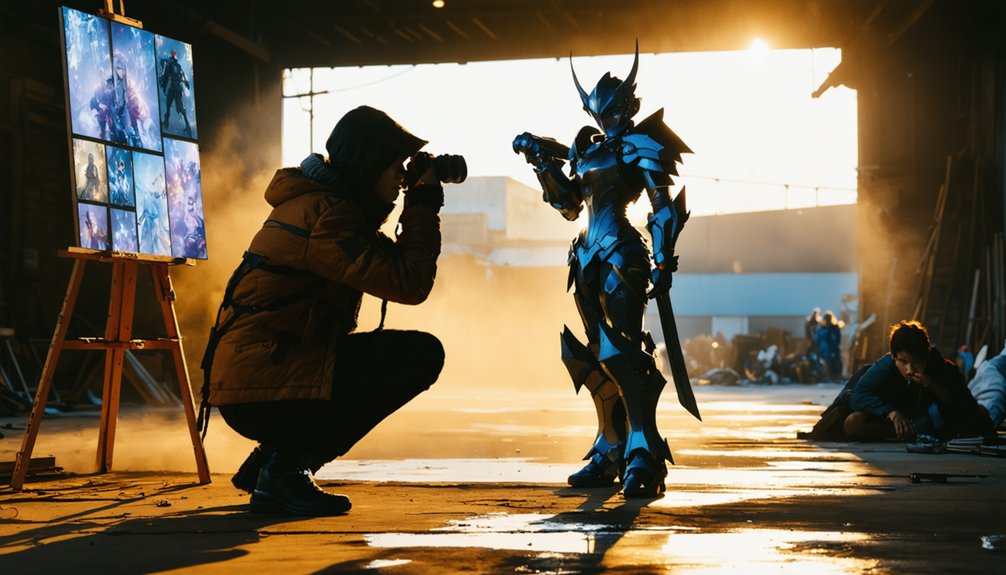
Fandom knowledge transforms a competent cosplay photographer into an exceptional one. When you understand a character’s lore, personality, and iconic moments, you’ll direct poses that resonate authentically with the community.
Fandom knowledge doesn’t just inform your shots—it transforms them from competent captures into authentic character storytelling.
Studying fan art and cosplay costume details sharpens your creative instincts beyond surface-level aesthetics.
- Recognize signature stances tied to specific characters from source material
- Use fan art references to identify dynamic versus static posing opportunities
- Match personality traits to body language, tension, and expression choices
- Leverage wiki screenshots for environmental and contextual posing accuracy
- Highlight cosplay costume elements by suggesting poses that showcase key props
Your fandom fluency builds trust, attracts community-driven clientele, and positions you as the go-to photographer for authentic character representation. Deep knowledge doesn’t just inform your shots—it elevates them.
How Post-Production Editing Elevates Your Cosplay Photos
Capturing the perfect pose is only half the work—what happens in post-production determines whether your cosplay photo feels cinematic or flat. Digital enhancements let you amplify mood, sharpen costume details, and remove distracting background elements that weaken your composition.
Color grading is especially powerful—it transforms a technically correct shot into an emotionally resonant image that reflects your character’s world. Cooler tones suggest mystery or danger, while warmer palettes evoke warmth and heroism.
You can also use light and shadow manipulation to deepen dimension, making flat lighting feel dramatic. Mood boards created during pre-shoot planning should guide your editing decisions, ensuring consistency between your creative vision and final output.
When executed precisely, post-production doesn’t alter your photo—it completes it.
How the Cosplay Community Connects Photographers and Cosplayers
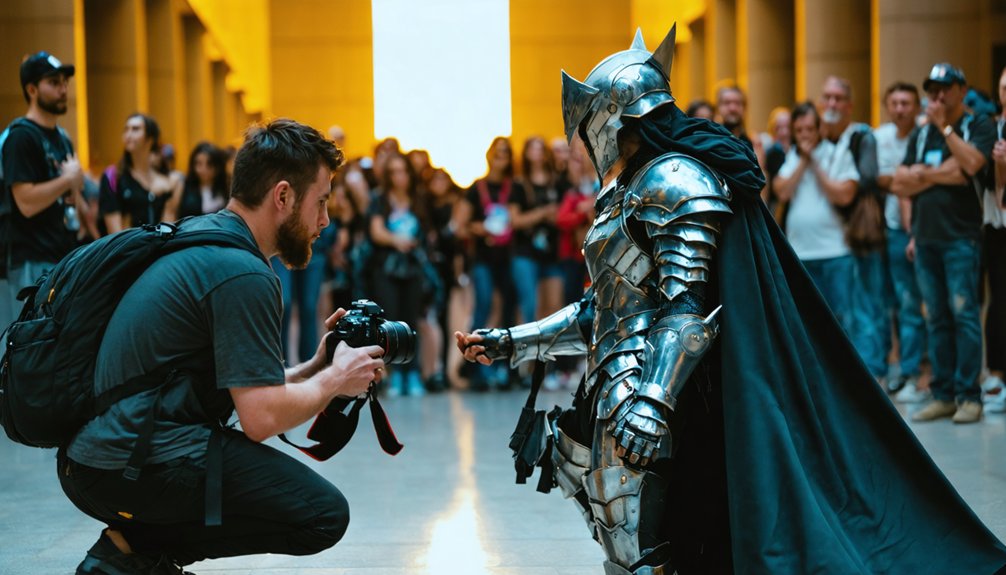
Behind every great cosplay photograph is a network that made the collaboration possible. The cosplay community actively bridges photographers and cosplayers through shared passion and strategic connection-building. You’ll find creative collaboration thriving in spaces designed for exactly this purpose.
- Join local cosplay groups and convention pages to find photographers specializing in your character’s fandom.
- Build your portfolio through free convention shoots to establish credibility within the community.
- Leverage word-of-mouth referrals by delivering exceptional results that cosplayers enthusiastically share.
- Align yourself with photographers who understand your character’s personality for more accurate posing direction.
- Use fandom expertise as your competitive advantage to attract cosplayers seeking authentic representation.
Your reputation within the cosplay community compounds over time, transforming casual connections into sustained creative collaboration that consistently produces technically precise, emotionally resonant imagery.
How to Find a Cosplay Photographer You’ll Love
Finding a cosplay photographer you’ll genuinely love working with starts long before you ever step in front of a camera. Begin by reviewing portfolios critically — examine how they handle costume accuracy, ensuring fabric textures, color tones, and intricate details aren’t lost to poor lighting choices.
Study how they capture facial expressions. A skilled photographer directs emotion authentically rather than staging hollow, generic looks. You’ll want someone who understands your character’s psychological depth.
Use convention community pages and fandom forums to identify photographers specializing in your specific genre. Request pre-shoot consultations to gauge communication chemistry and creative alignment.
Ask directly about their post-production approach and angle experimentation techniques.
Trust your instincts — if their artistic vision aligns with yours during initial discussions, the final images will reflect that synergy powerfully.
Frequently Asked Questions
How Much Does Hiring a Professional Cosplay Photographer Typically Cost?
You’ll find cost variability significant, ranging from free convention shoots to $500+ for professionals. Factor budget considerations carefully—experience, location, and editing services drive pricing, so you’re investing in both technical skill and artistic vision.
What Camera Equipment Do Most Famous Cosplay Photographers Prefer Using?
You’ll find most famous cosplay photographers favor full-frame DSLRs or mirrorless systems for camera gear choices, pairing them with prime lenses and natural lighting techniques to capture vivid, dynamic shots that push creative boundaries authentically.
How Long Does an Average Cosplay Photography Shoot Usually Take?
You’re sculpting light into art—an average shoot lasts two to four hours. You’ll refine lighting techniques, experiment with posing strategies, and iterate creatively, ensuring every dynamic frame authentically captures your character’s essence with innovative precision.
Do Cosplay Photographers Retain Rights to the Photos They Take?
You’ll find that photographers typically retain copyright ownership over their images. However, you should negotiate model releases beforehand, granting cosplayers usage rights while the photographer maintains creative control over their innovative, artistically captured work.
Can Beginner Cosplayers Work Successfully With Highly Experienced Cosplay Photographers?
Yes, you can succeed in cosplay collaboration with experienced photographers. Trust their direction, study reference poses beforehand, and communicate your vision clearly. These beginner photographer tips guarantee you’ll capture technically dynamic, artistically authentic images together.
References
- https://www.geekchicelite.com/cosplay-photography-the-artists-behind-the-lens/
- https://www.lyricalvillaincosplay.com/post/cosplay-photography-101
- https://www.reddit.com/r/photography/comments/1cgebfp/interested_in_cosplay_photography/
- https://www.youtube.com/watch?v=uUtcDlVM7Kc
- https://www.youtube.com/watch?v=Ykczjok7mJs
- https://animecorner.me/cosplay-photography-capturing-the-character-through-the-lens/