To win cosplay competitions at conventions, you’ll need to master craftsmanship, stage presence, documentation, and division strategy. Judges score technical complexity, material variety, and originality—so choose costumes that genuinely challenge your skills and showcase structural ambition. Arrive early, prepare your build book, and rehearse your stage routine until it’s second nature. Every competition you enter is a data point for improvement, and the details ahead will sharpen every part of your competitive approach.
Key Takeaways
- Master craftsmanship by focusing on construction quality, technical variety, and complex techniques like layered armor and illuminated components to impress judges.
- Choose costumes that align with your strongest skills, prioritizing structural complexity and mixed materials to showcase genuine technical challenge.
- Select the correct competition division through honest self-assessment of your experience level and prior awards to protect eligibility.
- Prepare thoroughly for prejudging by documenting your build process and rehearsing confident, character-accurate stage presentations multiple times.
- Arrive early on contest day with emergency repair supplies and collect judge feedback afterward to continuously improve future entries.
Understand What Cosplay Competition Judges Actually Score
Before you invest hundreds of hours into a build, you need to know exactly what judges are evaluating. Judge criteria vary by event, but most scoring breakdowns share core priorities: craftsmanship focus, technical variety, originality importance, and character accuracy.
Judges examine construction quality, material choices, and the range of techniques you’ve applied.
Documentation value is real — build books and progress photos let judges verify your process and problem-solving. Don’t underestimate presentation impact either. Performance skills and stage confidence directly influence final scores when events weigh both costume and delivery.
Your experience level also shapes expectations. Novice divisions have different thresholds than Master categories. Understanding these distinctions early lets you strategically target the right division and tailor your entire build accordingly.
Choose a Costume Built to Win Your Cosplay Competition
Winning starts before you touch a single piece of fabric, so research past winners in your target division to understand the craftsmanship bar you’ll need to clear.
Choose a character whose construction demands techniques you’ve already mastered or can realistically develop, since judges reward visible technical range, not ambition that outpaces execution.
Prioritize builds that showcase structural complexity, mixed materials, or advanced finishing work, because technically demanding costumes give you more opportunities to score across multiple craftsmanship criteria.
Prioritize Technically Complex Builds
When selecting a costume for competition, you’ll want to think strategically about technical complexity. Judges actively reward builds that demonstrate diverse technical techniques across sewing, prop construction, painting, and wiring.
Complexity considerations should drive your design choices from the start, so map out build challenges early and select advanced materials that push your abilities forward.
Incorporate design intricacies like layered armor fabrication, structural undergarments, or illuminated components to signal serious craftsmanship investment. Each element you tackle becomes an opportunity for skill improvement and creative problem solving under real build conditions.
Tool mastery matters too — knowing when to use a heat gun versus a Dremel versus a sewing machine separates competitive builds from casual ones. Choose a costume that genuinely challenges you, then execute it with precision.
Match Character To Your Skills
Technical complexity matters, but it only works in your favor when the costume aligns with what you already do well. Start with an honest skill assessment before committing to any build.
If your strengths are structural fabrication and prop construction, choose a character whose design demands armor, mechanicals, or hard surface work. If you excel at tailoring and textile manipulation, prioritize characters with intricate garment construction.
Character alignment isn’t just about aesthetics — it’s strategic. Judges evaluate execution quality relative to the techniques present in your build.
A flawlessly executed costume within your expertise will consistently outperform an ambitious build where skill gaps show. Match the character’s technical demands to your strongest methods, and you’ll enter judging with a measurable competitive advantage.
Research Past Winners First
Before committing to a build, study the winners from previous years at your target competition. Use research techniques to analyze materials, compare styles, and evaluate themes that consistently place well.
Study judges’ backgrounds to understand their aesthetic preferences and technical priorities.
- Analyze materials used in award-winning entries to identify construction expectations.
- Assess techniques like moldmaking, fabric manipulation, and structural engineering that judges reward.
- Review trends across multiple competition years to spot evolving standards and originality benchmarks.
- Explore inspirations behind top entries by examining build documentation and interview footage.
This intelligence shapes smarter costume selection.
You’re not copying winners—you’re decoding what excellence looks like at that specific event and building toward it strategically.
Pick the Right Cosplay Competition Division Before You Register
Choosing the right division before you register can make or break your competition experience. Division selection requires an honest self-assessment against each event’s eligibility criteria. Craftsmanship divisions typically separate competitors by prior awards, not perceived skill, so misplacing yourself risks disqualification or mismatched judging expectations.
Division errors aren’t just technicalities — they can cost you eligibility before judging even begins.
Review novice placements carefully — prior wins often push you into intermediate or advanced tiers automatically. If you’re entering as a group, some contests require everyone to compete under the highest-ranked member’s category.
Performance categories carry distinct registration requirements separate from pure craftsmanship tracks, so confirm which scoring criteria apply.
Getting your division right directly protects your award eligibility. Read the rules before submitting anything — division errors after registration are rarely correctable.
Build Your Cosplay Competition Entry to a Winning Standard

Craftsmanship judges score on construction quality, technical range, and originality — so building to a competition standard means deliberately addressing all three.
Align your fabrication skills with judges’ preferences by diversifying your costume techniques rather than relying on a single method.
- Source design inspiration early — reference character accuracy against original material before cutting or sculpting anything.
- Document build challenges — photograph solutions to fabrication problems; this proves your competition mindset and construction depth.
- Incorporate creative materials strategically — unexpected material choices that serve storytelling elements signal genuine innovation to evaluators.
- Balance craftsmanship with presentation — performance tips matter here; how your costume reads onstage affects perceived quality.
Your build book should connect every decision back to intentional, demonstrable craft — not assumption.
Document Your Cosplay Competition Build Like a Serious Competitor
Documentation isn’t an afterthought — it’s a scoring tool, and serious competitors treat it that way. Build journals should capture construction timelines, material sourcing decisions, and technical problem-solving from day one.
Don’t wait until the week before the contest to organize anything.
Use consistent photo organization methods — label images by date, technique, and build phase. Digital portfolios give judges fast, structured access to your process without requiring them to dig through disorganized files.
Progress tracking lets you demonstrate deliberate decision-making, not just a finished product.
Schedule feedback sessions with experienced cosplayers during your build, then document those exchanges too. Show how you responded to critique and refined your work.
Judges reward competitors who can prove their craft evolved intentionally from concept through completion.
Nail the Cosplay Competition Prejudging Process
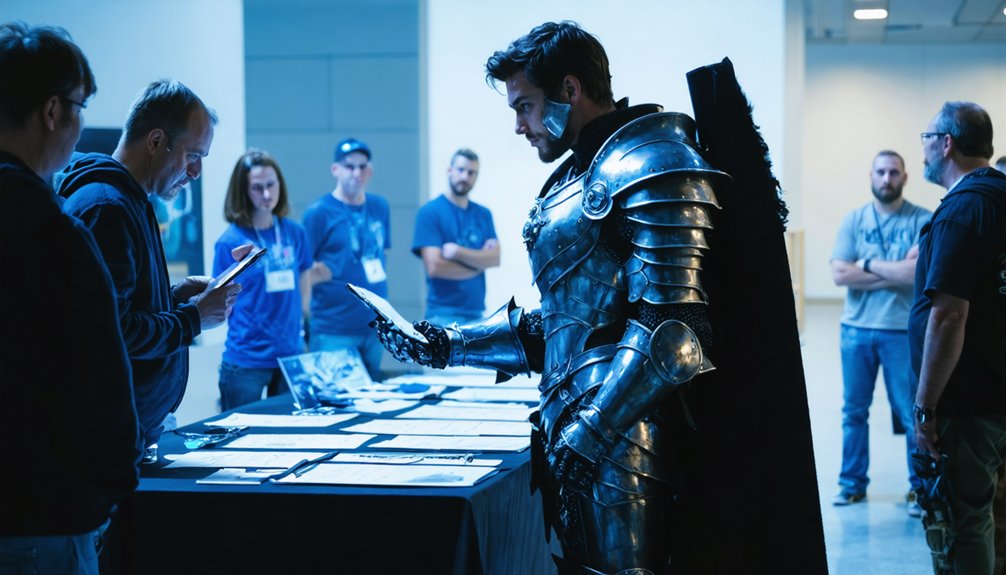
Prejudging is where craftsmanship scores are often decided, so you need to treat it as a structured performance, not a casual walk-through.
Manage competition nerves by rehearsing your judge interactions beforehand and knowing your build documentation cold.
- Organize entry preparation by bringing physical or digital progress tracking records showing construction phases, materials, and techniques.
- Highlight costume details proactively — point judges toward complex seams, engineered props, and layered paintwork they might miss.
- Demonstrate character accuracy through deliberate posing and confident, knowledgeable explanations of design choices.
- Prioritize costume maintenance immediately before prejudging — fix loose elements, touch up paint, and steam wrinkles.
Strong presentation skills during prejudging communicate both technical mastery and intentional design thinking, directly elevating your competitive score.
Own the Stage During Your Cosplay Competition
Once prejudging ends, the stage becomes your next scoring opportunity, and how you carry your costume in front of judges and the audience directly shapes your final result.
Strong stage presence requires deliberate movement, controlled pacing, and purposeful positioning that highlights your costume’s best construction details. Don’t rush across the stage; instead, use the full space and pause strategically so judges can observe your work clearly.
Character embodiment elevates your presentation beyond simple display. Adopt your character’s physicality, posture, and energy with precision rather than casual approximation.
Rehearse your routine multiple times before the event, accounting for stage dimensions, lighting angles, and timing. If your contest scores both craftsmanship and performance, treating the stage segment as seriously as your build directly increases your competitive advantage.
Don’t Forget These Contest Day Logistics
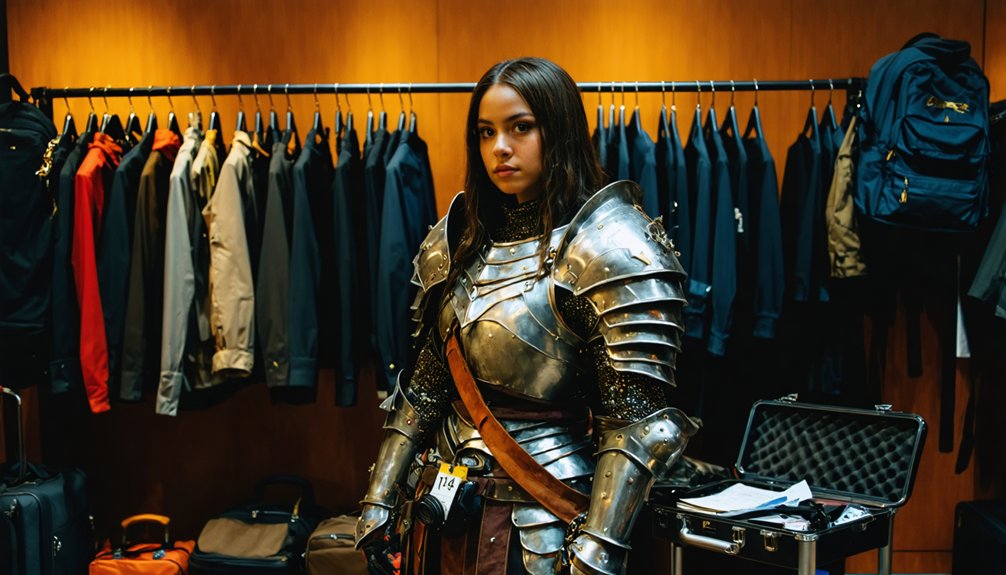
Arriving early gives you time to handle registration, confirm your schedule slot, and resolve any check-in issues before they become problems.
Tight registration timing and a smooth check-in process eliminate last-minute stress that disrupts stage presence and sharpens your focus despite competition nerves.
- Costume transportation: Pack components in labeled, padded containers to prevent damage during transit.
- Prop management: Confirm peace-bonding requirements ahead of time and carry tools for quick adjustments.
- Backup plans: Bring emergency supplies including adhesives, spare fabric, and fasteners for rapid costume repairs.
- Registration timing: Arrive at least one hour early to accommodate unexpected delays in the check-in process.
Preparation neutralizes variables.
Every logistical detail you control beforehand frees mental energy for your actual performance.
Learn From Every Cosplay Competition You Enter
Every competition you enter is a data point, so treat it like one.
Review your judge notes critically, compare your progress photos against finished results to spot construction gaps, and study past winners to identify the techniques and presentation choices that scored well.
This feedback loop sharpens your eye, tightens your builds, and moves you closer to the podium with each entry.
Analyze Your Judge Notes
After each competition, collect your judge notes and score sheets before leaving the venue—these documents are among the most actionable feedback you’ll receive.
Judge feedback reveals exactly where your costume evaluation succeeded or fell short within the score criteria.
Analyze these four key areas:
- Craftsmanship emphasis – Identify which techniques scored highest and which need refinement in your construction approach.
- Performance impact – Note whether stage presence or character embodiment affected your overall ranking.
- Presentation tips – Review comments targeting your stage timing, posing, or audience engagement.
- Competition strategies – Cross-reference scores across judging process categories to spot consistent patterns in your results.
Treat every score sheet as a technical roadmap.
Recurring low scores signal your next build priority.
Track Your Progress Photos
Tracking progress photos throughout each build gives you a concrete visual record that serves double duty: it documents your craftsmanship for prejudging portfolios and build books, and it creates a timeline you can study after each competition to pinpoint where your construction decisions paid off or fell short.
Consistent photo organization by project milestones—patterning, base construction, detailing, finishing—makes cosplay timelines reviewable at a glance. When you’re documenting techniques, capture each method before moving to the next layer, since judges and your future self both need that context.
Sharing progress publicly adds accountability and invites technical feedback mid-build. Over multiple projects, your archived shots reveal genuine build evolution, showing which approaches you’ve refined and where gaps in your visual storytelling still weaken your overall presentation strategy.
Study Past Winners
Progress photos build your internal record, but studying past winners shifts your focus outward—giving you a calibrated benchmark against which to measure your own work.
Analyze convention galleries, social media archives, and official highlight reels to extract actionable intelligence:
- Identify craftsmanship trends — Notice which construction techniques judges consistently reward across divisions.
- Decode judging criteria — Cross-reference winners against published scoring rubrics to pinpoint weighted priorities.
- Evaluate costume authenticity — Observe how closely top entrants align their builds with source material without sacrificing structural integrity.
- Extract performance tips — Study stage presence, pacing, and character embodiment in winning skit footage.
You’re not copying winners—you’re reverse-engineering excellence to strategically elevate your next entry’s technical and presentational standards.
Frequently Asked Questions
Can I Enter a Cosplay Competition Without a Convention Badge?
You’ll typically need a valid convention badge to meet competition eligibility requirements. Most cosplay rules mandate attendee registration before entry. Always verify the specific event’s guidelines early, as requirements can vary across different conventions.
Are Contestants Under 18 Allowed to Enter Cosplay Competitions?
You can enter if you’re under 18, but you’ll need to meet age restrictions by submitting a parental consent waiver signed by your parent or legal guardian before competition organizers will approve your entry.
Can Staff or Volunteers Enter the Cosplay Competition at Their Convention?
Like a locked door, costume rules often bar staff and volunteers from entering. You’ll find that judging criteria frequently excludes convention workers, so check your event’s official guidelines early to confirm your eligibility.
Is There a Limit to How Many Competitions I Can Enter?
You’ll find that competition rules vary by convention, so check each event’s official guidelines for entry limits. Some contests restrict multiple entries, and entry fees may apply per submission, so plan your strategy accordingly.
Do Group Entries Need to Compete in the Highest-Ranked Member’s Division?
Absolutely every group entry rule demands you compete in the highest-ranked member’s division. Don’t underestimate division eligibility — it’s non-negotiable. Review group entry rules carefully to guarantee your entire team meets the required division standards before registering.
References
- https://cosplay.com/archive/thread/dy2xy4/how-to-win-cosplay-competitions
- https://theswordstall.co.uk/blogs/news/how-to-win-a-cosplay-contest
- https://www.blackowlstudio.com/en/behind-the-scenes-of-cosplay-contests/
- https://www.reddit.com/r/CosplayHelp/comments/1kqmhgm/what_does_it_take_to_win_a_craftsmanship_contest/
- https://www.comicpalooza.com/activities/tracks/cosplay/cosplay-contest/cosplay-contest-rules/
- https://wigs101.com/cosplay-contest-101
- https://www.animefargo.org/cosplay-contest-categories/
- https://www.youtube.com/watch?v=tUeuyDXTDa8
- https://www.firststopcosplay.com/blogs/fsco-blog/new-blog-post-wip-cosplay-convention-survival-guide
- https://www.facebook.com/groups/galaxyconraleighfangroup/posts/1217711295599040/