Successful LARPing starts with knowing the rules, building a grounded character, and respecting everyone around you. You’ll want to minimize out-of-character talk, share the spotlight generously, and always check consent before physical contact. Handle disputes through referees rather than public arguments, follow organizer rulings promptly, and silence your phone to protect immersion. Small habits like prop safety checks and cleanup duties reflect your investment in the event. Keep going to master every essential convention.
Key Takeaways
- Always establish clear consent for physical contact before engaging in combat or emotionally intense scenes with other participants.
- Minimize out-of-character talk during play, reserving it strictly for safety concerns or urgent real-world needs.
- Avoid dominating scenes or hijacking storylines, allowing every participant equal opportunity to contribute meaningfully.
- Signal a referee immediately during disputes rather than arguing publicly, accepting their rulings promptly and professionally.
- Silence phones, maintain props responsibly, and honor shared space cleanup to demonstrate respect for everyone’s experience.
Know the Rules, Calls, and Consent Policies Before You Arrive
Before your first scene begins, you need to know the rules. Read the event documentation thoroughly, covering combat mechanics, safety protocols, and consent discussions before you step onto the field. Organizers expect you to arrive prepared, not learning basics mid-play.
Understand how your character backstory fits the setting’s established lore and group dynamics. A well-integrated character strengthens plot integration and makes scenes richer for everyone involved. Avoid building concepts that dominate or isolate others.
Familiarize yourself with immersion techniques and role playing tips specific to the event’s tone and language expectations. Know the out-of-character signals, restricted content policies, and weapon requirements in advance.
This preparation isn’t optional—it’s foundational. When you arrive ready, you protect the experience for yourself and every player sharing the game with you.
How to Build a LARP Character That Fits the Game
Once you’ve absorbed the rules and consent policies, your next job is building a character that actually belongs in the world you’re entering.
Start with a grounded character backstory and commit to motivation exploration that connects your character’s drives to the broader setting. Your alignment choices should complement the game’s tone rather than disrupt it.
Your character’s past should fuel their present — choose motivations and alignment that feel native to the world, not foreign to it.
Focus skillset development on abilities that create opportunities for collaboration. Strong relationship dynamics give you natural hooks into other players’ stories, making every scene richer.
Let costume considerations reinforce your character’s identity without overshadowing others.
Plan character arcs that evolve through shared events rather than isolated performance. Set clear in-game goals that intersect with the community’s narrative.
A well-integrated character doesn’t just exist in the world — it actively enriches it for everyone.
Once you’re in the game, keep out-of-character talk to an absolute minimum so you protect everyone’s immersion and signal respect for the shared experience.
Resist the urge to dominate every scene, because giving other players room to shine strengthens the story for the whole group.
React to what’s happening around you rather than forcing your own storyline forward, and you’ll naturally become someone others want to play alongside.
Limiting Out-Of-Character Talk
Staying in character during active play is one of the most important contributions you can make to a LARP event. Every out-of-character conversation fragments immersion for everyone nearby, not just you.
When you must step outside the fiction, use your game’s agreed signal—a raised fist, a tap on the shoulder, or a specific phrase—to clearly mark out of character boundaries.
Keep those exchanges brief, then re-engage with immersive dialogue as quickly as possible. Move OOC discussions away from active scenes so nearby players aren’t pulled out of the story.
Silence your phone before play begins, since unexpected notifications break focus just as effectively as whispered side conversations.
Consistent in-character presence signals respect for your fellow players and deepens the collective experience for everyone involved.
Avoiding Spotlight-Hogging Behavior
Sharing the spotlight is just as essential as staying in character, because LARP thrives on collective storytelling rather than individual performance. When you dominate scenes, you disrupt spotlight balance and shrink opportunities for others to contribute meaningfully.
Instead, treat every interaction as a collaborative exchange rather than a personal showcase.
Prioritize reactive storytelling by responding to what others bring into scenes. Strong character interactions emerge when you listen actively, build on existing narrative threads, and create openings for fellow players to shine.
Avoid steering every scene toward your character’s agenda or hijacking emotionally significant moments others have carefully developed.
Recognize when to step back. Supporting a quieter player’s scene or deferring to an ongoing conflict demonstrates confidence, not weakness.
Balanced participation ultimately creates richer, more immersive experiences for everyone involved.
Supporting The Shared Narrative
When you support the shared narrative, staying in character and sharing the spotlight stop being separate goals and become the same instinct.
Collaborative storytelling only works when every player treats the story as a living, group-owned structure rather than a personal platform.
Prioritize character interactions that respond to what others bring into a scene. React genuinely, build on established threads, and let your character be changed by events.
You don’t need to drive every plot point to matter.
Ask yourself whether your choices create openings for others or close them.
The strongest LARP experiences emerge when players amplify each other’s moments rather than redirect attention inward.
Lean into that dynamic, and the whole narrative becomes richer for everyone at the event.
LARP Etiquette for Physical Contact and Consent

Physical contact in LARP requires clear, ongoing consent—not a one-time assumption. Before touching another player, ask explicitly. Don’t rely on context or enthusiasm to signal permission.
Establish physical boundaries early, ideally during pre-game consent discussions, so everyone enters play with aligned expectations.
Before play begins, align on boundaries—so every player steps into the game feeling safe and seen.
Treat consent as a living agreement. Scenes escalate, emotions intensify, and what felt comfortable initially may shift. Check in when tension rises, and honor any withdrawal of consent immediately—no questions asked.
Extend this standard to props, too. Fake blood, restraints, or contact-based gestures all require prior approval. If you’re uncertain, ask.
A brief out-of-character moment protects everyone and strengthens trust across the entire player community. Prioritizing consent doesn’t break immersion—it builds the psychological safety that makes deeper, bolder storytelling possible.
Combat Calls, Weapon Safety, and Fair Play at LARP Events
Combat at LARP events runs on a shared system of calls, rules, and mutual respect—and you’re expected to know that system before you step onto the field.
Effective combat communication means understanding every strike call, status effect, and out-of-game signal used in your specific system. Don’t guess; review the rulebook and ask organizers before play begins.
Weapon handling matters just as much. Check your weapons regularly for damage, delamination, or unsafe wear, and never strike restricted target areas like the head, neck, or groin.
Keep your swings controlled and deliberate.
Fair play means accepting outcomes honestly. LARP combat isn’t about winning—it’s cooperative storytelling with physical stakes.
Dispute rulings through referees, not arguments on the field. Respect the system, and everyone’s experience improves.
How to Handle LARP Disputes Without Breaking Immersion

When a dispute arises mid-game, take it to a referee rather than arguing it out in front of other players.
Referees exist to resolve rules conflicts quickly so everyone can return to play without prolonged interruptions.
Keep in-game rivalry where it belongs—inside the fiction—and never let character conflict bleed into real-world hostility toward fellow players.
Resolving Conflicts Through Referees
Disputes at a LARP event are inevitable, but how you handle them determines whether the game stays immersive or falls apart. When disagreements arise over rules, outcomes, or player conduct, defer to referee authority immediately.
Arguing publicly mid-scene damages immersion for everyone nearby and rarely resolves anything. Instead, signal a referee using the event’s designated out-of-character method, then step away from active play to address the issue quietly.
Treat conflict resolution as a structured process, not a debate you need to win. Referees exist precisely to make neutral calls so the narrative continues smoothly.
Once a ruling is made, accept it and return to play. If you still disagree, raise your concerns with organizers after the session, not during it.
Keeping Rivalry In-Game
Character rivalry can electrify a LARP session, but it only works if you keep the tension inside the fiction. Strong in-game dynamics depend on separating what your character feels from what you feel. Your character can despise another character without you harboring resentment toward that player.
When friction builds, channel it through character relationships rather than personal confrontation. Argue through dialogue, use game mechanics, or involve a referee when disputes escalate.
Never carry in-character hostility into out-of-character spaces like meal breaks or post-event discussions.
Check in with the other player between scenes if needed. A quick out-of-character conversation prevents misreading and keeps both of you aligned.
Rivalry that stays fictional enriches the shared narrative; rivalry that bleeds into reality damages the community you’re both there to build.
How to Respect Players, Crew, and Organizer Rulings
One of the most important things you can do at a LARP event is treat every participant—players, crew, and organizers alike—as a valued contributor to the shared experience. Player appreciation isn’t just courteous; it actively strengthens the game’s collaborative foundation.
Show crew communication by listening attentively to staff instructions and asking questions respectfully rather than challenging rulings publicly. When an organizer makes a call, follow it promptly. Disputes slow the event and create friction that affects everyone around you.
If you disagree, raise concerns privately and calmly after the scene concludes. Avoid excluding others, targeting participants for personal reasons, or dismissing crew contributions as lesser roles. Everyone—from the newest player to the head organizer—deserves respect, and that collective attitude shapes the entire event’s quality.
Phones, Cleanup, and Practical LARP Etiquette at Events
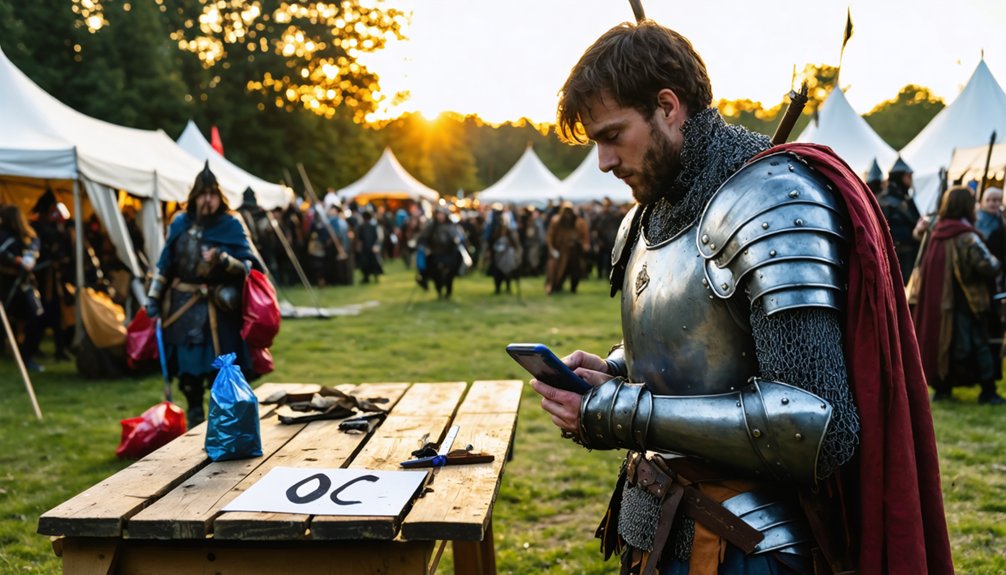
Beyond how you treat people, the small practical habits you bring to an event shape the experience just as meaningfully. Your phone etiquette and cleanup responsibilities signal whether you’re a true collaborator in the shared world everyone’s building.
Follow these four practical standards:
- Silence your phone completely — a notification mid-scene shatters immersion instantly.
- Step away from active play before checking any device, keeping disruptions contained.
- Honor your cleanup responsibilities by leaving sleeping areas, common spaces, and prop stations exactly as you found them.
- Inspect your weapons and props regularly, flagging any damage before it becomes a safety issue.
These habits cost little effort but demonstrate serious investment in the event’s quality, signaling respect for every participant’s experience.
Common LARP Etiquette Mistakes and How to Avoid Them
Even experienced LARPers slip into habits that quietly undermine the shared experience. Oversharing your character backstory development unprompted is one common mistake — let details emerge naturally through interaction rather than monologues.
Another error is breaking immersion unnecessarily; strong immersion techniques mean reserving out-of-character talk for genuine safety needs, not casual commentary.
Strong immersion means saving out-of-character talk for real safety needs — not casual asides that pull everyone out of the moment.
You’ll also want to avoid spotlight-hogging, which shuts other players out of meaningful scenes. Ignoring consent checks before physical contact is a serious misstep that damages trust fast.
Combat rule violations, even unintentional ones, create safety risks and frustration. Finally, dismissing organizer rulings publicly disrupts flow for everyone.
Recognize these patterns in yourself, correct them quickly, and you’ll strengthen both your own experience and the community around you.
Frequently Asked Questions
What Should I Do if I Feel Unwell During a LARP Event?
Drop everything instantly! Signal out-of-character, prioritize your health considerations, and inform an organizer immediately. You’re allowed to enforce personal boundaries by stepping away from play—your well-being always trumps immersion, no exceptions!
Can Children Participate in LARP Events, and Are There Age Restrictions?
Yes, children can participate in LARP events, but you’ll need to check each event’s age guidelines first. Child participation rules vary by organizer, so always review policies and guarantee proper supervision and consent measures are in place.
How Do I Find LARP Events or Communities Near Me?
You’ll find LARP communities through online platforms like Meetup and Facebook, social media groups, community boards, and event calendars. Check local resources and group meetups to connect with nearby players who’ll welcome your participation.
What Happens if My Costume Gets Damaged During an Event?
When your costume meets an unexpected adventure, don’t panic. You’ll want to bring emergency supplies like safety pins and tape for quick costume repair. Respect others’ space while fixing it, and always handle your gear carefully.
Are There Different LARP Styles, and How Do They Differ?
Yes, LARP styles vary widely. You’ll encounter fantasy domains with intense combat styles, narrative focus-driven dramatic events, or deep role immersion experiences. Each format shapes your engagement differently, so you’ll want to choose what excites your creative goals most.
References
- https://larpnews.org/larping-etiquette/
- https://www.reddit.com/r/LARP/comments/1cv7ze3/universal_larping_etiquette/
- https://www.reddit.com/r/LARP/comments/vja7rv/new_to_larp_want_to_know_the_social_rules/
- https://www.medievalcollectibles.com/blog/beginners-guide-to-larp/
- https://www.battlemerchant.com/en/blog/larp-etiquette-respectful-interaction-in-role-play
- http://www.crolarper.com/2012/12/the-15-rules-of-larp.html
- https://www.meadsa.co.za/DownloadFiles/Rules/A_Guide_to_Happy_Larping.pdf
- https://yelzkizi.org/larp-live-action-role-playing-games-history-rules/
- https://www.purplepass.com/blog/10-must-have-rules-for-larp-participants-at-your-event/
- https://frontierevents.ca/wp-content/uploads/2018/03/Combat-LARP-Basic-Rulebook.pdf