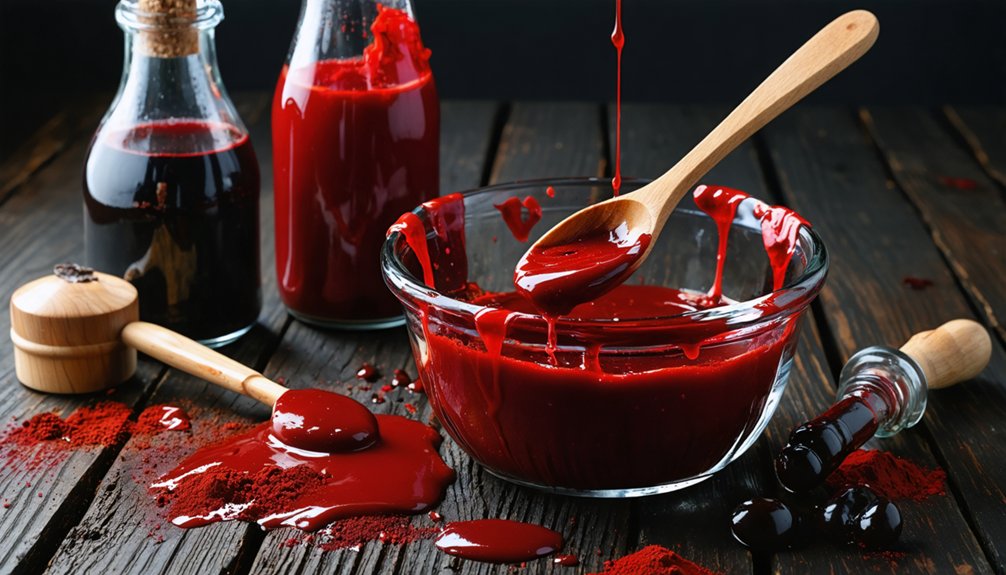
Homemade fake blood starts with corn syrup as your base, red food coloring as your primary pigment, and cocoa powder to kill that artificial brightness. You’ll adjust consistency with water for splatter or cornstarch for thick ooze. Add one to two drops of blue or green to nail a realistic blood tone. Test every batch on skin and fabric before committing. The recipes, application techniques, and storage tips below cover everything you need.
Key Takeaways
- Corn syrup forms the ideal base for fake blood, offering realistic viscosity and shine, with water added to adjust consistency for different effects.
- Red food coloring is the primary pigment; adding 1–2 drops of blue or cocoa powder creates more realistic, natural-looking blood tones.
- Thicker formulas suit deep wounds and prosthetics, while water-thinned mixtures work best for splatter, drips, and fabric staining.
- Always patch test fake blood on skin and fabric beforehand, as food coloring can stain porous surfaces quickly and permanently.
- Store fake blood in airtight glass jars, refrigerated, for weeks; water-heavy mixtures degrade faster and should be used within days.
The Best Ingredients for Homemade Fake Blood
Corn syrup forms the foundation of most effective fake blood recipes because its thick, glossy consistency mimics the viscosity and sheen of real blood. You’ll pair it with red food coloring as your primary pigment, then apply color blending techniques using small amounts of blue, green, or yellow to shift the tone toward a realistic maroon.
Cocoa powder or chocolate syrup deepens the hue further, eliminating the artificial brightness that exposes amateur work. For ingredient substitutions, consider honey for added thickness, cornstarch for opacity, or beetroot for a natural pigment alternative.
Water thins the mixture when splatter effects require faster movement. Each component serves a precise function, so adjusting one variable directly impacts texture, color accuracy, and how the blood behaves on fabric or skin.
Simple Fake Blood Recipes for Every Cosplay Look
Once you’ve gathered your core ingredients, you can build a functional base by combining ¼ cup corn syrup with 4 drops of red food coloring, then adding 2 teaspoons of cocoa powder to deepen the tone for wound effects.
From there, you’ll adjust consistency by mixing in small amounts of water to thin the blood for splatter work or increasing the corn syrup ratio for thicker, clinging applications.
If you’re targeting a specific look — fresh injury, oozing gore, or clotted trauma — you’ll fine-tune each batch with cornstarch for opacity, blue or green coloring for realism, or textural additives like flour or torn tissue paper.
Basic Recipe Starter Kits
Whether you’re building a subtle injury effect or a full gore look, three core recipes cover most cosplay needs. Each uses color mixing to shift tone away from flat Halloween-red toward realistic maroon or venous brown.
Kit 1 – Basic Bright Blood: ¼ cup corn syrup, 4 drops red food coloring. Thin with water for splatter effects.
Kit 2 – Dark Wound Blood: 2 tbsp corn syrup, 4 drops red, 2 tsp cocoa powder. Adds depth and opacity.
Kit 3 – Viscous Gore Blood: 8 tbsp corn syrup, 1 tsp cocoa powder, ¼ tsp cornstarch, 1 drop blue coloring. Delivers slow ooze and realistic tone.
For ingredient alternatives, swap cocoa with chocolate syrup or replace corn syrup with honey for varied viscosity.
Adjusting Blood Consistency Easily
Having a solid base recipe gets you started, but consistency is what actually sells the effect. Add water incrementally to thin your mixture for splatter and drip applications.
For thicker wound blood, increase corn syrup or blend in cornstarch or flour to build opacity and body.
Color mixing is equally critical. A drop of blue or green coloring shifts oversaturated red toward a realistic maroon tone. Cocoa powder deepens the hue while simultaneously adding viscosity.
When ingredient substitution becomes necessary, honey replaces corn syrup for a denser pull, while powdered sugar dissolved in water creates a lighter, faster-running alternative.
Test each adjustment in small increments, documenting your ratios.
Consistency control isn’t guesswork—it’s a precise, repeatable process that directly determines how convincing your final effect looks.
How to Color Fake Blood for a Realistic Shade
Achieving a realistic blood color starts with red food coloring as your base, but red alone produces a shade that’s too bright and artificial-looking. Effective color blending requires adding 1–2 drops of blue or green coloring to shift the tone toward a deeper, maroon-like hue.
Red alone reads too bright—add 1–2 drops of blue or green to achieve a deeper, realistic maroon tone.
A small amount of cocoa powder further darkens the mixture, suppressing that artificial brightness.
For pigment stability, incorporate colorants directly into corn syrup before adding other ingredients. This prevents uneven distribution and streaking during application.
Add blue or green incrementally—over-correction turns the mixture purple or muddy.
Cocoa powder quantities should stay under 2 teaspoons per quarter-cup of syrup to avoid overpowering the red tone.
Test your final shade against natural skin tone in direct lighting before committing to full application.
Thick, Thin, or Chunky: Matching Fake Blood to Your Costume
The consistency you choose directly affects how your fake blood reads on camera and in person, so match it to your costume’s specific effect.
For fresh wounds or fabric splatter, thin your corn syrup base with water to produce a runny, mobile drip.
For deep cuts or layered prosthetics, increase corn syrup concentration for a thick, clinging viscosity that stays where you place it.
If you’re building a horror or trauma look, add toilet paper strips, flour, or red velvet cake mix to your base to create chunky, clotted texture that mimics tissue and coagulation.
Consistency Matching Your Costume
When choosing a fake blood consistency, you’ll want to match the formula to how and where it appears on your costume.
- Fabric splatter: Use a water-thinned base for realistic drip patterns. Heavy syrup beads instead of absorbing.
- Skin wounds: Apply thick corn syrup formulas with color blending—cocoa plus blue drops—to avoid a flat, artificial red.
- Prosthetics and edges: Oozing effects need glycerin-corn syrup blends that move slowly and cling to dimensional surfaces.
- Props and weapons: Ingredient substitutions like chocolate syrup instead of cocoa powder create a glossier, darker coating that photographs well.
Test each mixture on a hidden section first. Different fabric types, skin textures, and lighting conditions will change how your chosen consistency performs visually.
Texture Options For Gore
Gore effects demand different textures depending on the wound type you’re simulating, and your ingredient ratios control everything.
For deep lacerations, combine 2 tablespoons corn syrup with 2 teaspoons cocoa powder and 4 drops red food coloring. Color blending with one drop of blue darkens the tone beyond standard Halloween-red, achieving realistic venous coloring.
Chunky gore requires ingredient substitutions like torn toilet paper strips, onion flakes, or red velvet cake mix folded directly into your base mixture. These additions simulate clotted tissue convincingly.
For surface abrasions needing thinner coverage, increase water content incrementally while reducing corn syrup.
Layered application amplifies realism — place darker mixtures into wound depths and brighter tones at edges.
Test every textured mixture on a fabric swatch before committing to full costume application.
Which Fake Blood Recipe Works on Skin vs. Fabric?
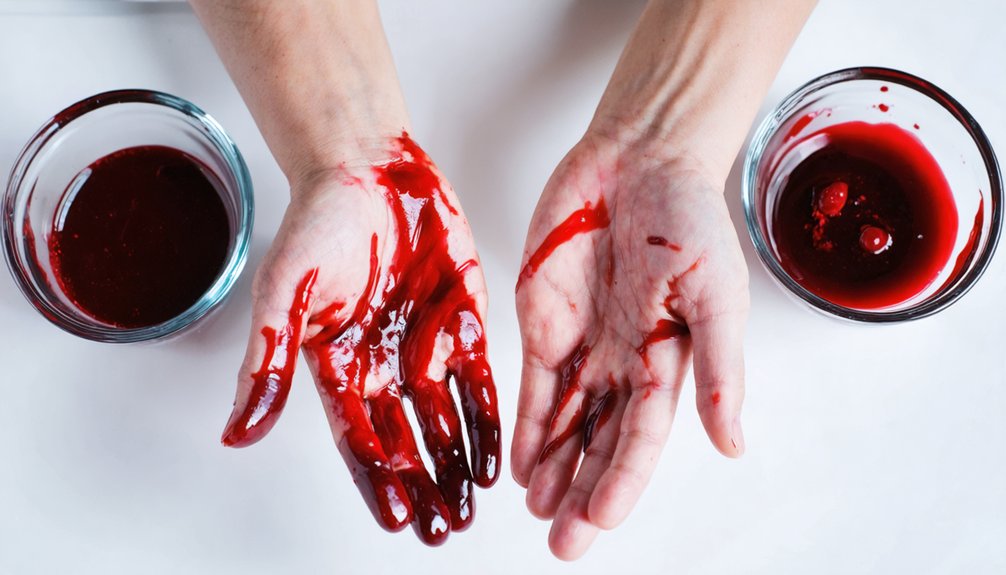
Choosing the right fake blood recipe depends heavily on whether you’re applying it to skin or fabric, since each surface behaves differently with syrup- and water-based mixtures. Matching your formula to your surface prevents staining, irritation, and inconsistent results.
- Skin: Use corn syrup with edible vs. non-edible coloring distinction in mind — edible-grade food coloring reduces irritation risk.
- Fabric: Water-thinned mixtures penetrate fibers better, creating realistic splatter patterns without heavy residue.
- UV reactive pigments: These work on both surfaces but adhere more durably to fabric; test before full application.
- Prosthetics/wounds: Thick corn syrup and cocoa powder formulas layer well over latex without sliding off under stage lighting.
Always patch-test fabric and skin separately before committing to full-costume application.
How to Apply Fake Blood for Convincing Results
Applying fake blood convincingly requires layering tones rather than slapping on a single uniform coat. Start with darker, maroon-toned blood deep inside wound edges using color mixing techniques — cocoa powder and blue coloring shift red toward realistic bruised tissue.
Then layer brighter red outward to simulate fresh bleeding. Your application techniques matter as much as your formula. Use a fine brush for controlled wound detail, a sponge for blunt trauma patterns, and finger-flicking for arterial splatter.
Apply in thin passes, letting each layer partially set before adding the next. For skin applications, keep the mixture thinner near edges so it doesn’t crack. For fabric, saturate the fibers fully so the blood reads as soaked rather than surface-painted.
Will Fake Blood Stain Your Costume or Skin?

Fake blood can and will stain both fabric and skin, but the severity depends on your base ingredients and how quickly you treat the mess. Food coloring used in color blending sets fast into porous fibers. Ingredient substitution—like swapping food dye for beet juice—reduces permanent staining risk.
- Fabric: Pre-treat with cold water immediately; heat bonds dye permanently.
- Skin: Corn syrup rinses cleanly, but red food coloring may tint for hours.
- Cocoa powder: Leaves oily residue on fabric; use cornstarch as an ingredient substitution.
- Color blending with blue or green dye: Darker mixtures stain more aggressively than single-color formulas.
Always test your mixture on a hidden costume section before full application.
Can You Store Homemade Fake Blood Between Uses?
Homemade fake blood stores surprisingly well between uses, provided you match your storage method to your base ingredients. Corn syrup and glycerin-based formulas remain stable for weeks when sealed in airtight storage containers — glass jars or squeeze bottles with locking caps work best.
Corn syrup and glycerin-based fake blood stays fresh for weeks — just seal it tight in glass or squeeze bottles.
Refrigeration extends shelf life and prevents microbial growth in recipes containing cocoa powder or organic thickeners. Water-heavy mixtures degrade faster, so you’ll want to use those within a few days.
Avoid storage containers that previously held synthetic scent products, since residual fragrance compounds can alter your formula’s color chemistry.
Before reusing stored blood, stir thoroughly, as pigment and solids will settle. If separation appears excessive or the texture has shifted markedly, remix with a small amount of fresh corn syrup to restore consistency.
Frequently Asked Questions
Can Homemade Fake Blood Be Used Safely Around Open Wounds?
You shouldn’t apply homemade fake blood near open wounds. Prioritize safety precautions by checking allergen considerations—food coloring, corn syrup, and cocoa powder can cause irritation, infection, or allergic reactions when introduced to broken skin.
Does Fake Blood Smell Bad After Sitting Out for Hours?
Cocoa powder and corn syrup develop mild sour or stale scent retention after hours of exposure. You’ll notice odor removal becomes necessary—store it sealed, refrigerate between uses, and reapply fresh batches during extended cosplay sessions.
Can Children Safely Use Homemade Fake Blood During Halloween Events?
Yes, children can safely use homemade fake blood on Halloween costumes if you select edible, food-safe ingredients like corn syrup and food coloring, prioritizing child safety by avoiding staining dyes near eyes or sensitive skin.
Will Fake Blood Affect Silicone or Latex Prosthetic Adhesives?
Liquid crimson artistry can compromise your adhesive integrity. Syrup-based formulas aren’t always silicone safe, and water or glycerin content may weaken latex compatibility, causing prosthetic lift. You’ll want to apply blood *after* securing your prosthetics fully.
Can Fake Blood Ruin a Wig or Synthetic Hair Piece?
Yes, fake blood can cause wig staining and synthetic hair damage. Food coloring penetrates synthetic fibers permanently, while corn syrup’s stickiness mats strands together. You’ll want to test on hidden sections before full application.
References
- https://www.thesprucecrafts.com/make-fake-blood-fake-blood-recipes-1105964
- https://stevespangler.com/experiments/fake-blood-recipes/
- https://www.youtube.com/watch?v=QmrTNqkhk8U
- https://www.instagram.com/reel/Cy1Z1b2uJmQ/
- https://alamedapost.com/features/alameda-life/fake-blood-recipe-type-oh-wow/
- https://medium.com/rockport-publishers/splash-splatter-or-drip-level-up-your-halloween-costume-with-diy-blood-2e9673e90080
- https://www.backstage.com/magazine/article/how-to-make-fake-blood-77827/
- https://www.coles.com.au/recipes-inspiration/baby-kids/how-to-make-fake-blood
- https://www.youtube.com/watch?v=V_3nOQxRBas
- https://www.wikihow.com/Make-Fake-Blood