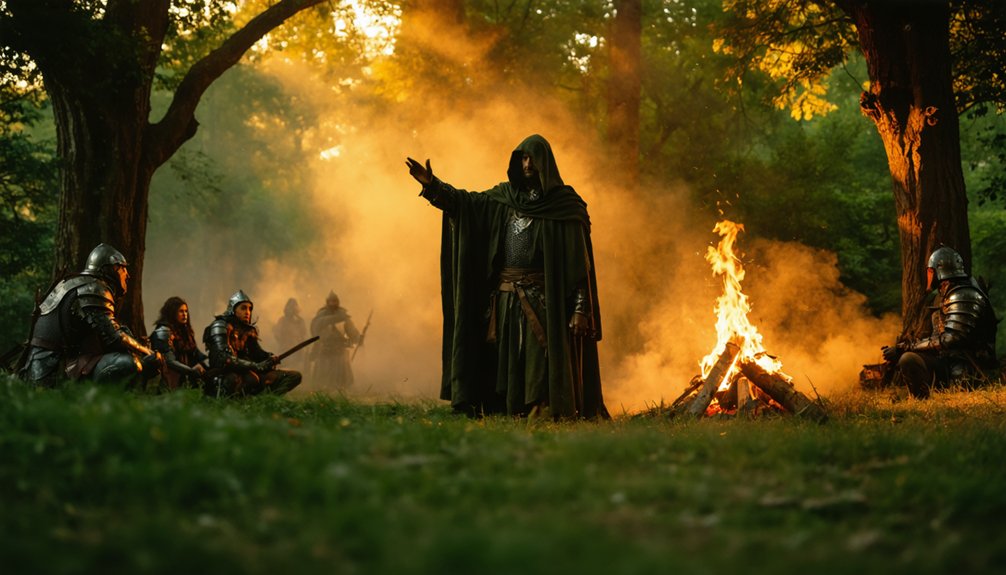
To create a LARP character backstory, you’ll need five core elements: origin, identity, motivation, conflict, and relationships. Start by matching your character to the setting’s tone, lore, and culture. Build a focused identity around two or three traits you can actually perform under pressure. Keep your history lean, leave intentional gaps for in-game growth, and give your character an immediate reason to act. Stick around — there’s much more to uncover.
Key Takeaways
- Ground your character in five core elements: origin, identity, motivation, conflict, and relationship hooks to create a well-rounded, playable backstory.
- Select 2-3 performable personality traits, quirks, and flaws that remain consistent and believable under pressure during live play.
- Match your character’s background to the setting’s lore, tone, cultural norms, factions, and social hierarchies for consistency.
- Avoid overloaded histories; keep the structure lean and leave intentional gaps for in-game discovery and improvisation.
- Focus on immediate goals and specific relationship hooks—mentors, rivals, debts—to drive engagement and generate scenes naturally.
The Five Elements Every LARP Character Backstory Needs
A strong LARP character backstory isn’t built from a wall of prose — it’s built from five load-bearing elements that give your character shape, purpose, and room to breathe in play. Those elements are: origin, identity, motivation, conflict, and relationships.
Your origin grounds you in historical accuracy — where you came from, who raised you, and what cultural influences shaped your worldview.
Your origin isn’t just setting — it’s the soil your character grew from.
Identity gives you personality traits and behavioral anchors you can actually perform.
Motivation tells you why you’re acting *now*, not just what happened years ago.
Conflict creates tension that drives real scenes.
Relationships hand other players the hooks they need to engage you.
Miss any one of these, and your backstory becomes decoration. Hit all five, and you’ve built a character worth playing.
Match Your Character to the LARP Setting First
Before you write a single line of your character’s history, research the LARP setting thoroughly so you understand its genre, tone, technology level, and cultural rules.
Once you know the world, you can match your character concept to its logic, choosing a role that feels like it genuinely belongs there rather than one imported from a different story.
A grounded character who fits the setting naturally earns trust from staff and other players, making it far easier to find scenes, hooks, and meaningful play from the first moment you step into the game.
Research the Setting First
Where you place your character matters just as much as who they’re — so start by diving deep into the LARP’s setting before you write a single line of backstory. Read every document the organizers provide. Understand the genre, tone, technology level, and social hierarchies shaping the world.
Historical accuracy and cultural sensitivity aren’t optional extras — they’re foundational. If the setting draws from real-world traditions or constructed cultures, you need to represent them respectfully and correctly. A character built on misread lore creates friction at the table and weakens your own immersion.
Learn which races, factions, and classes exist, then identify where your concept fits naturally. The setting isn’t a backdrop — it’s the logic system your entire backstory must answer to.
Match Tone and Genre
Once you know the setting’s bones, you need to match your character’s tone to the world’s mood — because a brooding antihero dropped into a lighthearted swashbuckling adventure creates dissonance for everyone around you. Tone shapes everything: your humor, your speech patterns, your emotional range at the table.
If the event leans into historical accuracy, your character’s worldview should reflect period-appropriate thinking, not modern sensibilities smuggled into a medieval frame. If cultural authenticity drives the setting, honor those cultural frameworks through your character’s values and behavior rather than cherry-picking aesthetics.
Ask yourself whether the world is gritty, heroic, political, or mythic — then build your personality, goals, and conflicts to amplify that mood rather than fight it.
Alignment with tone makes collaboration effortless.
Ground Your Character Logically
Tone gets you halfway there — but even a perfectly pitched character falls apart if the logic underneath doesn’t hold. Your character needs to make sense within the setting’s rules, not just its atmosphere.
If the world limits fantasy magic to certain bloodlines, your character can’t casually wield it without justification. If futuristic technology is restricted to specific factions or classes, your background must reflect that boundary honestly.
Ask yourself what your character realistically knows, owns, and can do given their origin and social position. Skills, resources, and connections all follow internal logic.
When your concept aligns with the world’s established systems, you stop being a contradiction the game has to work around — and start becoming a believable piece of a living, collaborative story.
Build a Core Identity You Can Actually Play
Before you write a single line of history, nail down who your character actually is at their core. Choose two or three personality traits that you can perform consistently under pressure, around strangers, and during chaotic combat scenes.
Character quirks bring this identity to life faster than pages of lore ever will, so pick one signature gesture, phrase, or habit that others can recognize immediately.
Resist power fantasies that exist only on paper. Your core identity should shape how your character speaks, reacts, negotiates, and fails, not just what they’ve supposedly accomplished.
Define one clear value and one genuine flaw. That tension between strength and limitation is what makes you interesting to play alongside.
Keep it simple, specific, and repeatable across every scene you’ll enter.
Structure Your LARP Character’s History Without Going Overboard

Your character’s history needs a skeleton, not a novel. Start with origin: where they’re from, who raised them, and what shaped their early world.
Historical accuracy matters here — if your setting draws from cultural diversity, honor that texture with specifics rather than vague generalities.
Then add two or three formative moments. A loss, a turning point, a hard-earned skill. These beats explain who your character became without exhausting your reader or yourself.
Finally, anchor them to the present. Why are they here, at this event, right now? That answer drives everything forward.
Leave breathing room. Your backstory should launch your character into play, not trap them inside a history too dense to carry.
Structure it lean, and let the event fill in the rest.
Give Your Character a Reason to Act Right Now
A tight history gets your character to the starting line — but motivation is what makes them run. Without motivational triggers, your character watches events unfold instead of driving them. Define what your character urgently needs *right now*.
Build your immediate goals around active pressure:
- A debt comes due — someone expects payment, loyalty, or answers this event
- A window is closing — an opportunity, alliance, or resource won’t last long
- A threat is moving — danger approaches and waiting means losing
- A secret risks exposure — silence becomes harder to maintain
Each trigger creates forward momentum. You’re not playing someone who *had* a story — you’re playing someone *inside* one.
When your motivational triggers connect to immediate goals, every conversation and conflict becomes purposeful, not accidental.
Create Relationship Hooks That Invite Other Players In

Motivation gives your character direction, but relationships give other players a reason to care. Build one to three relationship hooks that create immediate, playable connections. Name a mentor who disappeared under strange circumstances. Claim a rival within your faction alliances whose ambition directly threatens yours. Reference a debt owed to someone who might appear at the event.
These hooks aren’t decorative. They signal to other players and staff that your character is ready to generate scenes, not just receive them. Strong hooks mirror NPC motivations too, giving the world texture and giving you organic entry points into larger storylines.
Keep each hook specific and actionable. “I distrust House Vrakon” opens nothing. “I owe House Vrakon a debt I can’t repay” opens everything.
Avoid These Common LARP Backstory Mistakes
Strong hooks set you up for great play, but a few common mistakes can quietly undermine everything you’ve built.
Lean on fictional tropes or clichéd backgrounds, and your character stops feeling lived-in and starts feeling borrowed.
Watch for these traps:
- Overloaded histories that leave no room for growth or discovery during play
- Unplayable claims like rare powers or secret titles you can’t actually demonstrate in-game
- Isolated backstories that don’t connect to other characters, factions, or the world’s logic
- Clichéd backgrounds built entirely from fictional tropes instead of grounded, setting-specific choices
Keep it tight, leave gaps intentionally, and build toward action.
Your backstory isn’t a finished novel—it’s a launchpad. The best stories emerge at the event, not before it.
Frequently Asked Questions
Can I Update My LARP Character Backstory After the Event Starts?
Like Tolkien’s living legends, you can evolve your backstory, but protect story consistency. Embrace organic character development through play, collaborate with staff, and let your in-game experiences authentically reshape who you’re becoming.
How Do I Coordinate My Backstory With Another Player’s Character?
Share your character motivations openly, then build overlapping histories that spark relationship development. You’ll craft richer, more immersive stories when you collaborate early, align your backstory details, and leave exciting gaps for organic discovery during play.
Should I Share My Full Backstory With the Game Organizers Beforehand?
Yes, share it! Don’t worry about losing mystery — organizers use your backstory to enrich character development and narrative depth, weaving your story into the world so you’ll experience richer, more immersive moments during play.
How Long Should I Spend Writing a LARP Character Backstory?
Spend one to two focused hours on character development—enough to build narrative depth without over-engineering. You’ll want room left for organic, collaborative storytelling that naturally unfolds and evolves once you’re actually immersed in live play.
Can My Character Backstory Include Events From Previous LARP Campaigns?
Like threads weaving a tapestry, past campaigns enrich your story. You can include previous LARP events to fuel character development, but confirm they align with narrative consistency and that organizers accept cross-campaign history before committing.
References
- https://www.reddit.com/r/LARP/comments/18uwj0z/character_stories/
- https://www.youtube.com/watch?v=DULOal1O3PE
- https://artisansdazure.com/blogs/blogs/how-to-create-a-larp-character
- https://www.thestoryschool.org/post/larp-101-2-creating-your-character
- https://www.reddit.com/r/LARP/comments/ttsk8h/whats_your_go_to_method_for_writing_your/
- https://www.larp-platform.nl/tips-tricks/writing-a-character-background/
- https://www.reddit.com/r/LARP/comments/94y309/how_do_i_create_a_great_larping_character_honest/
- https://www.cotvlarp.com/home/character-guides/backstory-guide